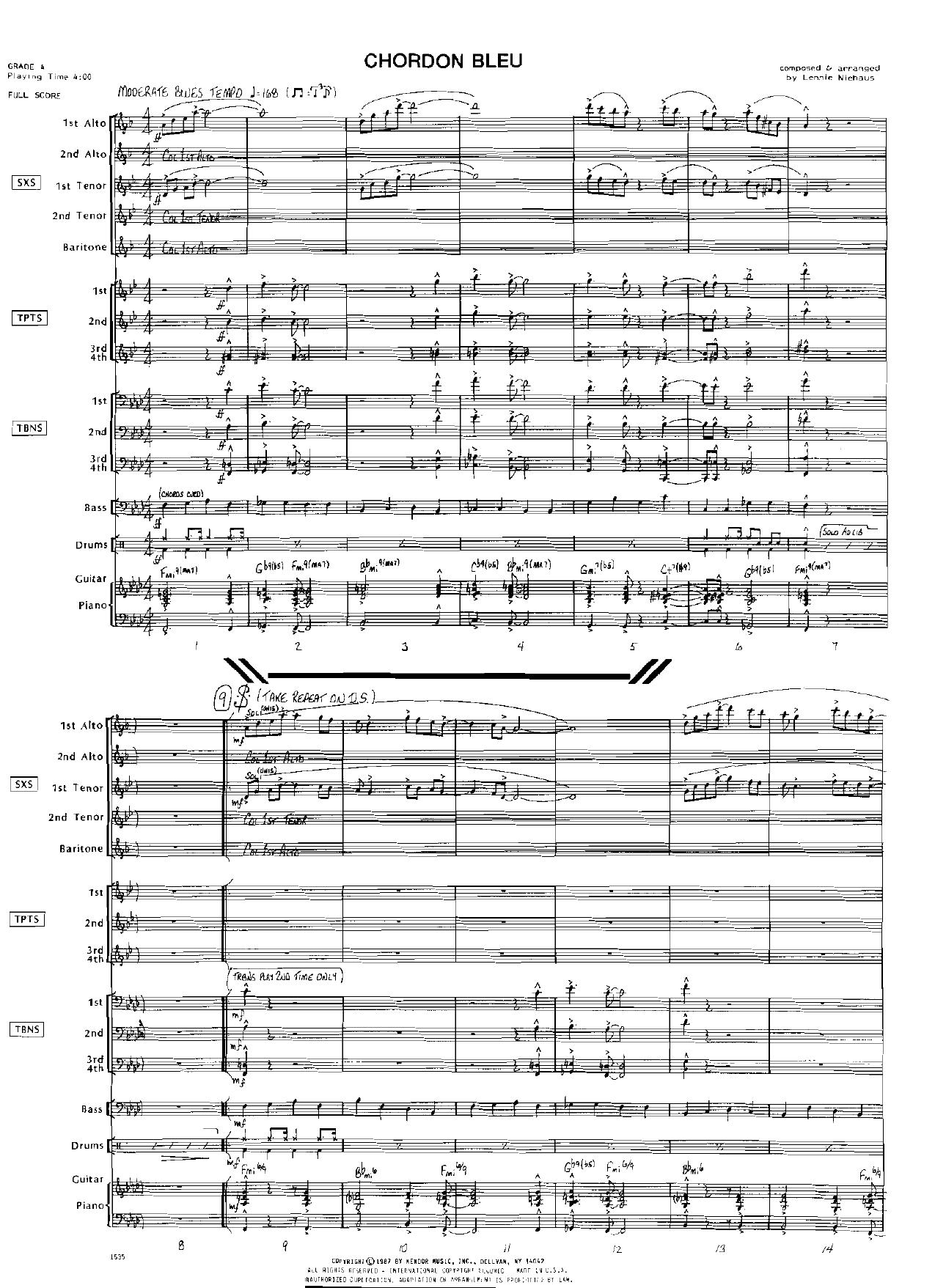
Chordon Blue (L.Niehaus)
Composed by Lennie Niehaus
Arranged by Lennie Niehaus
- Ensemble: Big Band
- Pages: 45
- Instruments (17): 1st Eb Alto Sax, 2nd Eb Alto Sax, 1st Bb Tenor Sax, 2nd Bb Tenor Sax, Eb Baritone Sax, 1st Bb Trumpet, 2nd Bb Trumpet, 3rd Bb Trumpet, 4th Bb Trumpet, 1st Trombone, 2nd Trombone, 3rd Trombone, 4th Trombone, Piano, Bass, Guitar, Drums
- Difficulty: medium
- Content: Individual Parts
- Format: PDF Download (Instant)
- Price: $24.99
Lennie Niehaus’s "Chordon Blue" stands as a brilliant testament to the West Coast cool jazz movement of the 1950s, capturing the sophisticated, counterpoint-driven aesthetic that defined the Modern Jazz Quartet and the Stan Kenton saxophone sections. As both a prolific alto saxophonist and a master arranger who worked extensively with Kenton, Niehaus carved out a distinct compositional voice characterized by intricate linear writing, crystal-clear harmonic voicings, and an infectious, driving swing feel. This chart distills the essence of post-bop West Coast modernism into a powerhouse big band format, bridging the gap between sophisticated harmonic exploration and high-energy ensemble accessibility. The musical character of "Chordon Blue" is defined by a bright, buoyant medium-up swing tempo (approx. quarter note = 208) in 4/4 time, propelled by a relentless walking bass line and crisp ride cymbal pulse. The mood is sophisticated, urbane, and relentlessly optimistic, evoking the smoky, modernist jazz clubs of mid-century Los Angeles. Niehaus constructs the harmonic framework around crisp, altered dominant structures and diatonic extensions that sound remarkably fresh. The composition opens with a sharp, angular brass-and-reed unison head that quickly expands into lush, tight-interval chord clusters typical of the West Coast school, steering clear of heavy, bombastic East Coast voicings in favor of transparent, sparkling textures. True to Niehaus's pedigree, the arrangement features masterclass-level saxophone soli sections that showcase the full 17-piece ensemble's ability to lock in on lightweight, fast-moving eighth-note lines. The saxophones—two altos, two tenors, and baritone—frequently act as a cohesive harmonic unit, often carrying the primary melodic weight before handing off punchy counter-lines to the trumpets and trombones. Featured solo space allows designated horn players to stretch out over standard changes that reward fluid, bebop-oriented vocabulary. The chart builds momentum toward a textbook Niehaus shout chorus, where dynamic contrasts and interlocking rhythmic figures between brass and reeds create a surging wave of tension and release before a snappy, punchy ending. Advanced high school, collegiate, and professional big bands will find this arrangement an ideal vehicle for developing ensemble articulation, section blend, and stylistic versatility. While the technical demands require proficient sight-reading and clean execution of fast swing subdivisions, the reward lies in the exceptional voice-leading and inherent musical logic built into every measure. Conductors will appreciate how naturally the orchestration balances itself, allowing the inner voices to cut through without forcing the volume, making "Chordon Blue" a standout selection for festival performance and concert programming alike. Achieving the authentic West Coast cool jazz sound in "Chordon Blue" requires strict attention to lightweight, horizontal articulation rather than heavy, accented downbeats. The rhythm section must maintain an even, driving pulse with the drummer utilizing a feathered bass drum and crisp, skipping ride cymbal pattern; avoid heavy backbeats on the high-hat. Brass players should keep tonguing clean and dry, utilizing subtle lip slurs and minimal vibrato to preserve the bright, modern tonal palette. Technical challenges center primarily on the fast unison and harmonized eighth-note lines found in the sax soli and transitional shout sections. Directors should rehearse these passages at a slow tempo with a metronome clicking on beats 2 and 4, gradually building speed while maintaining absolute uniformity in release lengths and dynamic shaping. Pay close attention to the dynamic markings; Niehaus uses sudden subitoforte and piano contrasts to build tension, and executing these precisely will define the overall success of the performance. Q: What instruments and parts are included in this big band arrangement? A: The complete 17-instrument big band instrumentation features Alto Saxophone 1, Alto Saxophone 2, Tenor Saxophone 1, Tenor Saxophone 2, and Baritone Saxophone, alongside standard brass (trumpets and trombones) and rhythm section parts, backed by a comprehensive 45-page conductor score. Q: What is the difficulty level of "Chordon Blue"? A: This arrangement is graded as advanced, best suited for skilled high school, collegiate, and professional big bands due to its fast swing tempos, dense harmonic voicings, and intricate saxophone soli passages. Q: What musical style and historical era does this piece represent? A: Composed and arranged by Lennie Niehaus, "Chordon Blue" is firmly rooted in the 1950s West Coast cool jazz and modern bebop tradition, emphasizing linear counterpoint, clean articulation, and sophisticated harmonic structures. Q: What makes this Lennie Niehaus arrangement unique? A: The chart stands out for its signature tight-interval saxophone voicings, transparent orchestration that allows inner counter-melodies to shine, and a brilliantly structured shout chorus that builds maximum energy without relying on sheer volume. Q: What is the recommended performance tempo and duration for this piece? A: It is designed to be performed at a bright, medium-up swing tempo (approximately quarter note = 208), resulting in a performance duration of roughly 3 to 4 minutes depending on solo extensions.
Questions and answers
- What is included in the Chordon Blue (L.Niehaus) PDF?
- The verified current file contains a conductor score and individual parts across 45 pages.
- How many instruments or parts are listed for Chordon Blue (L.Niehaus)?
- The verified instrumentation list contains 17 entries for this Big Band arrangement.
- Who is credited for Chordon Blue (L.Niehaus)?
- Composer: Lennie Niehaus. Arranger: Lennie Niehaus.
- What difficulty is listed for Chordon Blue (L.Niehaus)?
- The verified difficulty level is medium.
- Can I preview Chordon Blue (L.Niehaus) before buying?
- Yes. The product page provides a preview generated from the current PDF file.
- How is Chordon Blue (L.Niehaus) delivered?
- After successful payment, the digital PDF is made available for download. The displayed price is $24.99.
Musicians Also Search For
Chordon Blue Lennie Niehaus PDF • Chordon Blue Lennie Niehaus sheet music • Chordon Blue arranged by Lennie Niehaus • Lennie Niehaus big band charts • Lennie Niehaus jazz arrangements PDF • Chordon Blue Lennie Niehaus big band arrangements • Chordon Blue big band arrangements • Chordon Blue big band PDF download • Chordon Blue jazz sheet music • big band sheet music download • Chordon Blue conductor score PDF • Chordon Blue individual parts download • Chordon Blue sheet music PDF • buy Chordon Blue sheet music • download Chordon Blue PDF • Chordon Blue jazz charts • best Lennie Niehaus big band arrangements • Chordon Blue printable sheet music • big band repertoire PDF