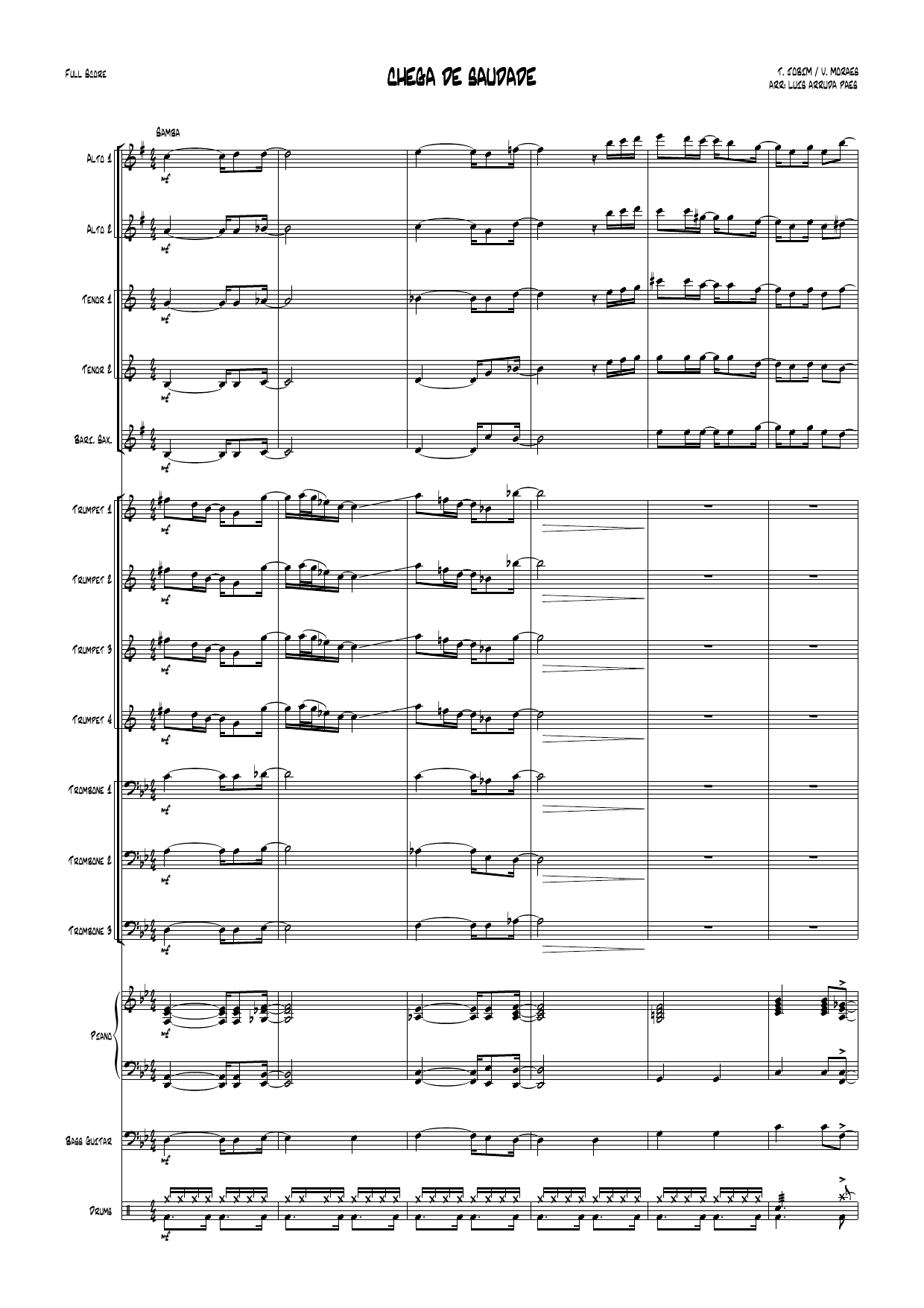
Chega De Saudade (Luiz A. Paes)
Composed by Antonio Carlos Jobim
Arranged by Luiz A. Paes
- Ensemble: Big Band
- Pages: 61
- Instruments (15): Alto 1, Alto 2, Tenor 1, Tenor 2, Bari. Sax., Trumpet 1, Trumpet 2, Trumpet 3, Trumpet 4, Trombone 1, Trombone 2, Trombone 3, Piano, Bass Guitar, Drums
- Difficulty: advanced
- Content: Individual Parts
- Format: PDF Download (Instant)
- Price: $24.99
Emerging from the sun-drenched coastal clubs of Rio de Janeiro in the late 1950s, "Chega de Saudade"—frequently recognized internationally as "No More Blues"—stands as the foundational masterpiece that ignited the global bossa nova movement. Composed by Antonio Carlos Jobim with lyrics by Vinícius de Moraes, and famously immortalized by João Gilberto’s landmark 1958 recording, this seminal composition permanently bridged the gap between sophisticated cool jazz harmony and syncopated Brazilian samba rhythms. Within this tradition, the composition represents a masterclass in emotional duality, seamlessly blending the melancholic yearning inherent in the Portuguese concept of *saudade* with an irrepressible, rhythmic optimism that transformed the DNA of twentieth-century popular music and modern jazz improvisation. Luiz A. Paes approaches this iconic standard through a lush, expansive big band lens that honors the delicate intimacy of the original bossa nova idiom while expanding its sonic architecture for full ensemble forces. Driven by an authentic, undulating percussion-heavy Latin groove in 4/4 time, the arrangement establishes a cool, hypnotic tempo feel that balances relaxed eighth-note subdivisions with sharp, punchy ensemble punctuations. The harmonic landscape retains Jobim's signature extended chord structures—rich major sevenths, minor-ninths, and altered dominants—while Paes introduces sophisticated reharmonizations in the bridge that elevate the tension before resolving into warm, sweeping saxophone solis and lush brass voicings. Throughout the chart, instrumental responsibilities shift dynamically across the ensemble to maintain textural variety. The woodwind section, anchored by dual alto, tenor, and baritone saxophones, carries the primary thematic weight during delicate head statements, often utilizing tight, cool-school voicings reminiscent of the Gerry Mulligan or Stan Getz collaborations. Featured solo space allows improvisers to stretch out over standard bossa changes, while carefully sculpted shout choruses build organic dramatic tension without sacrificing the genre's characteristic understated elegance. The intricate countermelodies woven through the inner horn voices demand precise articulation and careful dynamic control, ensuring that the rhythm section's subtle bossa nova clave remains the driving heartbeat of the performance. Advanced high school, collegiate, and professional jazz ensembles will find this comprehensive 61-page chart to be an exceptionally rewarding addition to their repertoire. While the rhythm section must possess a deep, internalized feel for Brazilian syncopation rather than a rigid swing mindset, horn players are challenged to master lyrical phrasing, blend within tight section unisons, and navigate sophisticated harmonic territory. Delivering a masterclass in stylistic contrast, this arrangement provides an ideal vehicle for festival programs or sophisticated concert settings demanding both rhythmic vitality and refined musicality. Successful execution of Luiz A. Paes’s arrangement hinges entirely on the rhythm section’s ability to establish an authentic, relaxed bossa nova groove. The drummer should utilize a lightweight rim-click cross-stick pattern paired with a subtle hi-hat chick on beats two and four, avoiding heavy backbeats. The bassist must anchor the ensemble with a steady, hypnotic root-fifth or root-third pulse that breathes with the harmony, resisting the urge to swing the eighth notes. For the horns, the primary technical challenge lies in maintaining a smooth, legato phrasing style during the sustained ensemble lines, contrasting sharply with crisp, punchy staccato accents on the syncopated off-beats. Conductors should emphasize dynamic restraint in the brass section; open horns should blend with a warm, dark timbre, saving any aggressive brightness for the developmental peaks. Pay close attention to the dynamic markings under the improvised solo sections to ensure the soloist remains clearly audible over the rolling, conversational background figures. Q: What instruments and parts are included in this big band arrangement? A: The arrangement is scored for a standard 15-instrument big band instrumentation, featuring Alto Saxophone 1, Alto Saxophone 2, Tenor Saxophone 1, Tenor Saxophone 2, and Baritone Saxophone, alongside a complete brass and rhythm section. It includes a comprehensive 61-page conductor score and all individual player parts. Q: What is the difficulty level of this chart? A: This arrangement is tailored for advanced high school, collegiate, and professional big bands. It requires strong section playing, precise rhythmic coordination in the rhythm section, and soloists comfortable navigating bossa nova chord progressions. Q: What is the historical and stylistic context of the piece? A: Based on the foundational bossa nova standard by Antonio Carlos Jobim, this arrangement honors the late-1950s Rio de Janeiro movement. It fuses cool jazz harmonic sophistication with an authentic, syncopated Brazilian Latin groove. Q: What makes Luiz A. Paes's arrangement unique? A: Paes expertly expands the intimate bossa nova aesthetic into a full big band canvas by utilizing rich extended voicings, lush saxophone soli sections, and sophisticated harmonic reharmonizations that build organic dramatic tension. Q: What is the performance duration and recommended tempo feel? A: The chart is designed to be performed at a relaxed, medium bossa nova tempo (approximately 120-132 BPM), making it an ideal, substantial centerpiece for a concert or festival set.
Questions and answers
- What is included in the Chega De Saudade (Luiz A. Paes) PDF?
- The verified current file contains a conductor score and individual parts across 61 pages.
- How many instruments or parts are listed for Chega De Saudade (Luiz A. Paes)?
- The verified instrumentation list contains 15 entries for this Big Band arrangement.
- Who is credited for Chega De Saudade (Luiz A. Paes)?
- Composer: Antonio Carlos Jobim. Arranger: Luiz A. Paes.
- What difficulty is listed for Chega De Saudade (Luiz A. Paes)?
- The verified difficulty level is advanced.
- Can I preview Chega De Saudade (Luiz A. Paes) before buying?
- Yes. The product page provides a preview generated from the current PDF file.
- How is Chega De Saudade (Luiz A. Paes) delivered?
- After successful payment, the digital PDF is made available for download. The displayed price is $24.99.
Musicians Also Search For
Chega De Saudade Luiz A. Paes PDF • Chega De Saudade Luiz A. Paes sheet music • Chega De Saudade arranged by Luiz A. Paes • Luiz A. Paes big band charts • Luiz A. Paes jazz arrangements PDF • Chega De Saudade Antonio Carlos Jobim sheet music • Chega De Saudade Antonio Carlos Jobim big band arrangements • Antonio Carlos Jobim big band charts • Chega De Saudade big band arrangements • Chega De Saudade big band PDF download • Chega De Saudade jazz sheet music • big band sheet music download • Chega De Saudade conductor score PDF • Chega De Saudade individual parts download • Chega De Saudade sheet music PDF • buy Chega De Saudade sheet music • download Chega De Saudade PDF • Chega De Saudade jazz charts • best Luiz A. Paes big band arrangements • Antonio Carlos Jobim arranged by Luiz A. Paes • Chega De Saudade printable sheet music • big band repertoire PDF