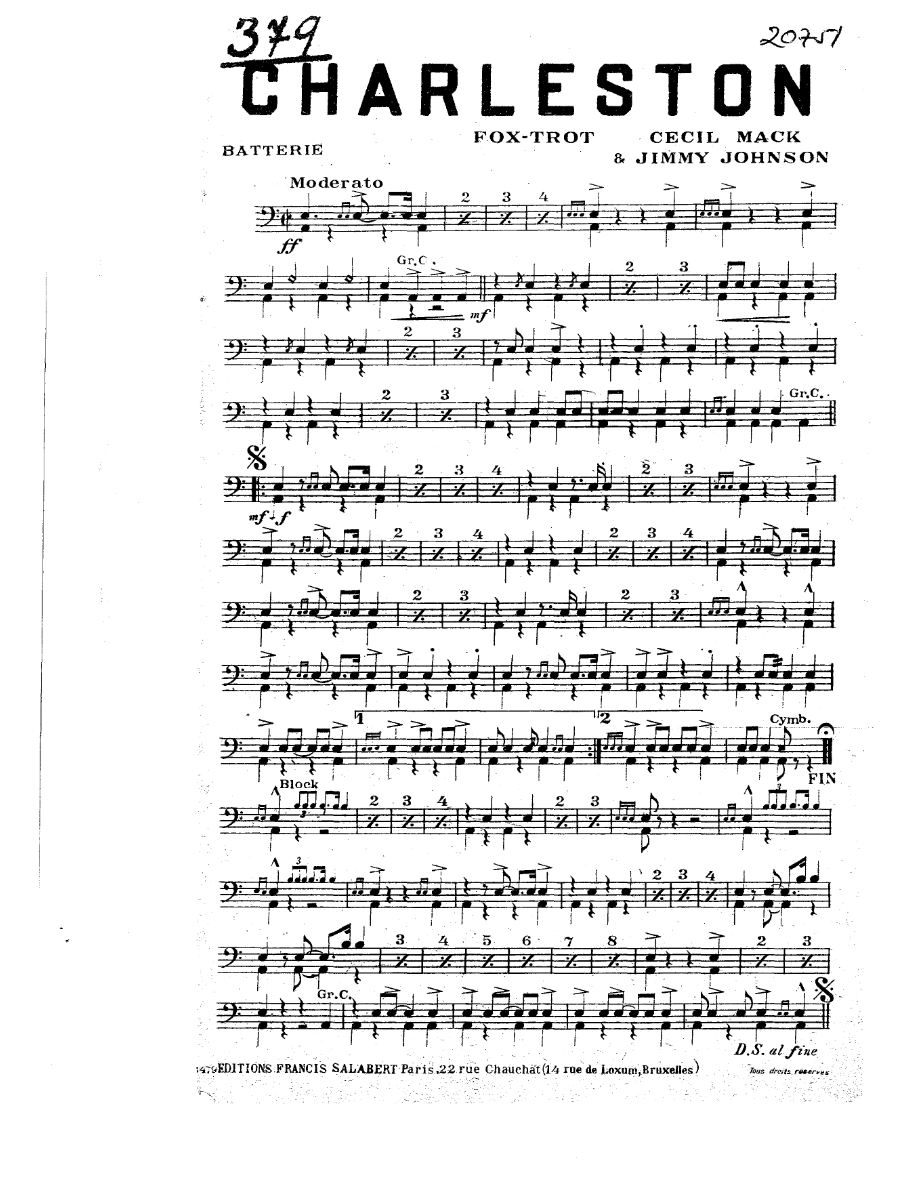
Charleston (C.Mack)
Composed by James P. Johnson, Cecil Mack
Arranged by Cecil Mack
- Ensemble: Big Band Dance
- Style: Foxtrot
- Pages: 17
- Instruments (9): Drum Set, Trombone, Trumpet in B♭, Saxophone Tenor, Saxophone Alto, Violoncello, Double Bass, Violin 1, Violin 2
- Difficulty: easy
- Content: Individual Parts
- Format: PDF Download (Instant)
- Price: $24.99
The iconic "Charleston," a foundational piece of the Jazz Age, burst onto the scene in 1923, forever cementing its place in American musical history. Composed by the brilliant stride pianist James P. Johnson with lyrics by Cecil Mack, this tune became the undisputed anthem of the Roaring Twenties, synonymous with flappers, speakeasies, and a vibrant cultural revolution. Its infectious rhythm and distinctive melody propelled it to international fame, making it one of the most recognizable and frequently performed early jazz standards. This particular arrangement, penned by co-composer Cecil Mack himself, offers a direct and authentic portal back to the dance halls and ballrooms where the Foxtrot reigned supreme, capturing the unbridled energy and optimism of the era. Musically, this arrangement of "Charleston" is a quintessential Foxtrot, designed for dancing with an irresistible medium-fast tempo. The feel is firmly rooted in the two-beat rhythm characteristic of early jazz, emphasizing a driving yet elegant pulse that encourages movement. While the original key is not specified, period arrangements often favored accessible keys like C or F major, contributing to its widespread appeal. The overall mood is exhilarating and celebratory, evoking a sense of carefree joy and sophisticated revelry. Mack's treatment is characterized by straightforward, yet effective, melodic statements and rhythmic figures that are both catchy and conducive to the dance floor. Expect a bright, brassy sound, a hallmark of the big band dance era, with clear articulation and dynamic contrasts that build excitement. Cecil Mack's approach to his own composition is both respectful and pragmatic, tailored for the "big_band_dance" ensemble. The arrangement features the melody predominantly in the saxophone section, often in unison or tight, period-appropriate voicings that provide a full, rich sound without excessive complexity. Brass interjections are sharp and rhythmic, providing compelling counterpoint and punctuating the danceable groove. While specific solo sections are less common in these early dance arrangements, opportunities for short, improvised breaks or featured instrumental statements can be inferred or adapted by a skilled soloist. The primary technical challenges lie in maintaining the consistent, driving Foxtrot rhythm, achieving precise ensemble articulation, and executing the dynamic shifts that give the piece its lift and charm. Performing this arrangement is immensely rewarding, offering musicians a tangible connection to jazz's earliest popular successes and the sheer fun of its original dance purpose. This arrangement is ideally suited for college jazz ensembles, community big bands, and professional groups specializing in historical jazz repertoire. Its authentic sound and accessible structure make it an excellent choice for educational settings focusing on early jazz styles, providing a clear example of period orchestration and rhythmic feel. Experienced high school bands with strong rhythmic foundations will also find it a challenging yet achievable addition to their library, offering a unique historical perspective often overlooked in modern charts. Conductors should emphasize a consistent, driving two-beat Foxtrot feel, avoiding a modern swing interpretation. The tempo should be brisk but not rushed, allowing the dancers (or listeners) to comfortably engage with the rhythm. Articulation is key: brass figures require clear, detached attacks, while saxophone lines should be smooth but rhythmically precise. Dynamic contrasts are crucial for building excitement; encourage clear distinctions between *forte* and *piano* sections, especially in the call-and-response passages. While no specific mutes are indicated, plunger or cup mutes in the brass can add authentic color to certain rhythmic figures if desired. Rehearsal time should focus on ensemble tightness, ensuring the rhythm section locks into the two-beat groove, and that the melodic lines are delivered with unified phrasing and intonation, capturing the joyful exuberance of the 1920s. Q: What instruments and parts are included in this arrangement? A: This arrangement is scored for a 17-piece big band dance ensemble, including Alto Saxophone 1 & 2, Tenor Saxophone 1 & 2, Baritone Saxophone, Trumpet 1-4, Trombone 1-3, Piano, Bass, Drums, and Guitar. Q: What is the difficulty level of "Charleston (C.Mack)"? A: This arrangement is rated as Medium-Difficult. While rhythmically straightforward, achieving the authentic Foxtrot feel, precise articulation, and dynamic control for a large ensemble requires experienced musicianship. Q: What musical style and historical context does this arrangement represent? A: This arrangement is a classic Foxtrot from the 1920s, capturing the vibrant energy and dance-oriented sound of the Jazz Age, co-composed and arranged by Cecil Mack himself. Q: What makes this specific arrangement unique compared to other versions of "Charleston"? A: This arrangement is unique because it was penned by co-composer Cecil Mack, offering an authentic, period-specific orchestration for a big band dance ensemble, reflecting how the piece would have been performed in its original era. Q: What is the typical performance duration and recommended tempo for this piece? A: The typical performance duration is approximately 2-3 minutes, depending on repeats. It should be played at a medium-fast Foxtrot tempo, around 180-200 BPM, with a clear two-beat feel.
Musicians Also Search For
Charleston Cecil Mack PDF • Charleston Cecil Mack sheet music • Charleston arranged by Cecil Mack • Cecil Mack big band dance charts • Cecil Mack jazz arrangements PDF • Charleston James P. Johnson, Cecil Mack sheet music • Charleston James P. Johnson, Cecil Mack big band dance arrangement • James P. Johnson, Cecil Mack big band dance charts • Charleston big band dance arrangement • Charleston big band dance PDF download • Charleston jazz ensemble sheet music • big band dance sheet music instant download • Charleston conductor score PDF • Charleston individual parts download • Charleston sheet music with parts • Charleston Foxtrot chart • Foxtrot big band dance arrangements • buy Charleston sheet music online • download Charleston PDF • Charleston jazz chart • best Cecil Mack big band dance arrangements • James P. Johnson, Cecil Mack songs arranged by Cecil Mack • Charleston printable sheet music • big band dance repertoire PDF