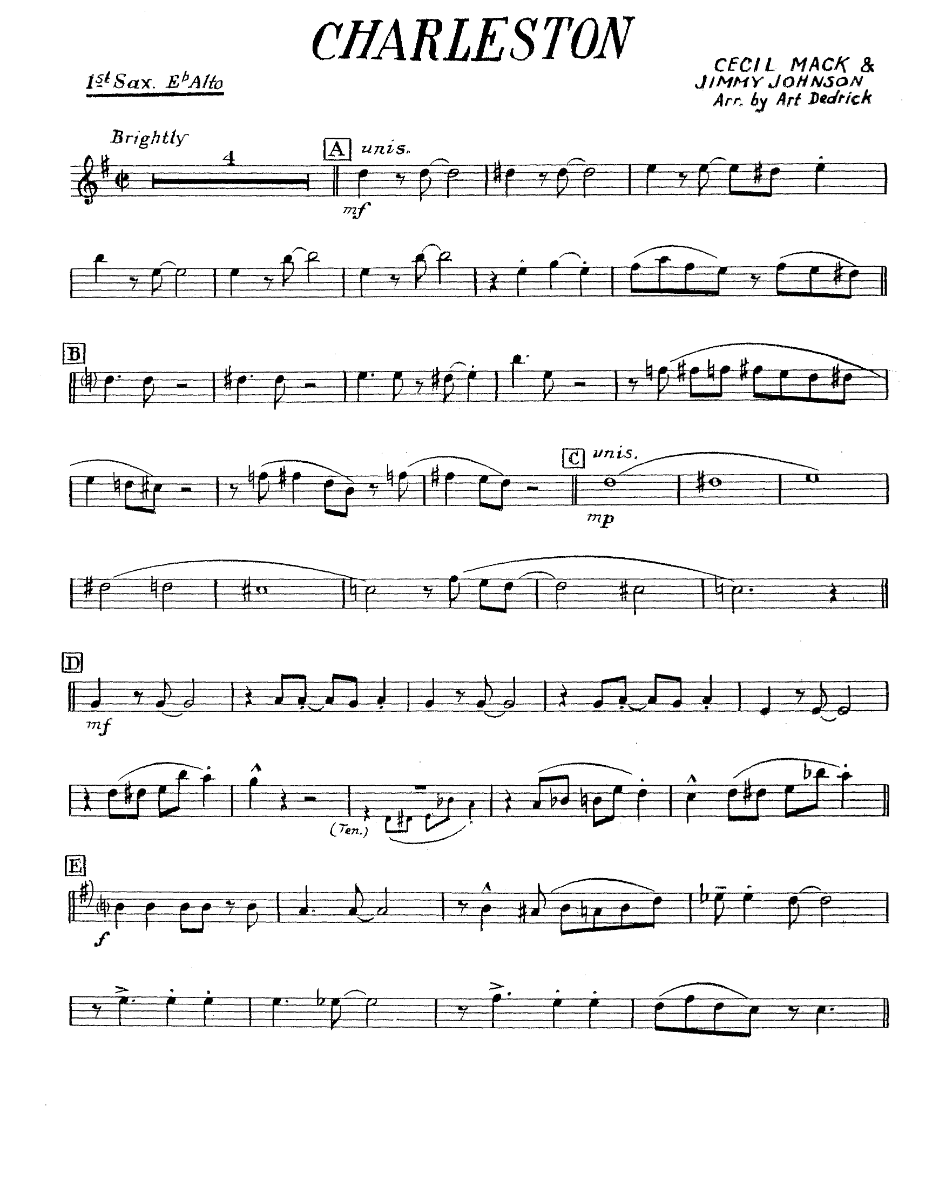
Charleston (A.Dedrick) sheet music preview

Charleston (A.Dedrick)

Composed by James P. Johnson

Arranged by Art Dedrick

  • Ensemble: Big Band
  • Style: Jazz Standard
  • Pages: 24
  • Instruments (17): Alto Saxophone 1, Tenor Saxophone 2, Alto Saxophone 3, Tenor Saxophone 4, Baritone Saxophone 5, Trumpet 1, Trumpet 2, Trumpet 3, Trumpet 4, Trombone 1, Trombone 2, Trombone 3, Trombone 4, String Bass, Guitar, Drum Set, Piano
  • Difficulty: medium
  • Content: Individual Parts
  • Format: PDF Download (Instant)
  • Price: $24.99

The iconic "Charleston," originally composed by James P. Johnson in 1923 for the Broadway show *Runnin' Wild*, stands as an undeniable cornerstone of early jazz and American popular music. This infectious tune not only lent its name to the quintessential dance craze of the Roaring Twenties but also became a defining anthem of the Jazz Age itself. Johnson, a pivotal figure in the stride piano tradition, crafted a melody that perfectly encapsulated the exuberant, syncopated spirit of the era. Its enduring popularity as a jazz standard is a testament to its catchy, memorable theme and its historical significance in shaping the sound of 20th-century music. Art Dedrick's arrangement masterfully reinterprets this classic for the big band format, infusing it with a vibrant energy that bridges its historical roots with contemporary big band sensibilities. Dedrick's treatment of "Charleston" is an exhilarating, up-tempo swing chart, primarily in the key of F major, designed to evoke the joyous, high-energy atmosphere of its namesake dance. The arrangement immediately establishes a driving 4/4 swing feel, propelled by a walking bass line and a crisp drum pattern. Dedrick is renowned for his ability to craft arrangements that are both accessible and musically engaging, and this chart is no exception. He employs his signature clear voicings, ensuring that the intricate melodic and harmonic lines are always distinct. The initial statement of the melody is typically carried by the saxophone section, often in unison or tight block chords, before being passed to the brass, creating a call-and-response dynamic that builds excitement. The overall mood is undeniably celebratory and high-spirited, making it an excellent choice for concert openers or any occasion demanding an injection of pure, unadulterated musical fun. A hallmark of Dedrick's arranging style is his judicious use of soli sections and powerful shout choruses. In this "Charleston" arrangement, listeners can anticipate sophisticated saxophone solis that weave intricate counter-melodies, contrasted by robust brass figures that punctuate the rhythmic drive. While the arrangement is primarily ensemble-focused, there are typically opportunities for improvised solos, often over the familiar "Charleston" chord changes, providing a platform for a tenor saxophone or trumpet to shine. Dedrick's harmonic palette, while rooted in the standard's original framework, is subtly enhanced with extended harmonies that add depth and color without sacrificing the tune's authentic character. The arrangement culminates in a thrilling shout chorus, where the full ensemble unites in a powerful, syncopated statement, bringing the piece to a rousing conclusion that is both impactful and immensely satisfying to perform. This arrangement is ideally suited for high school and college jazz ensembles, as well as community bands looking for a spirited and well-crafted chart. Its clear structure, engaging melodic lines, and manageable technical demands make it an excellent teaching tool for developing ensemble precision, swing feel, and dynamic contrast. The rewarding interplay between sections, coupled with the sheer joy inherent in the music, ensures that both musicians and audiences will find this rendition of "Charleston" to be a memorable and highly enjoyable experience. "Charleston (A. Dedrick)" demands a crisp, energetic up-tempo swing feel, maintaining a consistent quarter note pulse around 200-220 BPM. The primary technical challenge lies in achieving precise ensemble articulation and rhythmic accuracy, particularly in the syncopated figures and brass punches. Emphasize light, detached eighth notes in the rhythm section to maintain the driving feel without becoming heavy. The saxophone solis require careful attention to balance and blend, ensuring the inner voices are heard clearly. Brass players should focus on clean attacks and releases, utilizing short, accented notes for maximum impact in the shout choruses. There are no specific extended techniques like plunger mutes or falls indicated, allowing the focus to remain on fundamental big band execution. Rehearsal should prioritize rhythmic unison, dynamic shaping, and the infectious, light-hearted character of the piece to fully capture its essence. Q: What instruments are included in this arrangement? A: This arrangement is scored for a standard 17-piece big band, including Alto Saxophone 1 & 2, Tenor Saxophone 1 & 2, Baritone Saxophone, Trumpet 1-4, Trombone 1-4, Piano, Bass, Guitar, and Drums. Q: What is the difficulty level of Art Dedrick's "Charleston" arrangement? A: This arrangement is rated as Medium-Easy to Medium, making it appropriate for high school, college, and community jazz ensembles. It offers engaging parts without excessive technical demands. Q: What musical style and historical context does this arrangement represent? A: This is an up-tempo swing arrangement of "Charleston," a classic jazz standard composed by James P. Johnson in 1923, embodying the exuberant spirit of the Jazz Age and the Roaring Twenties. Q: What makes Art Dedrick's treatment of "Charleston" unique? A: Dedrick's arrangement is characterized by its clear, accessible voicings, driving up-tempo swing feel, and effective use of ensemble solis and powerful shout choruses, all while retaining the original tune's infectious energy. Q: What is the typical performance duration and tempo for this piece? A: The typical performance duration for this arrangement is approximately 2 minutes and 30 seconds to 3 minutes, played at a brisk, up-tempo swing feel, generally in the range of 200-220 beats per minute.

Musicians Also Search For

Charleston Art Dedrick PDFCharleston Art Dedrick sheet musicCharleston arranged by Art DedrickArt Dedrick big band chartsArt Dedrick jazz arrangements PDFCharleston James P. Johnson sheet musicCharleston James P. Johnson big band arrangementJames P. Johnson big band chartsCharleston big band arrangementCharleston big band PDF downloadCharleston jazz ensemble sheet musicbig band sheet music instant downloadCharleston individual parts downloadCharleston sheet music with partsCharleston Jazz Standard chartJazz Standard big band arrangementsbuy Charleston sheet music onlinedownload Charleston PDFCharleston jazz chartbest Art Dedrick big band arrangementsJames P. Johnson songs arranged by Art DedrickCharleston printable sheet musicbig band repertoire PDF

All arrangements by Art Dedrick All James P. Johnson sheet music