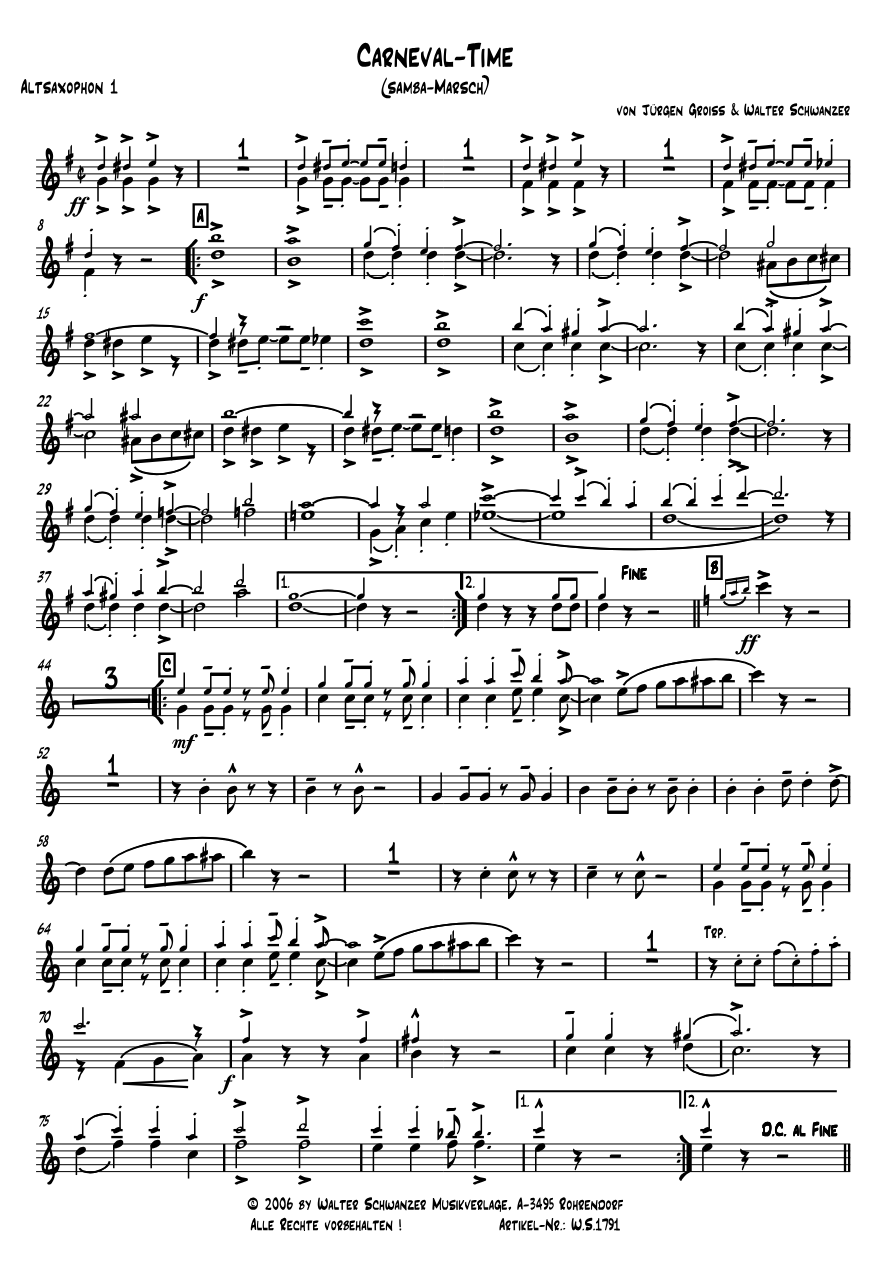
Carneval-Time (W.Schwanzer) sheet music preview

Carneval-Time (W.Schwanzer)

Composed by W. Schwanzer

  • Ensemble: Big Band Dance
  • Style: Big Band Dance
  • Pages: 15
  • Instruments (7): Alto Sax, Tenor Sax, Trumpet, Trombone, Piano, Bass, Drums
  • Difficulty: easy
  • Content: Individual Parts
  • Format: PDF Download (Instant)
  • Price: $18.99

## SECTION 1: Description "Carneval-Time," originally penned by W. Schwanzer, emerges from an era when big band dance music reigned supreme, captivating audiences with its infectious rhythms and sophisticated arrangements. While the precise composition date is not widely documented, the style firmly places it in the mid-20th century, a golden age for dance orchestras and ballroom culture. This period saw the rise of iconic bands and composers who crafted music specifically designed for social dancing, prioritizing clear melodic lines, driving rhythmic foundations, and arrangements that encouraged movement. Schwanzer's work, though perhaps not a household name like some contemporaries, embodies the spirit of this time, reflecting the polished yet energetic sound that defined the big band dance genre. It's a piece that evokes the festive atmosphere of a grand ballroom, where couples twirled and swayed to expertly orchestrated melodies. This particular arrangement of "Carneval-Time" presents a vibrant, medium-up tempo swing feel, firmly rooted in 4/4 time. The key, likely C or G major to facilitate accessibility for dance bands, contributes to its bright and celebratory mood. The energy is consistently high, driven by a walking bass line and a swinging drum pattern that propels the piece forward without ever feeling rushed. The harmonic language is characteristic of the era, employing rich, yet functional, extended chords (9ths, 13ths) that add color without obscuring the melodic clarity. The overall character is one of joyful exuberance, perfectly capturing the essence of a carnival or a lively dance event. It's a piece designed to uplift and entertain, with a polished sheen that speaks to its dance-band origins. While the arranger remains unknown, their approach to "Carneval-Time" is distinctly professional and idiomatic for the big band dance style. The arrangement features well-crafted soli sections, particularly for the saxophone and brass sections, which showcase tight ensemble playing and articulate phrasing. The melody is predominantly carried by the lead alto saxophone and trumpet, often in unison or harmonized in rich block chords, providing a clear and memorable theme. There are opportunities for featured solos, typically in the trumpet and tenor saxophone, allowing for improvisation over the established harmonic progression. The arrangement builds dynamically, culminating in a powerful shout chorus that utilizes full-band voicings and rhythmic punches, creating an exciting climax before returning to a final thematic statement. The technical challenges lie in maintaining the consistent swing feel at a medium-up tempo, executing clean soli passages, and ensuring precise articulation across the ensemble. The reward is a highly engaging performance that connects directly with the audience's desire for classic big band swing. This arrangement is ideally suited for college-level jazz ensembles, advanced high school bands, or community big bands looking to explore authentic big band dance repertoire. Its accessible yet sophisticated nature makes it an excellent teaching tool for developing ensemble precision, swing feel, and understanding of traditional big band voicings. The clear melodic structure and engaging solos make it a rewarding piece for performers, while its infectious energy guarantees an appreciative audience response. It offers a fantastic opportunity to delve into the historical context and performance practices of the big band dance era, providing both educational value and pure musical enjoyment. ## SECTION 2: Performance Notes "Carneval-Time" thrives on a consistent, buoyant medium-up swing feel, approximately quarter note = 180-200 BPM. Emphasize a light, driving eighth-note pulse from the rhythm section, with the bass providing a strong walking line. The primary technical challenge lies in achieving unified articulation and blend within the saxophone and brass soli sections; ensure precise cut-offs and attacks. Trumpets should aim for a bright, open sound, particularly on the lead line, while trombones provide a warm, foundational support. Drummers should focus on a crisp ride cymbal pattern and tasteful fills that propel the ensemble without overpowering. Rehearsal should prioritize rhythmic accuracy in the unison and harmonized lines, as well as dynamic shaping to build excitement towards the shout chorus. No special mutes or extended techniques are explicitly required, allowing the focus to remain on clean ensemble execution and a vibrant swing aesthetic. ## SECTION 3: FAQ Q: What instruments and parts are included in this arrangement? A: This arrangement includes parts for a standard big band dance ensemble, specifically Alto Sax, Tenor Sax, Trumpet, Trombone, Piano, Bass, and Drums. The full score is also included. Q: What is the difficulty level of "Carneval-Time (W. Schwanzer)"? A: This arrangement is considered intermediate to advanced, suitable for college-level jazz ensembles, advanced high school bands, or experienced community big bands. It requires solid ensemble playing and individual proficiency. Q: What musical style and historical context does this piece represent? A: "Carneval-Time" is a classic example of Big Band Dance music from the mid-20th century. It embodies the energetic, polished swing style designed for social dancing that was popular during that era. Q: What makes this specific arrangement unique or notable? A: This arrangement features well-crafted soli sections for both saxophones and brass, clear melodic statements, and a powerful shout chorus. It authentically captures the vibrant, celebratory mood of its original big band dance context. Q: What is the approximate performance duration and recommended tempo for this piece? A: The approximate performance duration is 3-4 minutes, depending on the number of improvised solos. The recommended tempo is a medium-up swing, typically around 180-200 beats per minute.

All W. Schwanzer sheet music