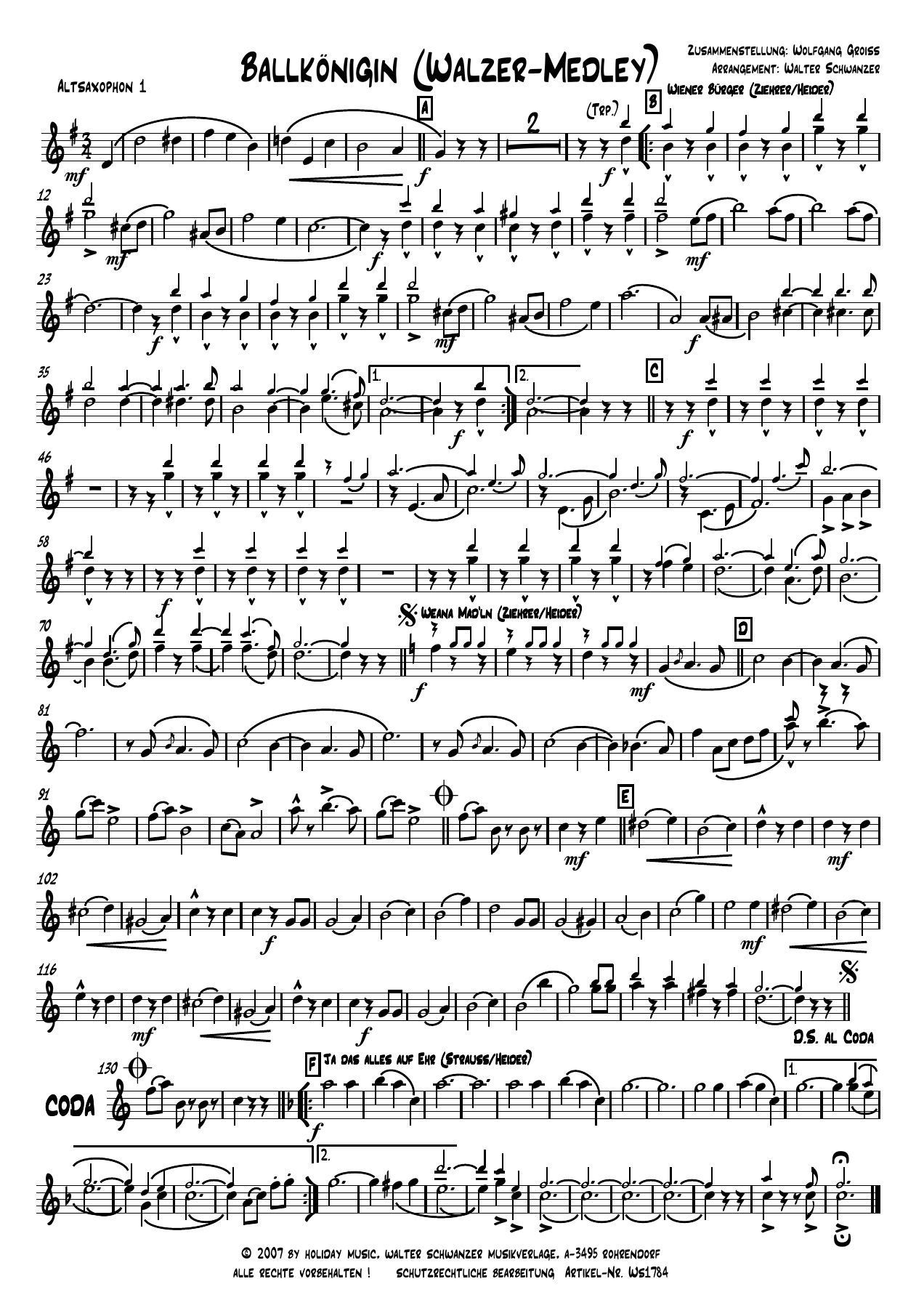
Ballkonigin (W.Schwanzer)
Composed by W. Schwanzer
Arranged by W. Schwanzer
- Ensemble: Big Band Dance
- Style: Waltz
- Pages: 17
- Instruments (14): Altsaxophon 1, Altsaxophon 2, Tenorsaxophon 1, Tenorsaxophon 2, Baritonsaxophon, Trompete 1, Trompete 2, Trompete 3, Posaune 1, Posaune 2, Piano, Gitarre, Bass, Drums
- Difficulty: easy
- Content: Individual Parts
- Format: PDF Download (Instant)
- Price: $24.99
"Ballkonigin (W.Schwanzer)" presents a charming and authentic big band dance arrangement of a classic waltz, penned and arranged by the composer himself, W. Schwanzer. While not a jazz standard in the typical improvisational sense, this piece embodies the sophisticated, elegant dance orchestra tradition prevalent in Central Europe during the early to mid-20th century. It evokes the atmosphere of grand ballrooms and refined social gatherings, where the waltz reigned supreme. Schwanzer's original composition captures the quintessential grace and flowing melodic lines characteristic of this era, offering a refreshing departure from swing-era jazz while maintaining the lush orchestration expected of a big band. The piece is designed to be a delightful, accessible, and historically resonant addition to any ensemble's repertoire, showcasing the big band's versatility beyond traditional swing. Musically, "Ballkonigin" is a medium-tempo waltz, firmly rooted in 3/4 time, establishing a buoyant yet stately feel. The primary key is C Major, which lends itself to a bright and open sound, though it features tasteful modulations that add harmonic interest and color without becoming overly complex. The mood is one of joyful elegance and lighthearted romance, perfectly suited for a dance setting or a concert program seeking a touch of continental charm. The energy is consistently engaging, driven by the rhythmic lilt of the waltz and the rich, layered voicings. Schwanzer's arrangement prioritizes clarity and melodic beauty, ensuring that the primary themes are always prominent and beautifully articulated by the various sections. W. Schwanzer's approach to arranging "Ballkonigin" is characterized by his deep understanding of the dance orchestra idiom. He utilizes the full 17-instrument big band palette to create a full, resonant sound. The arrangement features a classic "lead alto" melody statement, often doubled or harmonized by the other saxophones, creating a warm, cohesive blend. Brass sections contribute with both sustained harmonic support and punctuating figures, while the rhythm section provides a steady, danceable 3/4 pulse. There are no extended improvised solos in the traditional jazz sense; instead, the piece features beautifully crafted melodic lines passed between sections, often culminating in a full ensemble tutti that builds to a satisfying climax. The voicings are rich and traditional, emphasizing clear harmonic movement and melodic counterpoint. This arrangement is a testament to Schwanzer's skill in crafting an orchestral waltz that is both engaging to play and delightful to hear, highlighting the ensemble's ability to blend and articulate with precision. Performing "Ballkonigin" offers a rewarding experience for a variety of ensembles. The melody is primarily carried by the alto saxophones, often echoed or complemented by the trombones and trumpets. The technical demands are moderate, focusing more on precise articulation, blend, and rhythmic accuracy rather than extreme ranges or rapid-fire improvisation. It is particularly suitable for high school, community, and college-level big bands looking to expand their repertoire beyond typical swing charts. The piece offers excellent opportunities to work on ensemble balance, dynamic control, and achieving a cohesive, elegant sound in a 3/4 meter. The rewarding aspect lies in the sheer beauty of the melodies and the satisfaction of performing a piece that transports the audience to a different musical era, showcasing the big band's versatility and sophistication. "Ballkonigin" requires a light, flowing 3/4 feel, not too fast, aiming for a consistent dance tempo around quarter note = 144-152 bpm. Emphasize the "oom-pah-pah" rhythmic foundation in the bass and drums, ensuring it’s buoyant but not heavy-handed. Key technical challenges include achieving precise articulation in the melodic lines, particularly in the saxophone section, and maintaining excellent blend and balance across the full ensemble, especially during tutti sections. Focus on uniform phrasing and dynamic shaping to bring out the inherent elegance of the waltz. There are no special mutes or extended techniques required; standard ensemble playing and clear melodic interpretation are paramount. Rehearsal tips should include isolating melodic phrases to ensure consistent articulation and practicing the modulations slowly to secure intonation and smooth transitions. Q: What instruments are included in this arrangement? A: This arrangement is scored for a full 17-instrument big band dance ensemble, including Alto Saxophone 1, Alto Saxophone 2, Tenor Saxophone 1, Tenor Saxophone 2, Baritone Saxophone, Trumpet 1, Trumpet 2, Trumpet 3, Trumpet 4, Trombone 1, Trombone 2, Trombone 3, Trombone 4, Piano, Bass, Guitar, and Drums. Q: What is the difficulty level of "Ballkonigin (W.Schwanzer)"? A: This arrangement is rated as moderate difficulty. It is accessible for high school, community, and college-level big bands, focusing on precise articulation, blend, and rhythmic accuracy in a 3/4 waltz feel rather than extreme technical demands or complex improvisation. Q: What is the musical style and historical context of this piece? A: "Ballkonigin" is a classic waltz composed and arranged by W. Schwanzer, embodying the elegant European dance orchestra tradition of the early to mid-20th century. It represents a sophisticated, non-swing big band style suitable for ballroom dancing and concert programs. Q: What makes this arrangement unique compared to other big band charts? A: This arrangement is unique in its focus on the waltz form within a big band setting, offering a refreshing departure from typical swing or jazz charts. It showcases the ensemble's ability to perform with grace and precision in a 3/4 meter, highlighting beautiful melodic lines and lush, traditional voicings without improvised solos. Q: What is the recommended tempo and approximate performance duration? A: The recommended tempo for "Ballkonigin" is a medium waltz feel, around quarter note = 144-152 bpm. The approximate performance duration is typically between 3:00 and 3:30 minutes, depending on the chosen tempo and any optional repeats.
Questions and answers
- What is included in the Ballkonigin (W.Schwanzer) PDF?
- The verified current file contains individual parts across 17 pages.
- How many instruments or parts are listed for Ballkonigin (W.Schwanzer)?
- The verified instrumentation list contains 14 entries for this Big Band Dance arrangement.
- Who is credited for Ballkonigin (W.Schwanzer)?
- Composer: W. Schwanzer. Arranger: W. Schwanzer.
- What difficulty is listed for Ballkonigin (W.Schwanzer)?
- The verified difficulty level is easy.
- What style is listed for Ballkonigin (W.Schwanzer)?
- The catalog lists the style as Waltz.
- Can I preview Ballkonigin (W.Schwanzer) before buying?
- Yes. The product page provides a preview generated from the current PDF file.
- How is Ballkonigin (W.Schwanzer) delivered?
- After successful payment, the digital PDF is made available for download. The displayed price is $24.99.
Musicians Also Search For
Ballkonigin W. Schwanzer PDF • Ballkonigin W. Schwanzer sheet music • Ballkonigin arranged by W. Schwanzer • W. Schwanzer big band dance charts • W. Schwanzer jazz arrangements PDF • Ballkonigin W. Schwanzer big band dance arrangements • Ballkonigin big band dance arrangements • Ballkonigin big band dance PDF download • Ballkonigin jazz sheet music • big band dance sheet music download • Ballkonigin individual parts download • Ballkonigin sheet music PDF • Ballkonigin Waltz charts • Waltz big band dance arrangements • buy Ballkonigin sheet music • download Ballkonigin PDF • Ballkonigin jazz charts • best W. Schwanzer big band dance arrangements • Ballkonigin printable sheet music • big band dance repertoire PDF