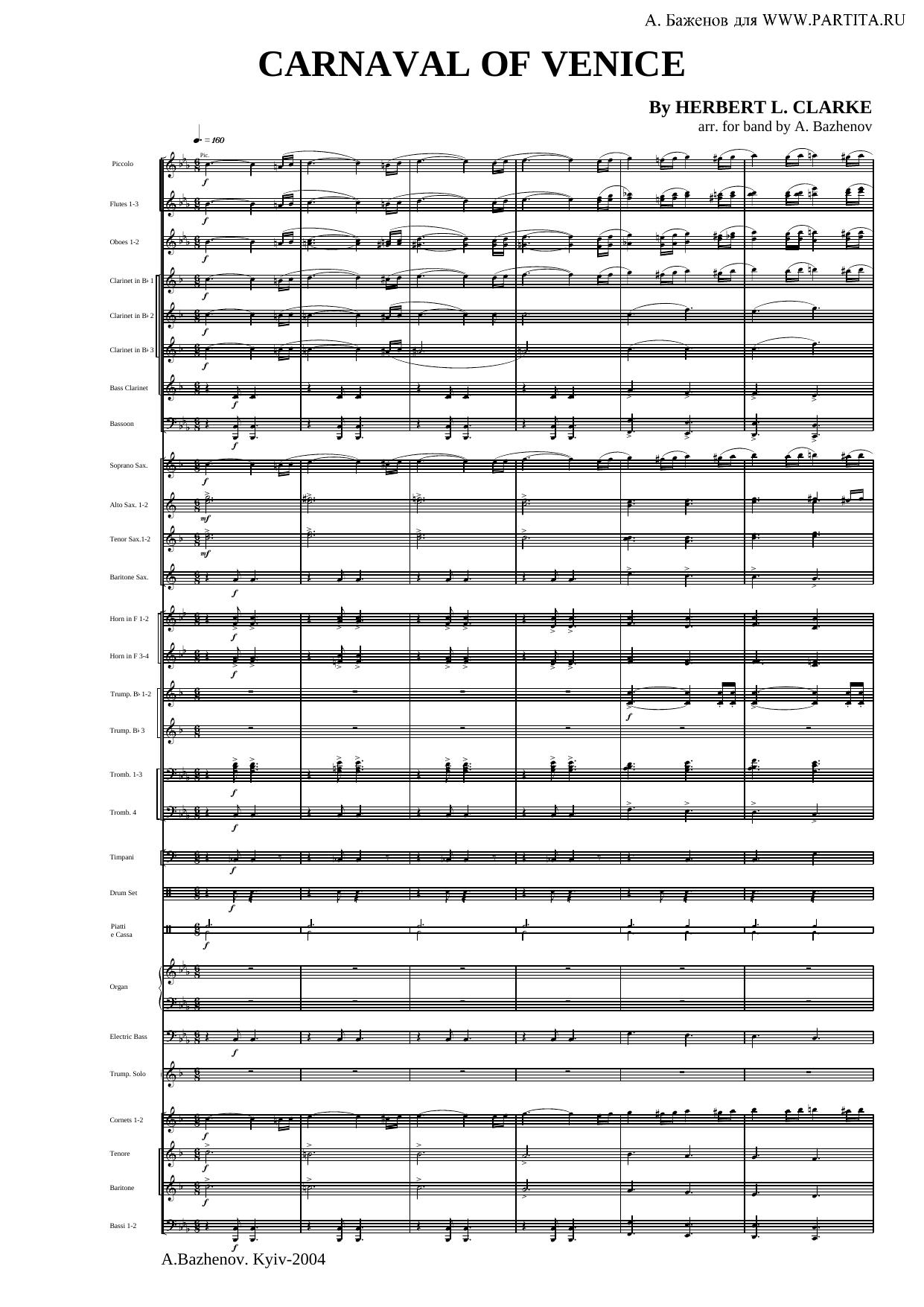
CARNAVAL OF VENICE - Herbert L. Clarke - A. Bazhenov (A. Bazhenov)
Composed by Jules Benedict
- Ensemble: Concert Band
- Pages: 197
- Instruments (28): Piccolo, Flutes 1-3, Oboes 1-2, Clarinet in Bb 1, Clarinet in Bb 2, Clarinet in Bb 3, Bass Clarinet, Bassoon, Soprano Sax., Alto Sax. 1-2, Tenor Sax. 1-2, Baritone Sax., Horn in F 1-2, Horn in F 3-4, Trumpet Bb 1-2, Trumpet Bb 3, Trombone 1-3, Trombone 4, Timpani, Drum Set, Piatti e Cassa, Organ, Electric Bass, Trumpet Solo, Cornets 1-2, Tenore, Baritone, Bassi 1-2
- Difficulty: advanced
- Content: Individual Parts
- Format: PDF Download (Instant)
- Price: $22.99
Jules Benedict's "Carnival of Venice" theme, a virtuosic staple often associated with Herbert L. Clarke's cornet variations, receives a captivating and unexpected transformation in A. Bazhenov's jazz-infused concert band arrangement. While the original theme dates back to the 19th century and is rooted in classical and folk traditions, Bazhenov's interpretation reimagines this iconic melody through a distinctly 20th-century jazz lens. This arrangement doesn't merely add a swing beat; it fundamentally reharmonizes and recontextualizes the piece, bridging the gap between historical virtuosity and contemporary jazz sensibility. The original "Carnival of Venice" is renowned for its technical demands and melodic charm, making it a natural fit for Bazhenov's inventive approach, which often involves reinterpreting classical works with modern harmonic and rhythmic structures. Bazhenov's arrangement unfolds as a vibrant, medium-up swing chart, typically set in a bright major key, likely B-flat or C major, allowing for both brilliance and harmonic depth. The mood is one of playful exuberance, shifting between moments of intricate ensemble work and soaring melodic statements. Expect a dynamic journey, characterized by a sophisticated harmonic palette that incorporates extended chords, altered dominant voicings, and unexpected chromaticism, all woven into a cohesive jazz framework. The energy builds steadily, culminating in a powerful, full-ensemble statement. Bazhenov's signature approach often involves intricate counterpoint and layered textures, ensuring that every section of the band contributes to the rich sonic tapestry. The arrangement masterfully distributes the iconic melody, initially presenting it in a lyrical, almost ballad-like setting before transitioning into the driving swing feel. Soli sections are prominent, showcasing the woodwind choir (flute, oboe, clarinets, bass clarinet, bassoon) with agile, interwoven lines that demand precision and blend. While specific solo opportunities are not explicitly detailed, the nature of the arrangement suggests potential for improvised or written-out solos over sophisticated chord changes, particularly for instruments like clarinet or flute, echoing the original's virtuosic spirit. Technical challenges abound, from rapid scale passages and arpeggios requiring clean articulation and finger dexterity, to intricate rhythmic figures that demand tight ensemble coordination. The rewarding aspect lies in the sheer joy of performing such a clever and well-crafted reinterpretation, offering both intellectual stimulation and visceral excitement. The piece is particularly suitable for advanced high school, collegiate, and community concert bands seeking a challenging yet accessible jazz-classical fusion piece that will undoubtedly captivate audiences. Conductors should establish a precise, medium-up swing feel from the outset, emphasizing a consistent underlying pulse even through tempo fluctuations or rhythmic complexities. Pay close attention to articulation markings, as they are crucial for conveying the jazz idiom – distinguishing between legato, staccato, and accented notes. The numerous soli sections for woodwinds require meticulous balance and blend; encourage players to listen across the section for unified phrasing and intonation, particularly in rapid scale passages. Bassoon and bass clarinet parts are often foundational, providing harmonic and rhythmic anchors, and their clarity is paramount. Rehearsal time should be dedicated to isolating challenging rhythmic figures and ensuring precise entrances and cutoffs, especially in the full ensemble sections. Focus on dynamic contrast to highlight the arrangement's dramatic arc, from delicate melodic statements to powerful tutti moments. Q: What instruments are included in this arrangement? A: This arrangement is scored for a full concert band, encompassing 15 distinct instrumental parts including Flute, Oboe, Clarinet, Bass Clarinet, Bassoon, and other standard wind and percussion instruments. Q: What is the difficulty level of "CARNAVAL OF VENICE - A. Bazhenov"? A: This arrangement is considered advanced, suitable for high school, collegiate, and community concert bands. It demands strong technical proficiency, intricate ensemble coordination, and an understanding of jazz stylistic elements. Q: What is the musical style and historical context of this arrangement? A: This is a jazz-infused concert band arrangement of Jules Benedict's "Carnival of Venice" theme, a 19th-century classical piece famously elaborated by Herbert L. Clarke. Bazhenov's treatment reharmonizes and recontextualizes the theme into a medium-up swing jazz style. Q: What makes A. Bazhenov's arrangement of "Carnival of Venice" unique? A: Bazhenov's arrangement is distinctive for its sophisticated reharmonization, intricate counterpoint, and transformation of a classical virtuoso piece into a vibrant, medium-up swing jazz chart, bridging historical tradition with modern jazz sensibility. Q: What is the typical performance duration or tempo of this piece? A: While specific duration can vary with interpretation, this arrangement is characterized by a medium-up swing tempo, suggesting a performance time typically in the 4-6 minute range, depending on any included improvisational sections.
Questions and answers
- What is included in the CARNAVAL OF VENICE - Herbert L. Clarke - A. Bazhenov (A. Bazhenov) PDF?
- The verified current file contains a conductor score and individual parts across 197 pages.
- How many instruments or parts are listed for CARNAVAL OF VENICE - Herbert L. Clarke - A. Bazhenov (A. Bazhenov)?
- The verified instrumentation list contains 28 entries for this Concert Band arrangement.
- Who is credited for CARNAVAL OF VENICE - Herbert L. Clarke - A. Bazhenov (A. Bazhenov)?
- Composer: Jules Benedict.
- What difficulty is listed for CARNAVAL OF VENICE - Herbert L. Clarke - A. Bazhenov (A. Bazhenov)?
- The verified difficulty level is advanced.
- Can I preview CARNAVAL OF VENICE - Herbert L. Clarke - A. Bazhenov (A. Bazhenov) before buying?
- Yes. The product page provides a preview generated from the current PDF file.
- How is CARNAVAL OF VENICE - Herbert L. Clarke - A. Bazhenov (A. Bazhenov) delivered?
- After successful payment, the digital PDF is made available for download. The displayed price is $22.99.
Musicians Also Search For
CARNAVAL OF VENICE - Herbert L. Clarke - A. Bazhenov Jules Benedict sheet music • CARNAVAL OF VENICE - Herbert L. Clarke - A. Bazhenov Jules Benedict concert band arrangements • Jules Benedict concert band charts • CARNAVAL OF VENICE - Herbert L. Clarke - A. Bazhenov concert band arrangements • CARNAVAL OF VENICE - Herbert L. Clarke - A. Bazhenov concert band PDF download • CARNAVAL OF VENICE - Herbert L. Clarke - A. Bazhenov jazz sheet music • concert band sheet music download • CARNAVAL OF VENICE - Herbert L. Clarke - A. Bazhenov conductor score PDF • CARNAVAL OF VENICE - Herbert L. Clarke - A. Bazhenov individual parts download • CARNAVAL OF VENICE - Herbert L. Clarke - A. Bazhenov sheet music PDF • buy CARNAVAL OF VENICE - Herbert L. Clarke - A. Bazhenov sheet music • download CARNAVAL OF VENICE - Herbert L. Clarke - A. Bazhenov PDF • CARNAVAL OF VENICE - Herbert L. Clarke - A. Bazhenov jazz charts • CARNAVAL OF VENICE - Herbert L. Clarke - A. Bazhenov printable sheet music • concert band repertoire PDF