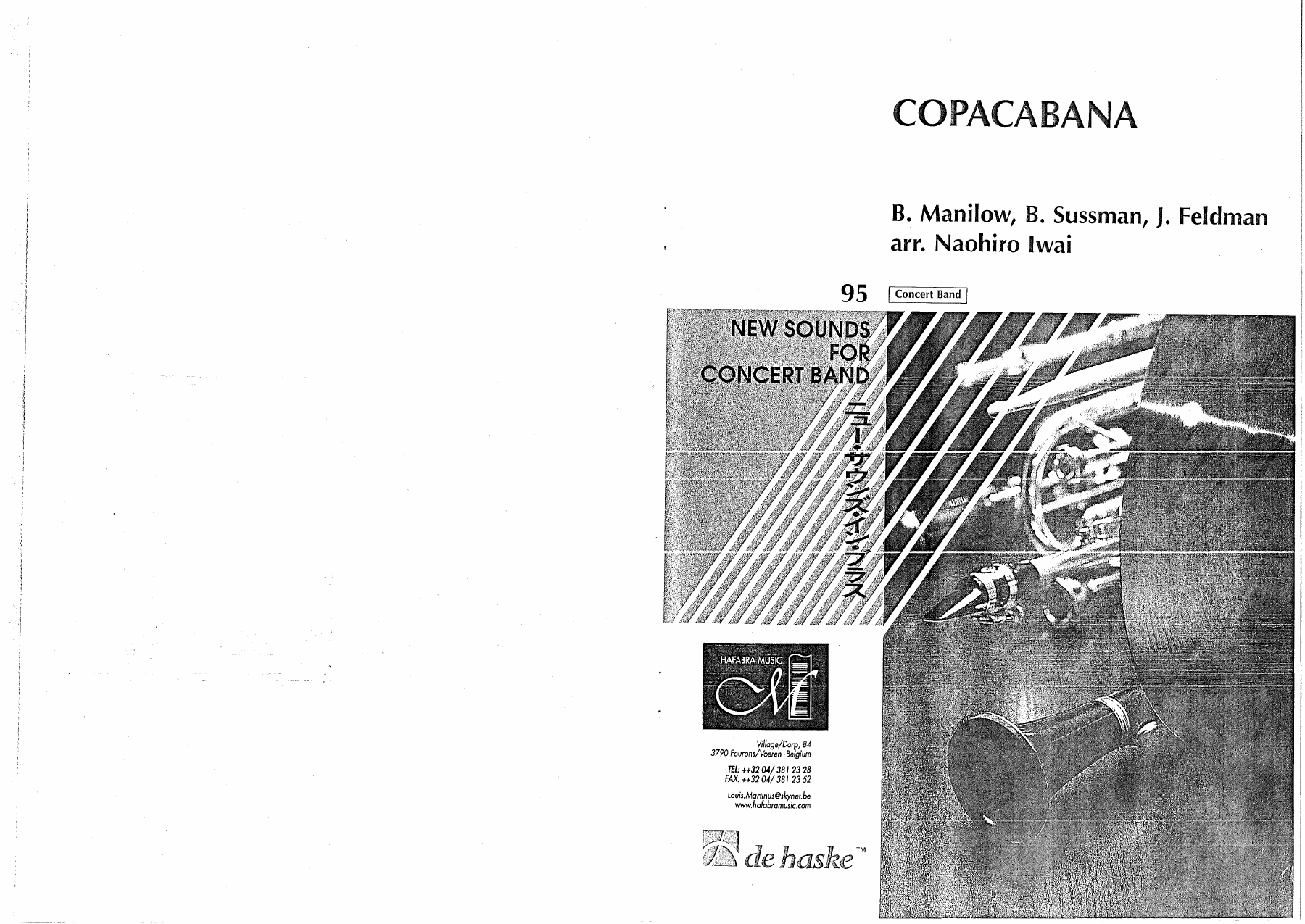
Copacabana (N,Iwai) sheet music preview

Copacabana (N,Iwai)

Composed by Barry Manilow, Bruce Sussman, Jack Feldman

Arranged by Naohiro Iwai

  • Ensemble: Concert Band
  • Style: Latin Jazz
  • Pages: 68
  • Difficulty: advanced
  • Content: Sheet Music
  • Format: PDF Download (Instant)
  • Price: $22.99

Barry Manilow's iconic "Copacabana" burst onto the music scene in 1978, a vibrant disco-pop narrative that quickly became a global sensation and a signature piece for the artist. Its infectious Latin-infused rhythm, storytelling lyrics, and dramatic build-up captured the late 1970s zeitgeist, earning Manilow a Grammy Award for Best Male Pop Vocal Performance. While not a traditional jazz standard, its enduring popularity and strong rhythmic foundation have made it a frequent subject for diverse instrumental arrangements, often reinterpreted through a jazz or Latin lens. The song's theatrical flair and memorable melody lend themselves exceptionally well to orchestral and ensemble settings, providing a rich canvas for arrangers to explore its inherent drama and rhythmic vitality. Naohiro Iwai's concert band arrangement of "Copacabana" masterfully transforms the disco-pop original into a sophisticated Latin Jazz showpiece. True to the song's character, this arrangement maintains a vibrant, up-tempo Latin groove, primarily in a driving 4/4 meter, evoking the energy and flair of a bustling dance floor. Iwai's signature style, known for its brilliant orchestration, dynamic contrasts, and accessible yet challenging writing for concert bands, shines through. The arrangement is characterized by its bright, full brass voicings, intricate woodwind lines that weave through the rhythmic foundation, and a prominent role for the percussion section, which is essential in establishing and maintaining the authentic Latin feel. Expect lush harmonies that expand upon the original's pop structure, adding a layer of jazz sophistication without losing the melody's immediate appeal. This arrangement features the melody prominently in various sections, often passed between the trumpet and saxophone sections, with rich counter-melodies and harmonies provided by the low brass and woodwinds. Iwai’s treatment includes powerful soli sections for the brass and woodwinds, showcasing the ensemble's precision and blend. While there aren't extended improvised solo sections in the traditional jazz sense, the arrangement provides opportunities for featured melodic lines and rhythmic interplay that highlight individual sections. Technical challenges include maintaining the relentless Latin rhythmic drive, particularly in the percussion and bass lines, precise articulation in the fast-paced brass and woodwind passages, and achieving the dynamic contrasts crucial to the piece's dramatic arc. The rewarding aspect lies in the sheer energy generated and the audience's immediate recognition and enjoyment of this beloved tune. This arrangement is ideally suited for advanced high school, collegiate, community, and professional concert bands. Its demands for rhythmic accuracy, strong ensemble blend, and dynamic control make it an excellent vehicle for developing musicianship, while its inherent entertainment value ensures it will be a crowd-pleaser. The comprehensive scoring ensures that all sections of the band have engaging and challenging parts, contributing to a full, vibrant sound that is characteristic of Iwai's best work. Its 68 pages of score and parts indicate a substantial and thoroughly developed piece, perfect for a concert opener, closer, or a vibrant addition to any program. Conductors should emphasize a consistent, driving Latin groove from the outset, ensuring the percussion section (congas, timbales, Latin shakers) establishes a solid foundation that the rest of the ensemble can lock into. The tempo should be a brisk, unwavering quarter note around 138-144 BPM to capture the original's danceable energy. Key technical challenges include the rapid articulation in the brass and woodwind soli passages, requiring diligent sectional rehearsal to achieve clarity and unison. Pay close attention to dynamic markings; Iwai uses a wide range to build tension and release, crucial for the dramatic narrative of the piece. The syncopated figures throughout demand precise rhythmic placement, particularly in the bass line and low brass. Encourage a bright, energetic tone from all sections, especially the trumpets and upper woodwinds, to project the celebratory mood. Rehearsal should focus on rhythmic precision, clean articulation, and balancing the intricate layers of harmony and counter-melody to allow the main melodic lines to soar. Q: What instruments and parts are included in the Naohiro Iwai arrangement of "Copacabana"? A: This concert band arrangement includes a full score and standard concert band instrumentation, typically encompassing flutes, oboes, bassoons, clarinets, saxophones (alto, tenor, baritone), trumpets, French horns, trombones, euphonium, tuba, string bass, and a comprehensive percussion section including drum set, Latin percussion (congas, timbales, shakers), and mallet percussion. Q: What is the difficulty level of this arrangement? A: This arrangement is considered advanced high school to collegiate level (Grade 4-5). It demands strong rhythmic precision, clean articulation in fast passages, dynamic control, and a well-developed ensemble blend across all sections. Q: How does this arrangement's style compare to the original "Copacabana" and what era does it represent? A: While the original 1978 "Copacabana" is a disco-pop song, Naohiro Iwai's arrangement reinterprets it as a vibrant Latin Jazz piece for concert band. It maintains the original's infectious energy and melodic hooks but infuses it with sophisticated jazz harmonies, intricate counter-melodies, and a prominent, authentic Latin rhythmic foundation, characteristic of late 20th-century concert band writing. Q: What makes Naohiro Iwai's arrangement of "Copacabana" unique compared to other versions? A: Iwai's arrangement is distinguished by its brilliant, full concert band orchestration, dynamic contrasts, and intricate soli sections for both brass and woodwinds. His signature style adds a layer of jazz sophistication and orchestral richness, transforming the pop original into a compelling and challenging showpiece for a large ensemble. Q: What is the typical performance duration and tempo for this arrangement? A: The typical performance duration for this arrangement is approximately 3 to 4 minutes. It should be performed at a brisk, up-tempo Latin groove, ideally around a quarter note at 138-144 BPM, to capture the energetic and danceable character of the piece.

Musicians Also Search For

Copacabana Naohiro Iwai PDFCopacabana Naohiro Iwai sheet musicCopacabana arranged by Naohiro IwaiNaohiro Iwai concert band chartsNaohiro Iwai jazz arrangements PDFCopacabana Barry Manilow, Bruce Sussman, Jack Feldman sheet musicCopacabana Barry Manilow, Bruce Sussman, Jack Feldman concert band arrangementBarry Manilow, Bruce Sussman, Jack Feldman concert band chartsCopacabana concert band arrangementCopacabana concert band PDF downloadCopacabana jazz ensemble sheet musicconcert band sheet music instant downloadCopacabana sheet music with partsCopacabana Latin Jazz chartLatin Jazz concert band arrangementsbuy Copacabana sheet music onlinedownload Copacabana PDFCopacabana jazz chartbest Naohiro Iwai concert band arrangementsBarry Manilow, Bruce Sussman, Jack Feldman songs arranged by Naohiro IwaiCopacabana printable sheet musicconcert band repertoire PDF

All arrangements by Naohiro Iwai All Barry Manilow, Bruce Sussman, Jack Feldman sheet music