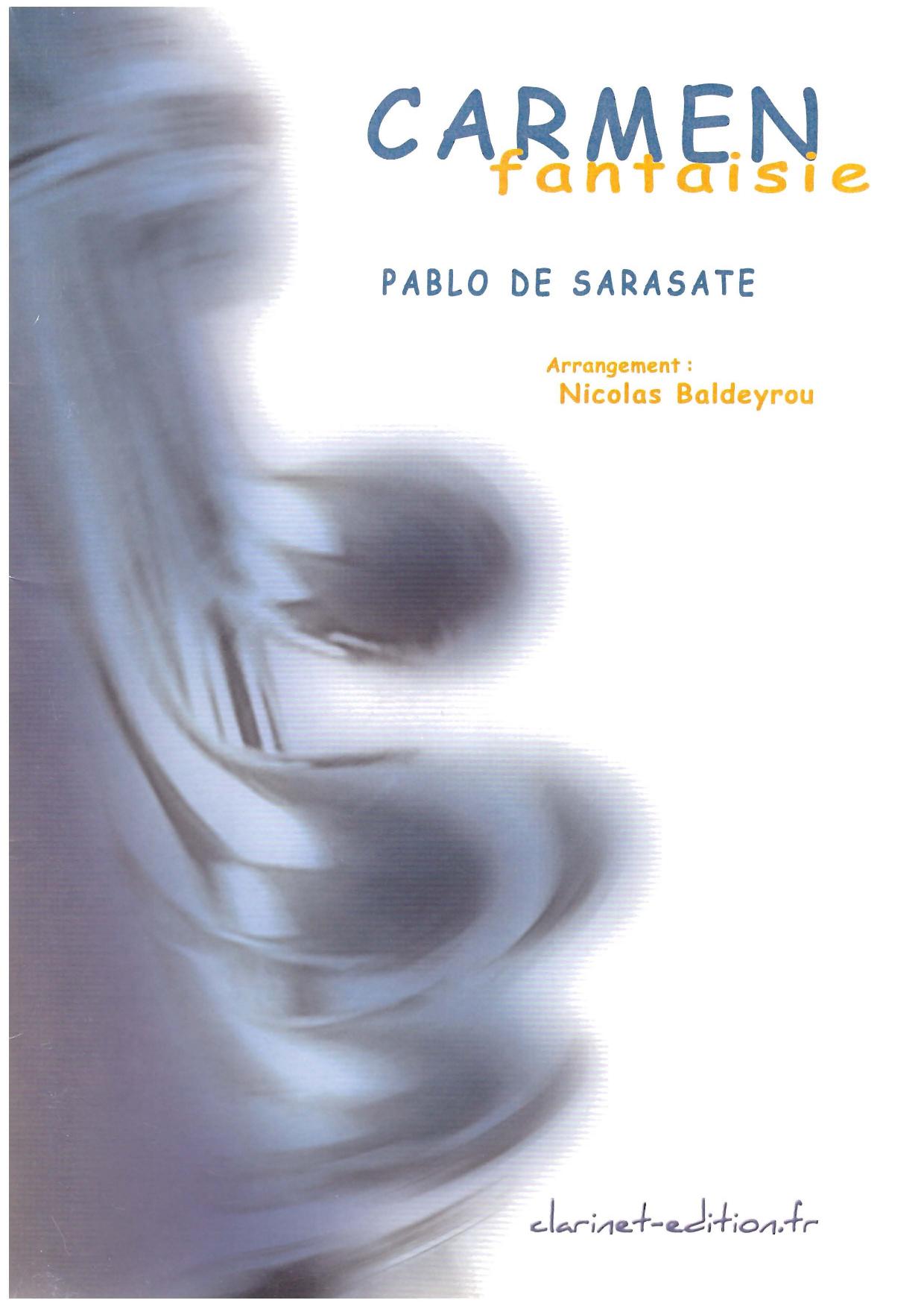
Carmen Fantasie (P.Sarasate)
Composed by Pablo de Sarasate
Arranged by P. Sarasate
- Ensemble: Concert Band
- Pages: 27
- Instruments (4): Clarinet 1, Clarinet 2, Clarinet 3, Bass Clarinet
- Difficulty: medium
- Content: Individual Parts
- Format: PDF Download (Instant)
- Price: $22.99
Pablo de Sarasate's iconic "Carmen Fantasie," originally a virtuosic showpiece for violin and orchestra, is reimagined here in a captivating jazz setting for clarinet quartet. The original "Carmen Fantasie" draws its inspiration from Georges Bizet's immortal opera *Carmen*, a work that premiered in 1875 and quickly became one of the most frequently performed operas in the Western canon. Sarasate, a Spanish violin virtuoso and composer of the Romantic era, composed his fantasy around 1883, transforming Bizet's memorable themes—such as the Habanera, Seguidilla, and Gypsy Dance—into a dazzling display of technical brilliance and melodic invention. While the original is firmly rooted in 19th-century classical tradition, this arrangement boldly transports these familiar melodies into the 20th-century jazz idiom, offering a fresh perspective on a beloved classic. This particular arrangement by P. Sarasate (the jazz arranger, distinct from the original composer) masterfully infuses the dramatic flair of Bizet's opera with the rhythmic sophistication and harmonic language of jazz. The musical character is primarily a medium swing feel, though it fluidly transitions through various grooves, including moments of Latin-infused rhythm and even a brief, soulful ballad section. The key centers shift dynamically, navigating through both major and minor modes, often employing extended harmonies and reharmonizations that give the familiar melodies a distinctly modern jazz flavor. The mood oscillates between playful, sultry, and explosively energetic, evoking the passionate narrative of *Carmen* through a jazz lens. Expect intricate counterpoint, tight ensemble work, and a vibrant, improvisatory spirit woven into the fabric of the composition. P. Sarasate's distinctive approach to this arrangement is evident in the sophisticated voicings and the clever integration of jazz elements. The four clarinets are treated as a cohesive unit, often engaging in intricate soli sections that demand precise articulation and blend. While there isn't a traditional improvised solo section, the arrangement features numerous virtuosic passages that mimic the spontaneity of improvisation, particularly in the first clarinet part, which often carries the primary melodic and technical burden. The arranger employs a rich harmonic palette, utilizing dissonances and resolutions characteristic of post-bop jazz, and introduces rhythmic syncopation that recontextualizes Bizet's themes. The challenge lies in maintaining the classical precision required for the original's technical demands while simultaneously embodying the relaxed yet driving feel of jazz. Performance of this "Carmen Fantasie" arrangement is incredibly rewarding. The first clarinet typically carries the main melodic lines and the most demanding technical flourishes, requiring a player with advanced dexterity and a strong jazz sensibility. The other clarinet parts provide rich harmonic support, rhythmic drive, and engaging counter-melodies, requiring excellent ensemble listening and intonation. The piece is suitable for advanced high school, college, community, or professional clarinet quartets looking for a challenging and unique repertoire piece that bridges classical and jazz genres. It offers an excellent opportunity to explore advanced ensemble playing, rhythmic accuracy in a jazz context, and the interpretation of classical themes through a contemporary lens. Conductors and musicians should approach this "Carmen Fantasie" arrangement with a dual mindset, balancing classical precision with jazz feel. The primary technical challenge lies in executing the rapid passages and intricate rhythms with both accuracy and a relaxed, swinging articulation. Emphasize a consistent medium swing feel throughout, ensuring all players understand and internalize the rhythmic subdivisions. Pay close attention to dynamics and phrasing, as these are crucial for conveying the dramatic shifts in mood. Rehearsal should focus on intonation within the close voicings, particularly during the more harmonically dense sections. Practice the soli passages slowly to ensure rhythmic precision and blend. While no special techniques like plunger mutes are required, encourage a flexible approach to articulation—sharp and staccato where indicated, but legato and flowing for melodic lines, always with a jazz inflection. The tempo marking of quarter note = 120-132 bpm for the main swing sections should be a guide; allow for slight rubato in the more lyrical moments to enhance expression. Q: What instruments and parts are included in this arrangement? A: This arrangement is specifically for a clarinet quartet, featuring four distinct parts: Clarinet 1, Clarinet 2, Clarinet 3, and Clarinet 4. All parts are written for standard B-flat clarinets. Q: What is the difficulty level of "Carmen Fantasie (P. Sarasate)"? A: This arrangement is considered advanced, suitable for college-level, advanced community, or professional clarinet quartets. It demands strong technical proficiency, excellent ensemble skills, and a solid understanding of jazz rhythmic and harmonic concepts. Q: What musical style and historical context does this arrangement represent? A: This arrangement fuses the 19th-century classical virtuosity of Pablo de Sarasate's "Carmen Fantasie," based on Bizet's opera, with 20th-century jazz idioms. It presents the familiar themes in a contemporary jazz setting, primarily with a medium swing feel. Q: What makes P. Sarasate's arrangement of "Carmen Fantasie" unique? A: This arrangement stands out by reharmonizing Bizet's and Sarasate's original material with extended jazz harmonies and introducing sophisticated rhythmic syncopation. It transforms a classical showpiece into a challenging and engaging jazz ensemble work for clarinets. Q: What is the typical performance duration and primary tempo of this piece? A: The performance duration for this arrangement typically ranges from 7 to 9 minutes, depending on interpretive choices. The primary tempo for the main swing sections is a medium swing, generally around quarter note = 120-132 bpm.
Questions and answers
- What is included in the Carmen Fantasie (P.Sarasate) PDF?
- The verified current file contains a conductor score across 27 pages.
- How many instruments or parts are listed for Carmen Fantasie (P.Sarasate)?
- The verified instrumentation list contains 4 entries for this Concert Band arrangement.
- Who is credited for Carmen Fantasie (P.Sarasate)?
- Composer: Pablo de Sarasate. Arranger: P. Sarasate.
- What difficulty is listed for Carmen Fantasie (P.Sarasate)?
- The verified difficulty level is medium.
- Can I preview Carmen Fantasie (P.Sarasate) before buying?
- Yes. The product page provides a preview generated from the current PDF file.
- How is Carmen Fantasie (P.Sarasate) delivered?
- After successful payment, the digital PDF is made available for download. The displayed price is $22.99.
Musicians Also Search For
Carmen Fantasie P. Sarasate PDF • Carmen Fantasie P. Sarasate sheet music • Carmen Fantasie arranged by P. Sarasate • P. Sarasate concert band charts • P. Sarasate jazz arrangements PDF • Carmen Fantasie Pablo de Sarasate sheet music • Carmen Fantasie Pablo de Sarasate concert band arrangements • Pablo de Sarasate concert band charts • Carmen Fantasie concert band arrangements • Carmen Fantasie concert band PDF download • Carmen Fantasie jazz sheet music • concert band sheet music download • Carmen Fantasie conductor score PDF • Carmen Fantasie sheet music PDF • buy Carmen Fantasie sheet music • download Carmen Fantasie PDF • Carmen Fantasie jazz charts • best P. Sarasate concert band arrangements • Pablo de Sarasate arranged by P. Sarasate • Carmen Fantasie printable sheet music • concert band repertoire PDF