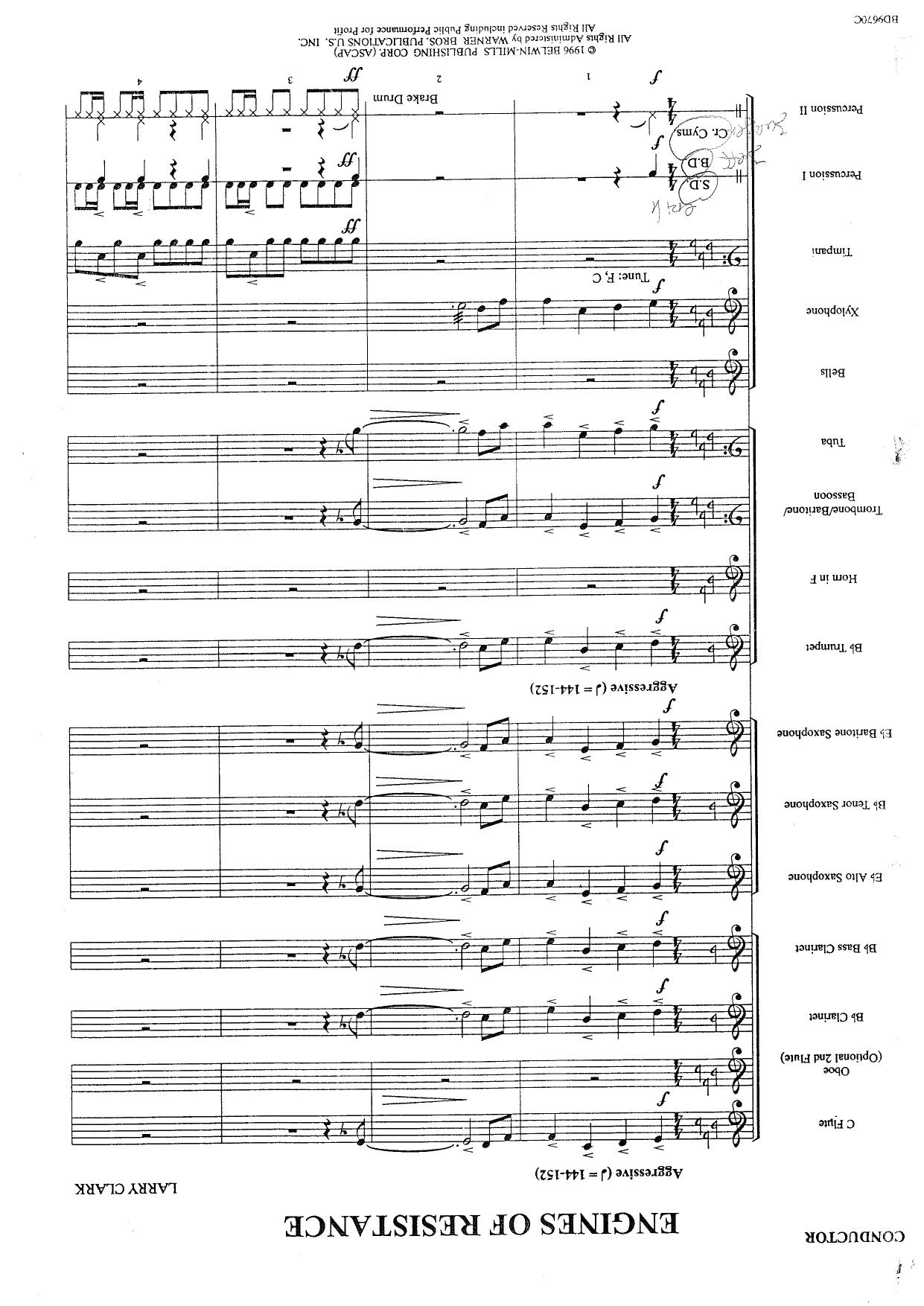
Engine of Resistance (L.Clark)
Composed by Larry Clark
Arranged by Larry Clark
- Ensemble: Concert Band
- Style: Fusion
- Pages: 53
- Difficulty: advanced
- Content: Sheet Music
- Format: PDF Download (Instant)
- Price: $22.99
"Engine of Resistance," composed and arranged by Larry Clark, stands as a compelling original work within the contemporary fusion landscape, specifically tailored for the concert band idiom. While not a historical jazz standard, this piece embodies the spirit and rhythmic intricacy often associated with 20th and 21st-century fusion, drawing on elements of jazz harmony, rock-infused grooves, and sophisticated orchestral textures. Its creation by Clark, a prolific composer and arranger known for his accessible yet engaging educational music, positions it as a significant contribution to the concert band repertoire seeking to explore modern jazz aesthetics. The piece doesn't aim to replicate a specific historical era but rather to forge a new path, offering a fresh, energetic, and harmonically rich experience that resonates with contemporary audiences and performers. Musically, "Engine of Resistance" is a high-energy, driving work, typically performed at a brisk tempo, often around a quarter note at 132-144 BPM. It features a relentless, syncopated groove, propelled by a powerful rhythm section that underpins a dynamic interplay between the brass and woodwind sections. The piece is characterized by its bold, often dissonant, yet ultimately resolving harmonies, typical of fusion. It projects a mood of determined forward motion and controlled intensity, evoking feelings of urgency and resilience. The primary key center shifts throughout, utilizing modal interchange and chromaticism to maintain harmonic interest and tension. The overall energy is consistently high, building through carefully constructed sections to powerful climaxes. Larry Clark's arrangement for concert band is a masterclass in adapting fusion concepts to a large symphonic ensemble. He expertly distributes the intricate rhythmic figures and melodic lines across the various sections, ensuring each part contributes meaningfully to the dense texture. Expect to find driving ostinatos in the low brass and woodwinds, soaring melodic statements in the upper woodwinds and trumpets, and powerful, often accented, chordal punches from the full ensemble. Clark's signature approach involves clear, articulate writing that emphasizes rhythmic precision and dynamic contrast. There are no traditional improvised solos in this arrangement; instead, Clark crafts highly detailed soli sections that emulate the virtuosic interplay found in small-group fusion, often featuring intricate counterpoint between instrumental families. The piece is rewarding to perform due to its rhythmic vitality, harmonic depth, and the sheer power it generates when executed with precision. This arrangement is ideally suited for advanced high school, collegiate, or accomplished community concert bands. Its technical demands, particularly in rhythmic accuracy, dynamic control, and ensemble balance, require a mature and disciplined group. The intricate counterpoint and challenging syncopation necessitate strong individual players and a cohesive ensemble capable of navigating complex textures. The piece offers an excellent opportunity to develop rhythmic precision, explore contemporary harmonies, and cultivate a unified, powerful ensemble sound, making it a valuable addition to a concert program seeking to showcase a band's technical prowess and stylistic versatility. "Engine of Resistance" demands meticulous rhythmic precision from all sections. Conductors should emphasize subdivision, particularly in the syncopated passages, using a strong, clear beat pattern. The primary technical challenge lies in maintaining rhythmic integrity and ensemble tightness through the piece's driving, often interlocking, rhythmic figures. Rehearsal should focus on isolating and layering these rhythmic motifs, ensuring each part locks into the overall groove. Dynamic contrast is crucial; Clark utilizes a wide dynamic range to shape the piece, from powerful *fortissimo* ensemble hits to more subdued, intricate *mezzo-forte* soli sections. Pay close attention to articulation markings – staccatos, accents, and tenutos – as they are vital to conveying the piece's aggressive yet controlled character. The tempo should be brisk and unwavering, around a quarter note at 132-144 BPM, maintaining a relentless forward momentum without rushing. No special techniques like plunger mutes or falls are explicitly required, but a strong, confident attack and release are paramount for all brass and percussion. Q: What instruments and parts are included in this arrangement? A: This arrangement is scored for a standard concert band instrumentation, typically including flutes, oboe, bassoons, clarinets, bass clarinet, alto/tenor/baritone saxophones, trumpets, French horns, trombones, euphonium, tuba, and a comprehensive percussion section (drum set, mallet percussion, auxiliary percussion). Q: What is the difficulty level of "Engine of Resistance" for concert band? A: This arrangement is considered advanced (Grade 5-6), suitable for advanced high school, collegiate, or accomplished community concert bands. It requires strong individual players and a cohesive ensemble capable of navigating complex rhythms, contemporary harmonies, and demanding dynamic control. Q: What is the musical style and historical context of "Engine of Resistance"? A: "Engine of Resistance" is an original composition in the fusion style, blending elements of jazz harmony and rhythm with rock energy and sophisticated concert band textures. It represents a contemporary approach to instrumental music, rather than a historical jazz standard. Q: What makes Larry Clark's arrangement of "Engine of Resistance" unique? A: Clark's arrangement is unique for its successful adaptation of complex fusion aesthetics to the concert band, featuring intricate, driving rhythms, bold harmonic language, and meticulously crafted soli sections that emulate small-group improvisation within a large ensemble context, all without relying on traditional improvised solos. Q: What is the typical performance duration and tempo for this piece? A: The typical performance duration for "Engine of Resistance" is approximately 4-5 minutes. It is designed to be performed at a brisk, driving tempo, generally around a quarter note at 132-144 BPM, maintaining a high level of energy throughout.
Musicians Also Search For
Engine of Resistance Larry Clark PDF • Engine of Resistance Larry Clark sheet music • Engine of Resistance arranged by Larry Clark • Larry Clark concert band charts • Larry Clark jazz arrangements PDF • Engine of Resistance Larry Clark concert band arrangement • Engine of Resistance concert band arrangement • Engine of Resistance concert band PDF download • Engine of Resistance jazz ensemble sheet music • concert band sheet music instant download • Engine of Resistance sheet music with parts • Engine of Resistance Fusion chart • Fusion concert band arrangements • buy Engine of Resistance sheet music online • download Engine of Resistance PDF • Engine of Resistance jazz chart • best Larry Clark concert band arrangements • Engine of Resistance printable sheet music • concert band repertoire PDF