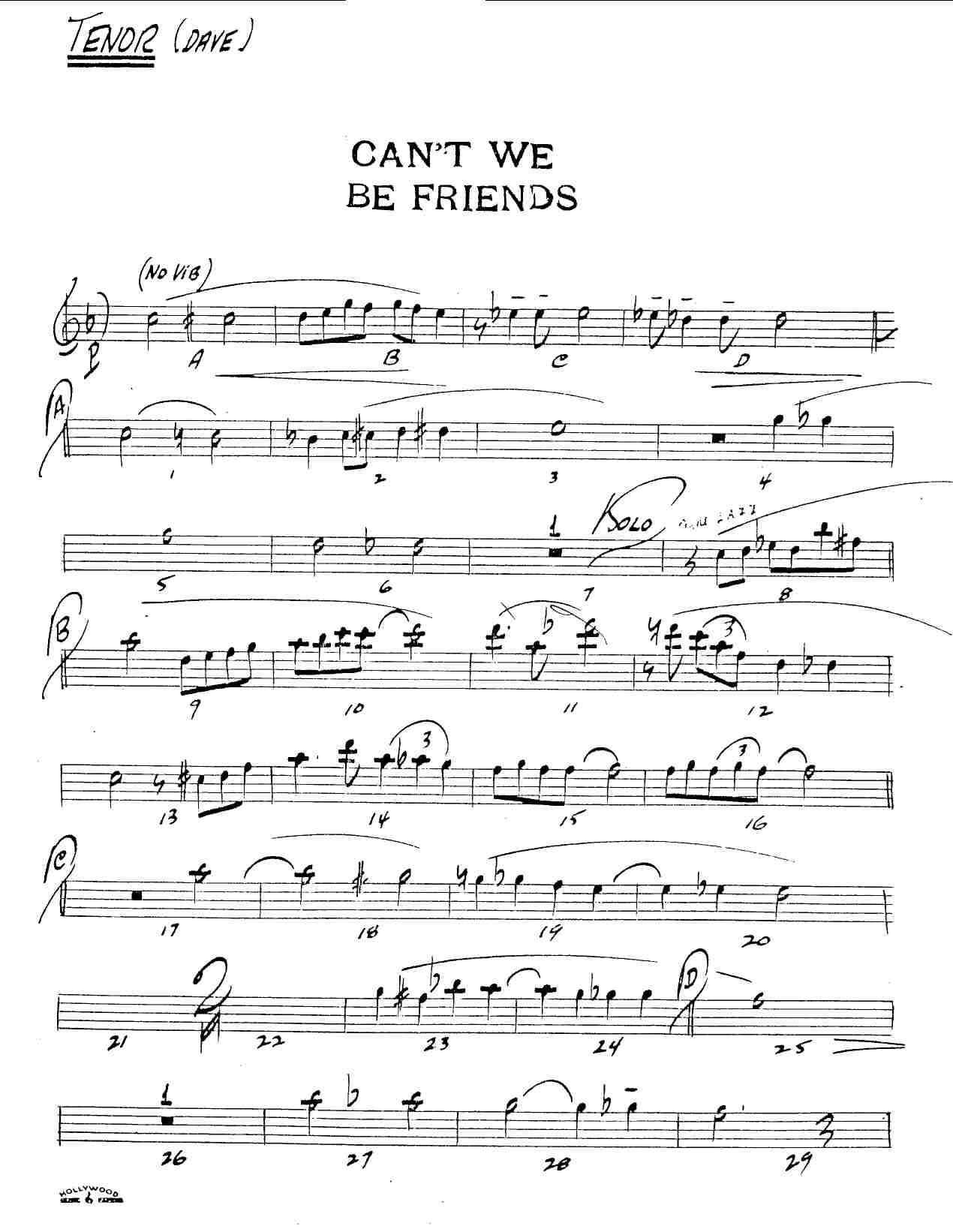
Can't We Be Friends - Paich - Dave Pell Octet - Ts,Bs,Trp,Trb+Rhythm
Composed by Kay Swift
- Ensemble: Small Ensemble
- Pages: 18
- Instruments (8): Tenor Saxophone, Trumpet, Trombone, Baritone Saxophone, Piano, Guitar, Bass, Drums
- Difficulty: easy
- Content: Individual Parts
- Format: PDF Download (Instant)
- Price: $12.99
"Can't We Be Friends?" stands as a quintessential jazz standard, originally composed by Kay Swift in 1929 for the Broadway musical "The Little Show." Emerging from the Tin Pan Alley era, this ballad quickly became a favorite for its poignant lyrics and sophisticated harmonic progression, embodying the bittersweet emotional landscape of the late 1920s and early 1930s. While many artists have interpreted it, it gained significant jazz renown through iconic recordings by Frank Sinatra, Ella Fitzgerald, and most notably, the instrumental interpretations that highlighted its melodic and harmonic richness. Its enduring appeal lies in its timeless melody and the inherent flexibility of its chord changes, which lend themselves beautifully to diverse jazz treatments, from intimate vocal renditions to sophisticated instrumental arrangements. This particular arrangement, crafted in the distinctive style of Marty Paich for the Dave Pell Octet, captures the cool, West Coast jazz aesthetic prevalent in the mid-20th century. It presents "Can't We Be Friends?" as a medium swing, laid-back yet harmonically rich exploration, likely in a comfortable key like F or Bb major. The mood is one of sophisticated introspection, evoking a smoky club atmosphere rather than a high-energy dance hall. Expect a meticulously crafted sound, characterized by Paich's signature voicings: tight, often close-position harmonies in the horn section that create a warm, blended sound. The arrangement prioritizes clarity and melodic integrity, with a focus on counterpoint and subtle interplay between the instrumental voices, rather than bombastic shout choruses. The arranger's approach is a masterclass in small ensemble writing, showcasing the individual strengths of the seven instruments (Tenor Sax, Baritone Sax, Trumpet, Trombone, Piano, Bass, Drums). The melody is typically introduced by a lead horn, often the trumpet or tenor sax, then passed around or harmonized in elegant soli sections involving the entire horn line. Featured solo sections are almost certainly present, offering opportunities for improvisation over the standard's rich chord changes. Technical challenges lie not in extreme ranges or rapid-fire passages, but in achieving precise articulation, impeccable blend, and a unified, relaxed swing feel. The reward is a performance that exudes understated elegance and musical maturity, making it an ideal choice for advanced high school, college, community, or professional ensembles seeking to delve into the nuances of West Coast cool jazz. The intricate voicings and subtle rhythmic placements demand careful attention to detail, but the resulting sound is incredibly rewarding and authentically captures a classic jazz era. This arrangement of "Can't We Be Friends?" requires a meticulous approach to blend and balance, particularly within the horn section. The medium swing tempo should be maintained with a relaxed, unhurried feel; avoid rushing or forcing the groove. Articulation is paramount: aim for a light, connected legato for melodic lines, with precise, unified attacks on ensemble figures. Pay close attention to dynamics, as subtle shifts are crucial for shaping phrases and highlighting the intricate voicings. Horn players should listen intently to each other to ensure accurate intonation within the close harmonies. Rehearsal should focus on achieving a seamless transition between melody statements, soli sections, and improvised solos, ensuring the rhythm section provides a consistent, supportive foundation. No special techniques like plungers or falls are explicitly required, but a nuanced understanding of jazz phrasing and articulation will elevate the performance. Q: Which instruments and parts are included in this arrangement? A: This arrangement is scored for a seven-instrument small ensemble, specifically Tenor Saxophone, Baritone Saxophone, Trumpet, Trombone, Piano, Bass, and Drums. All individual instrumental parts are included, along with a full score. Q: What is the difficulty level of this arrangement? A: This arrangement is considered advanced, suitable for college, community, or professional jazz ensembles. The challenges lie in achieving precise blend, intonation, and a sophisticated understanding of West Coast cool jazz phrasing, rather than extreme technical demands. Q: What musical style and historical context does this arrangement represent? A: This arrangement presents "Can't We Be Friends?" in the sophisticated West Coast cool jazz style, characteristic of Marty Paich's writing for the Dave Pell Octet from the mid-20th century, specifically the 1950s. Q: What makes this arrangement unique compared to other versions of "Can't We Be Friends?" A: Its uniqueness stems from its authentic emulation of Marty Paich's signature small ensemble voicings and the Dave Pell Octet's cool jazz aesthetic, focusing on intricate horn harmonies, subtle counterpoint, and a relaxed, elegant swing feel. Q: What is the typical performance duration and tempo for this piece? A: The typical performance duration for this arrangement is approximately 3-5 minutes, depending on the length of improvised solos. It is designed to be played at a medium swing tempo, emphasizing a laid-back, sophisticated groove.
Questions and answers
- What is included in the Can't We Be Friends - Paich - Dave Pell Octet - Ts,Bs,Trp,Trb+Rhythm PDF?
- The verified current file contains individual parts across 18 pages.
- How many instruments or parts are listed for Can't We Be Friends - Paich - Dave Pell Octet - Ts,Bs,Trp,Trb+Rhythm?
- The verified instrumentation list contains 8 entries for this Small Ensemble arrangement.
- Who is credited for Can't We Be Friends - Paich - Dave Pell Octet - Ts,Bs,Trp,Trb+Rhythm?
- Composer: Kay Swift.
- What difficulty is listed for Can't We Be Friends - Paich - Dave Pell Octet - Ts,Bs,Trp,Trb+Rhythm?
- The verified difficulty level is easy.
- Can I preview Can't We Be Friends - Paich - Dave Pell Octet - Ts,Bs,Trp,Trb+Rhythm before buying?
- Yes. The product page provides a preview generated from the current PDF file.
- How is Can't We Be Friends - Paich - Dave Pell Octet - Ts,Bs,Trp,Trb+Rhythm delivered?
- After successful payment, the digital PDF is made available for download. The displayed price is $12.99.
Musicians Also Search For
Can't We Be Friends - Paich - Dave Pell Octet - Ts,Bs,Trp,Trb+Rhythm Kay Swift sheet music • Can't We Be Friends - Paich - Dave Pell Octet - Ts,Bs,Trp,Trb+Rhythm Kay Swift small ensemble arrangements • Kay Swift small ensemble charts • Can't We Be Friends - Paich - Dave Pell Octet - Ts,Bs,Trp,Trb+Rhythm small ensemble arrangements • Can't We Be Friends - Paich - Dave Pell Octet - Ts,Bs,Trp,Trb+Rhythm small ensemble PDF download • Can't We Be Friends - Paich - Dave Pell Octet - Ts,Bs,Trp,Trb+Rhythm jazz sheet music • small ensemble sheet music download • Can't We Be Friends - Paich - Dave Pell Octet - Ts,Bs,Trp,Trb+Rhythm individual parts download • Can't We Be Friends - Paich - Dave Pell Octet - Ts,Bs,Trp,Trb+Rhythm sheet music PDF • buy Can't We Be Friends - Paich - Dave Pell Octet - Ts,Bs,Trp,Trb+Rhythm sheet music • download Can't We Be Friends - Paich - Dave Pell Octet - Ts,Bs,Trp,Trb+Rhythm PDF • Can't We Be Friends - Paich - Dave Pell Octet - Ts,Bs,Trp,Trb+Rhythm jazz charts • Can't We Be Friends - Paich - Dave Pell Octet - Ts,Bs,Trp,Trb+Rhythm printable sheet music • small ensemble repertoire PDF