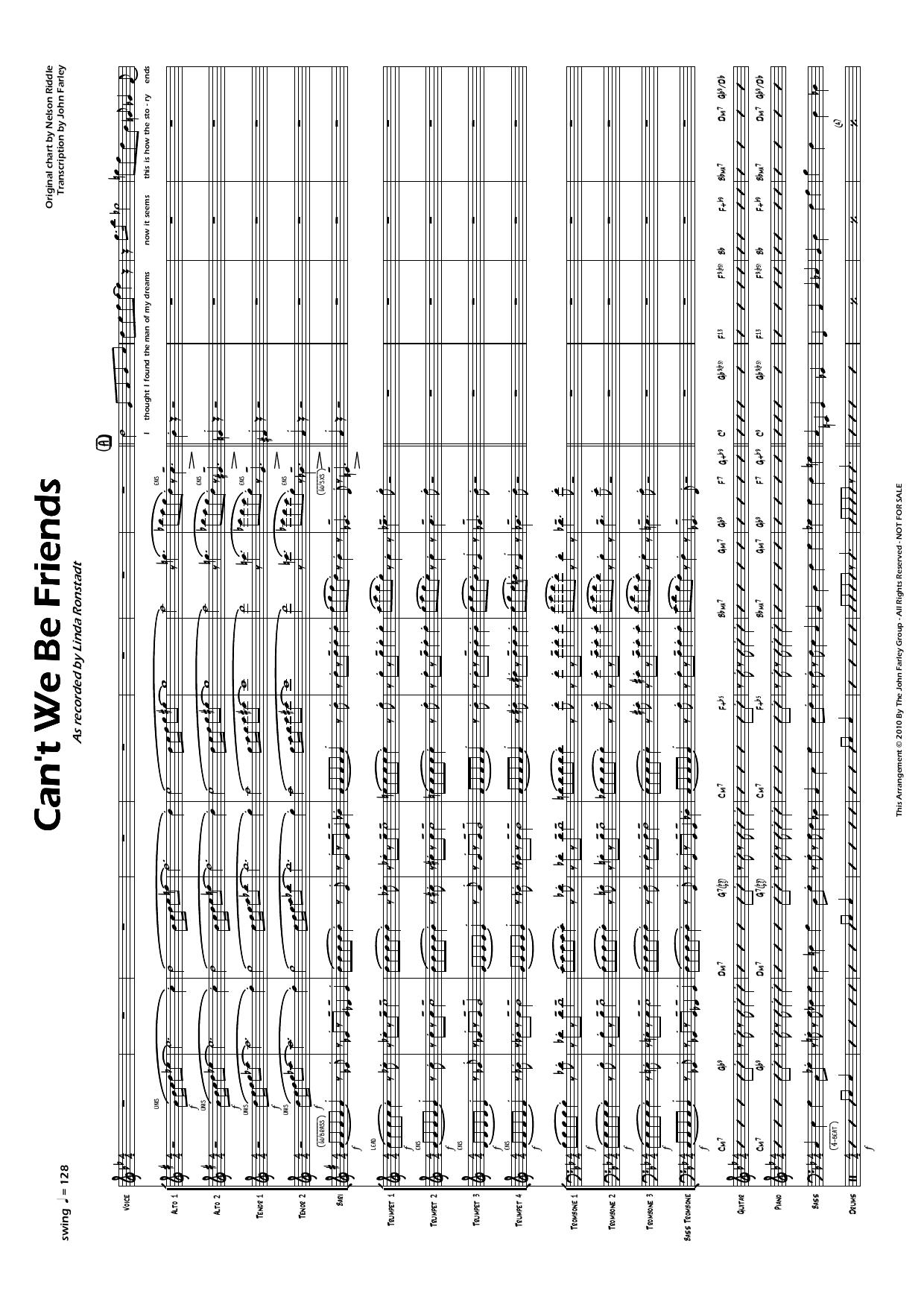
Can't We Be Friends (J.Farley)
Composed by Kay Swift
Arranged by John Farley
- Ensemble: Big Band
- Pages: 43
- Instruments (18): Voice, Alto Saxophone 1, Alto Saxophone 2, Tenor Saxophone 1, Tenor Saxophone 2, Baritone Saxophone, Trumpet 1, Trumpet 2, Trumpet 3, Trumpet 4, Trombone 1, Trombone 2, Trombone 3, Bass Trombone, Guitar, Piano, Bass, Drums
- Difficulty: medium
- Content: Individual Parts
- Format: PDF Download (Instant)
- Price: $24.99
Composed in 1929 by Kay Swift with lyrics by Paul James, "Can’t We Be Friends?" quickly transcended its origins in the Broadway revue *The Little Show* to become an enduring vehicle for jazz improvisation. The tune gained immortal status through classic recordings by legends like Ella Fitzgerald, Louis Armstrong, and Art Tatum, defining the sophisticated, bittersweet emotional palette of the late-1920s American Songbook. This timeless composition bridges early jazz and the swing era, offering a melancholy yet structurally buoyant framework that invites harmonic exploration and expressive phrasing. John Farley’s masterful big band adaptation reimagines this standard through a modern, textured lens, setting a seductive, medium-swing groove in 4/4 time. The arrangement balances bittersweet nostalgia with a vibrant, forward-driving pulse. Farley infuses the chart with rich, extended upper-structure chords and subtle chromatic inner-voice movements that evoke the sophisticated harmonic language of the post-bop era while honoring the tune's vintage pedigree. The mood shifts effortlessly from introspective, smoky ballad-like textures in the intro to an infectious, toe-tapping swing feel that builds steadily in warmth and intensity. The arrangement opens with a delicate, rubato piano intro that establishes the contemplative mood before the rhythm section locks into a steady, conversational medium-swing pocket. The melody is initially carried by the alto and tenor saxophones in a tight, harmonized soli that showcases Farley’s gift for linear counterpoint. Mid-chart, the arrangement opens up for a featured trumpet or trombone solo over changes that closely mirror the original AABA form, supported by feather-light horn background figures. The climax arrives in a tightly orchestrated shout chorus that avoids sheer volume in favor of brilliant dynamic contrast, crisp articulation, and lush brass voicings before winding down to a gentle, tongue-in-cheek tag ending. Tailored specifically for flexible big band setups or smaller jazz ensembles utilizing a focused 7-instrument core (Alto Sax, Tenor Sax, Trumpet, Trombone, Piano, Bass, and Drums across its comprehensive 43 pages), this chart is ideally suited for advanced high school, collegiate, and professional community groups. The technical demands center primarily on stylistic cohesion, swing subdivision accuracy, and intonation within sectional solis rather than brute-force velocity. Performers and audiences alike will find the chart deeply rewarding for its clever reharmonizations, nuanced dynamic interplay, and fresh perspective on a classic jazz standard. Executing John Farley’s arrangement of "Can’t We Be Friends?" successfully hinges on a unified approach to the medium-swing feel. Aim for a relaxed quarter-note pulse around 120 BPM, ensuring that the eighth notes are properly swung without rushing the triplets. The rhythm section must maintain an unhurried, driving pocket; the drummer should favor crisp, feathered bass drum accents and a traditional ride cymbal sizzle, keeping hi-hats sharp on beats two and four. Horn sections should pay meticulous attention to dynamic markings, particularly during the intro and background figures behind the soloist, where balancing the ensemble against the lead voice is critical. Articulation is paramount: ensure that all marked accents and gentle doits are executed uniformly across the sax and brass sections to preserve the swinging, vocal-like quality of the line. Rehearsal should begin by isolating the complex inner-voice harmonies in the rhythm and sax sections to lock in intonation before layering in the broader ensemble dynamics and solo spaces. Q: What specific instruments and parts are included in this 43-page arrangement? A: The arrangement is scored for a 7-instrument ensemble featuring Alto Saxophone, Tenor Saxophone, Trumpet, Trombone, Piano, Bass, and Drums, with full score and comprehensive individual parts included across the 43 pages. Q: What is the difficulty level of this John Farley chart? A: It is graded as advanced-intermediate to advanced, making it ideal for proficient high school groups, collegiate jazz bands, and professional small big band ensembles looking for sophisticated harmonies and tight sectional interplay. Q: What is the historical style and harmonic approach of this piece? A: Based on Kay Swift's 1929 jazz standard, this arrangement reinterprets the classic tune through a modern medium-swing lens, utilizing extended upper-structure chords, subtle chromaticism, and rich post-bop harmonic voicings. Q: What makes this particular arrangement unique? A: Farley’s distinct treatment features close-interval saxophone solis, conversational background figures, and a dynamic shout chorus that prioritizes textural nuance and harmonic cleverness over sheer volume. Q: What is the recommended performance tempo and duration? A: The arrangement is designed for a relaxed medium-swing tempo of approximately 120 BPM, yielding a performance duration of roughly 3.5 to 4 minutes depending on solo extensions.
Questions and answers
- What is included in the Can't We Be Friends (J.Farley) PDF?
- The verified current file contains a conductor score and individual parts across 43 pages.
- How many instruments or parts are listed for Can't We Be Friends (J.Farley)?
- The verified instrumentation list contains 18 entries for this Big Band arrangement.
- Who is credited for Can't We Be Friends (J.Farley)?
- Composer: Kay Swift. Arranger: John Farley.
- What difficulty is listed for Can't We Be Friends (J.Farley)?
- The verified difficulty level is medium.
- Can I preview Can't We Be Friends (J.Farley) before buying?
- Yes. The product page provides a preview generated from the current PDF file.
- How is Can't We Be Friends (J.Farley) delivered?
- After successful payment, the digital PDF is made available for download. The displayed price is $24.99.
Musicians Also Search For
Can't We Be Friends John Farley PDF • Can't We Be Friends John Farley sheet music • Can't We Be Friends arranged by John Farley • John Farley big band charts • John Farley jazz arrangements PDF • Can't We Be Friends Kay Swift sheet music • Can't We Be Friends Kay Swift big band arrangements • Kay Swift big band charts • Can't We Be Friends big band arrangements • Can't We Be Friends big band PDF download • Can't We Be Friends jazz sheet music • big band sheet music download • Can't We Be Friends conductor score PDF • Can't We Be Friends individual parts download • Can't We Be Friends sheet music PDF • buy Can't We Be Friends sheet music • download Can't We Be Friends PDF • Can't We Be Friends jazz charts • best John Farley big band arrangements • Kay Swift arranged by John Farley • Can't We Be Friends printable sheet music • big band repertoire PDF