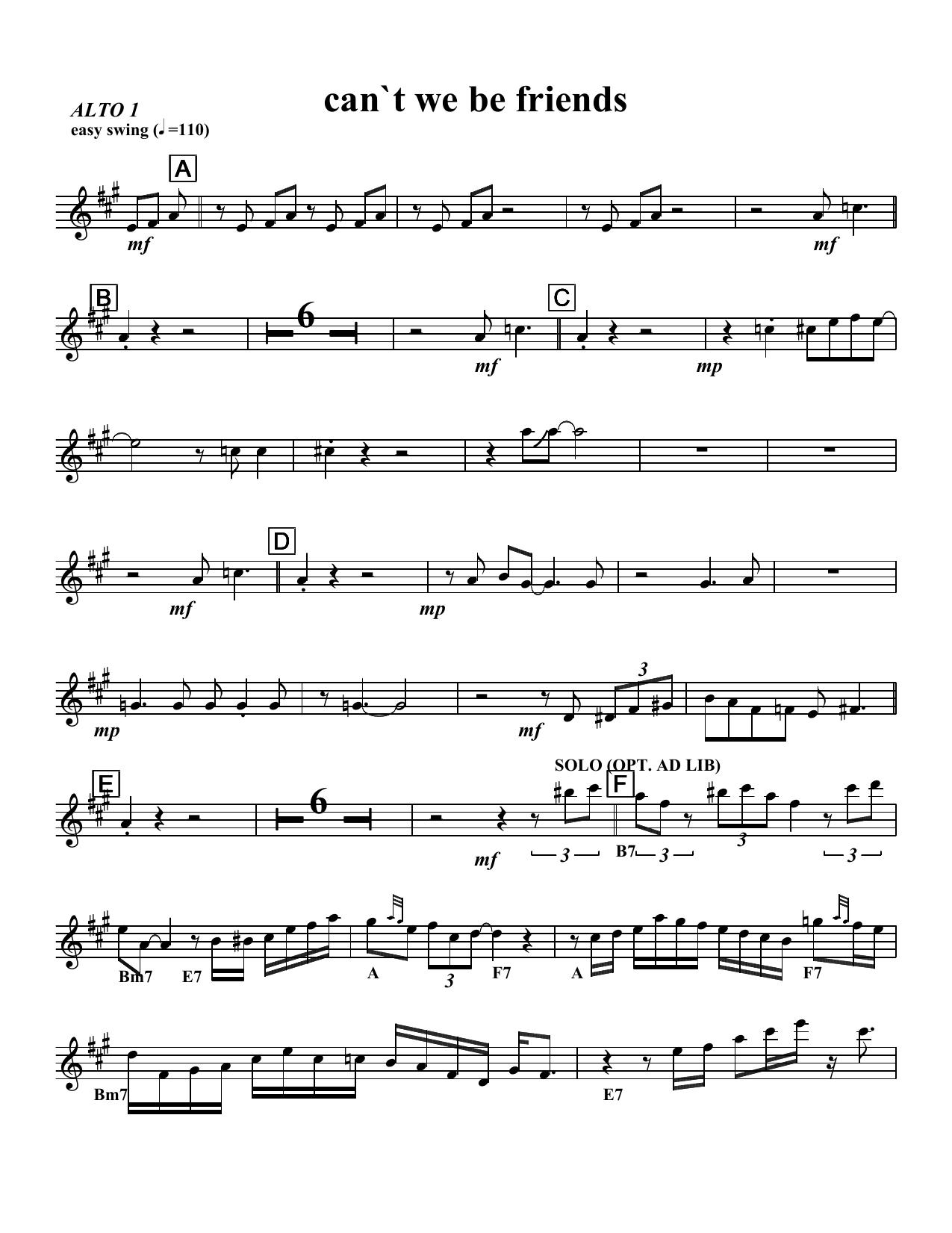
Can't We Be Friends (J.Farley-L.Ronstadt-N.Riddle) sheet music preview

Can't We Be Friends (J.Farley-L.Ronstadt-N.Riddle)

Composed by Kay Swift

Arranged by J.Farley-L.Ronstadt-N.Riddle

  • Ensemble: Big Band Vocal
  • Style: Jazz Standard
  • Pages: 28
  • Instruments (17): Alto Saxophone 1, Alto Saxophone 2, Tenor Saxophone 1, Tenor Saxophone 2, Baritone Saxophone, Trumpet 1, Trumpet 2, Trumpet 3, Trumpet 4, Trombone 1, Trombone 2, Trombone 3, Trombone 4, Piano, Guitar, Bass, Drums
  • Difficulty: medium
  • Content: Individual Parts
  • Format: PDF Download (Instant)
  • Price: $24.99

"Can't We Be Friends," a timeless American standard, was composed by Kay Swift with lyrics by Paul James (a pseudonym for her husband, James Warburg) and first introduced in the 1929 Broadway revue "The Little Show." Emerging from the sophisticated era of Tin Pan Alley and early Broadway, this ballad quickly became a favorite for its poignant melody and introspective lyrics, exploring themes of unrequited love and friendship. While many notable vocalists have interpreted the song over the decades, its enduring popularity as a jazz standard was solidified through iconic recordings by artists like Frank Sinatra, Ella Fitzgerald, and most famously, Linda Ronstadt with Nelson Riddle, whose 1983 collaboration on the album "What's New" brought a lush, orchestral jazz sensibility to the piece, introducing it to a new generation. This arrangement specifically draws inspiration from that celebrated Ronstadt-Riddle partnership, infusing the classic big band sound with a vocal feature that captures its emotional depth. This particular arrangement of "Can't We Be Friends" is presented in a medium-slow ballad tempo, typically around 72-80 BPM, establishing a reflective and tender mood from the outset. Set primarily in the key of C Major, it maintains a gentle swing feel, allowing the vocal line to float gracefully over a rich harmonic landscape. The musical character is one of understated elegance and heartfelt melancholy, evoking the classic, smoky atmosphere of a sophisticated jazz club. The arrangement prioritizes clarity and warmth, with carefully crafted voicings that support the vocalist without overpowering them, creating a cohesive and emotionally resonant sound. The arranger's approach, credited to J.Farley-L.Ronstadt-N.Riddle, is a meticulous homage to the lush, orchestral jazz style perfected by Nelson Riddle. Expect sophisticated, often dense, voicings in the brass and sax sections, creating a plush bed for the vocal. There are no aggressive shout choruses or extended, complex soli passages; instead, the focus is on seamless transitions and a flowing ensemble sound. Riddle's signature use of woodwind doublings and carefully placed counter-melodies within the brass provide textural depth. The arrangement features the vocal throughout, with the ensemble providing nuanced accompaniment, building subtly in intensity before receding to allow the vocal to shine. A notable feature is the carefully constructed instrumental interlude, offering a moment of rich, melodic development before returning to the vocal. Performance of this arrangement is rewarding for its expressive potential. The vocal carries the melody for the majority of the piece, requiring a vocalist with strong interpretive skills and excellent breath control to navigate the ballad tempo. While there are no improvised solos, the instrumentalists are challenged to blend precisely and maintain a consistent, warm tone, particularly in the sustained chords and delicate counter-lines. The brass sections will need to execute soft, controlled entrances and releases, while the saxophones are often called upon to provide a smooth, flowing legato. The rhythm section is crucial for establishing and maintaining the gentle swing feel, requiring sensitivity and dynamic control. This arrangement is ideally suited for college, community, and professional big bands that possess a strong vocalist and appreciate the nuanced artistry of classic orchestral jazz. It offers an excellent opportunity to focus on ensemble blend, dynamic shaping, and emotional delivery, making it a standout piece for any concert program. This arrangement of "Can't We Be Friends" demands a refined approach to dynamics and blend. Maintain a consistent medium-slow ballad tempo (approx. 72-80 BPM) with a gentle, flowing swing feel, ensuring the rhythm section provides a solid, yet unobtrusive, foundation. The primary technical challenge lies in achieving precise balance and intonation within the rich, often close, voicings, particularly in the brass and saxophones. Encourage brass players to use a warm, broad tone, avoiding harsh attacks, and to articulate sustained chords with a unified release. Saxophones should focus on legato phrasing and seamless transitions between notes. There are no special mute techniques required beyond standard straight mutes for brass for specific dynamic control. Rehearsal time should heavily focus on the ensemble supporting the vocalist, ensuring the instrumental parts never overshadow the vocal line. Pay close attention to dynamic swells and decays, particularly in the instrumental interlude, to build and release tension effectively. Q: What instruments and parts are included in this arrangement? A: This big band vocal arrangement includes parts for a standard big band instrumentation: 5 saxophones (AATTB), 4 trumpets, 4 trombones, piano, bass, drums, and a dedicated vocal lead sheet. Q: What is the difficulty level of this arrangement? A: This arrangement is rated as Medium-Advanced. It requires a strong vocalist with excellent interpretive skills and a big band capable of precise ensemble blend, nuanced dynamics, and solid intonation, making it suitable for college, community, and professional ensembles. Q: What musical style and historical context does this arrangement represent? A: This arrangement is a classic jazz standard ballad, drawing heavily from the sophisticated orchestral jazz style popularized by Nelson Riddle, particularly his work with Linda Ronstadt in the early 1980s. It embodies the elegance and emotional depth of the Great American Songbook. Q: What makes this specific arrangement unique compared to other versions of "Can't We Be Friends"? A: This arrangement is a faithful homage to the iconic J.Farley-L.Ronstadt-N.Riddle collaboration, featuring lush, detailed voicings and a focus on supporting the vocal with a rich, orchestral big band sound, rather than emphasizing extended instrumental solos or aggressive ensemble passages. Q: What is the approximate performance duration and tempo for this piece? A: The approximate performance duration for this arrangement is 4-5 minutes, depending on the vocalist's interpretation. It is designed to be performed at a medium-slow ballad tempo, typically around 72-80 beats per minute, with a gentle swing feel.

Questions and answers

What is included in the Can't We Be Friends (J.Farley-L.Ronstadt-N.Riddle) PDF?
The verified current file contains individual parts across 28 pages.
How many instruments or parts are listed for Can't We Be Friends (J.Farley-L.Ronstadt-N.Riddle)?
The verified instrumentation list contains 17 entries for this Big Band Vocal arrangement.
Who is credited for Can't We Be Friends (J.Farley-L.Ronstadt-N.Riddle)?
Composer: Kay Swift. Arranger: J.Farley-L.Ronstadt-N.Riddle.
What difficulty is listed for Can't We Be Friends (J.Farley-L.Ronstadt-N.Riddle)?
The verified difficulty level is medium.
What style is listed for Can't We Be Friends (J.Farley-L.Ronstadt-N.Riddle)?
The catalog lists the style as Jazz Standard.
Can I preview Can't We Be Friends (J.Farley-L.Ronstadt-N.Riddle) before buying?
Yes. The product page provides a preview generated from the current PDF file.
How is Can't We Be Friends (J.Farley-L.Ronstadt-N.Riddle) delivered?
After successful payment, the digital PDF is made available for download. The displayed price is $24.99.

Musicians Also Search For

Can't We Be Friends J.Farley-L.Ronstadt-N.Riddle PDFCan't We Be Friends J.Farley-L.Ronstadt-N.Riddle sheet musicCan't We Be Friends arranged by J.Farley-L.Ronstadt-N.RiddleJ.Farley-L.Ronstadt-N.Riddle big band vocal chartsJ.Farley-L.Ronstadt-N.Riddle jazz arrangements PDFCan't We Be Friends Kay Swift sheet musicCan't We Be Friends Kay Swift big band vocal arrangementsKay Swift big band vocal chartsCan't We Be Friends big band vocal arrangementsCan't We Be Friends big band vocal PDF downloadCan't We Be Friends jazz sheet musicbig band vocal sheet music downloadCan't We Be Friends individual parts downloadCan't We Be Friends sheet music PDFCan't We Be Friends Jazz Standard chartsJazz Standard big band vocal arrangementsbuy Can't We Be Friends sheet musicdownload Can't We Be Friends PDFCan't We Be Friends jazz chartsbest J.Farley-L.Ronstadt-N.Riddle big band vocal arrangementsKay Swift arranged by J.Farley-L.Ronstadt-N.RiddleCan't We Be Friends printable sheet musicbig band vocal repertoire PDF

All arrangements by J.Farley-L.Ronstadt-N.Riddle All Kay Swift sheet music