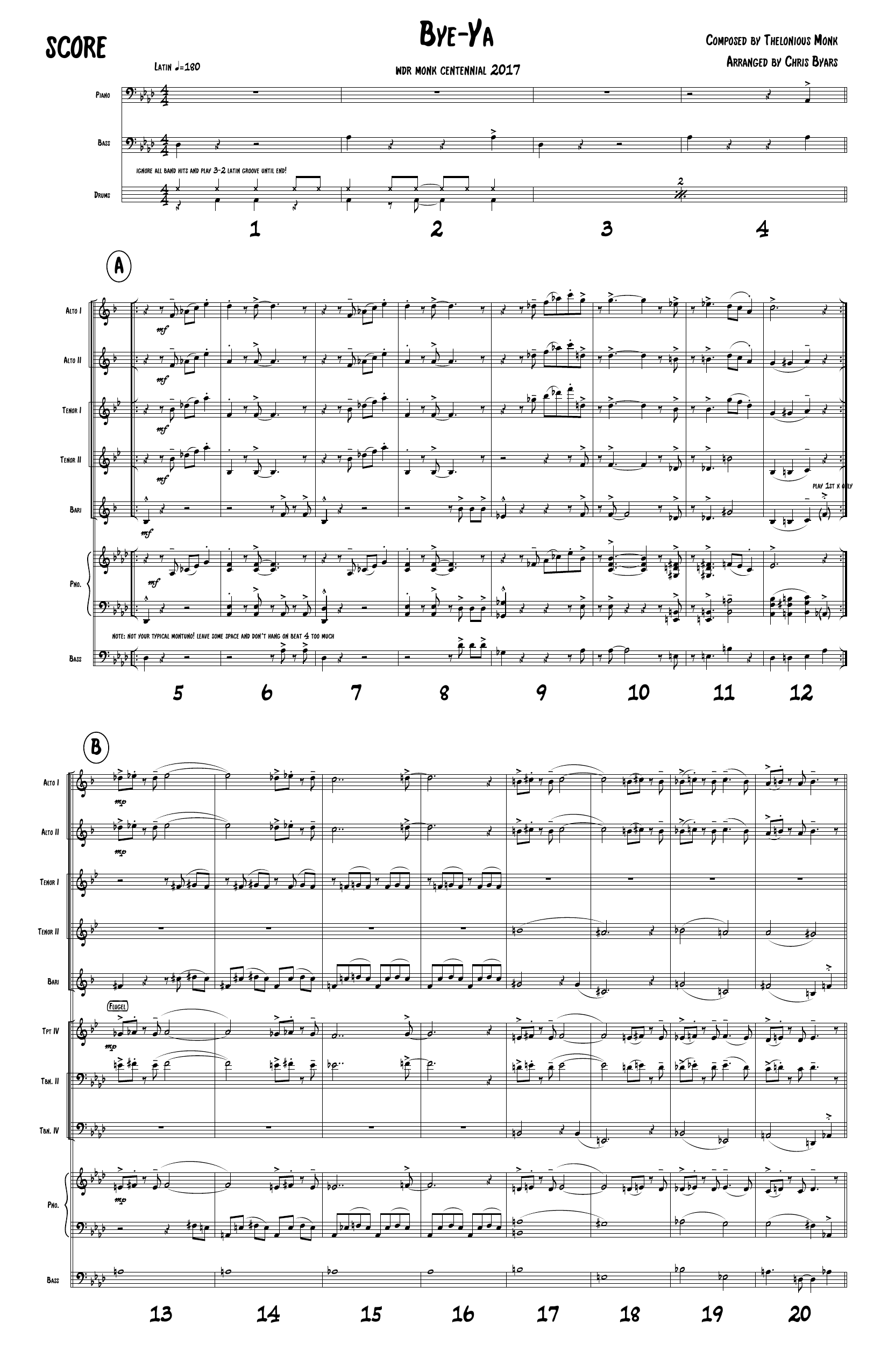
Bye-Ya (C.Byars)
Composed by Thelonious Monk
Arranged by Thelonious Monk (arr.C.Byars)
- Ensemble: Big Band
- Pages: 16
- Instruments (18): Alto Saxophone I, Alto Saxophone II, Tenor Saxophone I, Tenor Saxophone II, Baritone Saxophone, Trumpet I, Trumpet II, Trumpet III, Trumpet IV, Trumpet V, Trombone I, Trombone II, Trombone III, Trombone IV, Guitar, Piano, Bass, Drums
- Difficulty: easy
- Content: Individual Parts
- Format: PDF Download (Instant)
- Price: $24.99
Thelonious Monk’s angular masterpiece "Bye-Ya," first recorded for Columbia Records in 1952 on the landmark album *Straight, No Chaser*, stands as one of the composer’s most rhythmically intricate and infectious contributions to the bebop and hard bop canon. Built upon a distinctive Latin-tinged habanera-style groove colliding head-on with classic jazz swing, "Bye-Ya" eschews standard chord progression clichés in favor of Monk’s signature dissonances, chromatic displacement, and stark, motivic economy. This sophisticated big band adaptation by C. Byars translates Monk's idiosyncratic piano conception into a powerhouse small-ensemble big band format, capturing the quirky charm and relentless forward momentum of the original recording while offering a fresh, modern architectural framework for horns. Driven by an assertive, bouncing medium-tempo swing feel underscored by subtle Latin rhythmic undercurrents, the arrangement opens with the unmistakable, jagged thematic motif shared between the horns. The emotional landscape is playful yet intellectually demanding, radiating a cool, urban sophistication that requires absolute rhythmic precision from every player. Byars utilizes tight, modern harmonic voicings that preserve Monk's characteristic cluster chords and minor-second rubs, avoiding the temptation to "smooth out" the composer's idiosyncratic edges. Instead, the chart leans heavily into the tension, creating an atmosphere of joyful unpredictability where unexpected accents and staggered syncopations keep both performers and listeners perpetually on edge. The arrangement is masterfully tailored for a nimble seven-piece instrumentation—featuring Alto Saxophone, Tenor Saxophone, Trumpet, Trombone, Piano, Bass, and Drums—spanning a comprehensive 16-page score and part set. The melodic heavy lifting is distributed deftly between the alto and tenor saxophones, often locking in tight counterpoint before expanding into punchy, harmonized horn solis that evoke the spirit of a classic mid-century jazz workshop. Solo sections provide ample space for creative improvisation over Monk's labyrinthine form, challenging soloists to navigate the shifting tonal centers with thematic coherence rather than mere scale-running. The rhythm section acts as the crucial anchor, with the piano expected to comp with sparse, percussive authority in the true Monkish tradition while the drums maintain the vital tension between straight-eighth Latin feels and driving swing. Advanced high school, collegiate, and professional jazz ensembles will find this chart an immensely rewarding addition to their repertoire. Because of its reliance on tight ensemble interplay, angular phrasing, and advanced rhythmic independence—particularly regarding off-beat accents and polymetric phrasing—it serves as an exceptional vehicle for developing stylistic literacy in modern jazz. Ensembles looking to stretch beyond standard swing-era arrangements will discover that C. Byars's treatment of "Bye-Ya" offers a masterclass in translating piano-driven bebop into a lean, hard-hitting contemporary chamber-jazz format. Unlocking the authentic spirit of this arrangement requires treating every syncopation with razor-sharp articulation and deep rhythmic conviction. The tempo should remain steady at a comfortable medium swing, allowing the underlying Latin-inflected pulse to breathe without rushing the aggressive bebop figures. A primary technical challenge lies in the execution of Monk’s angular intervals; horn players must practice their lines slowly to ensure clean voice-leading through the dissonant harmonies without overblowing the accents. Conductors should pay close attention to the rhythm section, instructing the pianist to avoid heavy left-hand comping in favor of Monk-esque stabs and spatial awareness. Drummers must balance the tension between the backbeat and the implicit habanera groove, keeping the ride cymbal crisp and the cross-stick patterns articulate. Rehearsals should begin section by section, isolating the tricky unison lines before integrating the rhythm section to lock in the elusive, playful pocket that defines this timeless composition. Q: What instruments and parts are included in this arrangement? A: This arrangement is scored for a 7-instrument ensemble consisting of Alto Saxophone, Tenor Saxophone, Trumpet, Trombone, Piano, Bass, and Drums, complete with a 16-page comprehensive score and individual performance parts. Q: What is the difficulty level of this chart? A: It is designed for advanced high school, collegiate, and professional ensembles, primarily due to its intricate angular melodies, modern dissonant harmonies, and demanding rhythmic syncopation. Q: What style and historical era does this piece represent? A: The piece is rooted in the 1952 bebop and hard bop era pioneered by Thelonious Monk, uniquely blending a Latin habanera-style groove with traditional medium-tempo jazz swing. Q: What makes this specific arrangement by C. Byars unique? A: It successfully scales down the dense, idiosyncratic piano voicings of Monk's original recording into a lean, punchy 7-piece format without sacrificing any of the composer's signature harmonic tension or quirky angularity. Q: What is the recommended performance tempo and duration? A: The chart is designed to be played at a comfortable, driving medium swing tempo (approx. Quarter Note = 120-132 BPM), resulting in a performance duration of approximately 4 to 5 minutes depending on solo choruses.
Questions and answers
- What is included in the Bye-Ya (C.Byars) PDF?
- The verified current file contains a conductor score across 16 pages.
- How many instruments or parts are listed for Bye-Ya (C.Byars)?
- The verified instrumentation list contains 18 entries for this Big Band arrangement.
- Who is credited for Bye-Ya (C.Byars)?
- Composer: Thelonious Monk. Arranger: Thelonious Monk (arr.C.Byars).
- What difficulty is listed for Bye-Ya (C.Byars)?
- The verified difficulty level is easy.
- Can I preview Bye-Ya (C.Byars) before buying?
- Yes. The product page provides a preview generated from the current PDF file.
- How is Bye-Ya (C.Byars) delivered?
- After successful payment, the digital PDF is made available for download. The displayed price is $24.99.
Musicians Also Search For
Bye-Ya Thelonious Monk (arr.C.Byars) PDF • Bye-Ya Thelonious Monk (arr.C.Byars) sheet music • Bye-Ya arranged by Thelonious Monk (arr.C.Byars) • Thelonious Monk (arr.C.Byars) big band charts • Thelonious Monk (arr.C.Byars) jazz arrangements PDF • Bye-Ya Thelonious Monk sheet music • Bye-Ya Thelonious Monk big band arrangements • Thelonious Monk big band charts • Bye-Ya big band arrangements • Bye-Ya big band PDF download • Bye-Ya jazz sheet music • big band sheet music download • Bye-Ya conductor score PDF • Bye-Ya sheet music PDF • buy Bye-Ya sheet music • download Bye-Ya PDF • Bye-Ya jazz charts • best Thelonious Monk (arr.C.Byars) big band arrangements • Thelonious Monk arranged by Thelonious Monk (arr.C.Byars) • Bye-Ya printable sheet music • big band repertoire PDF