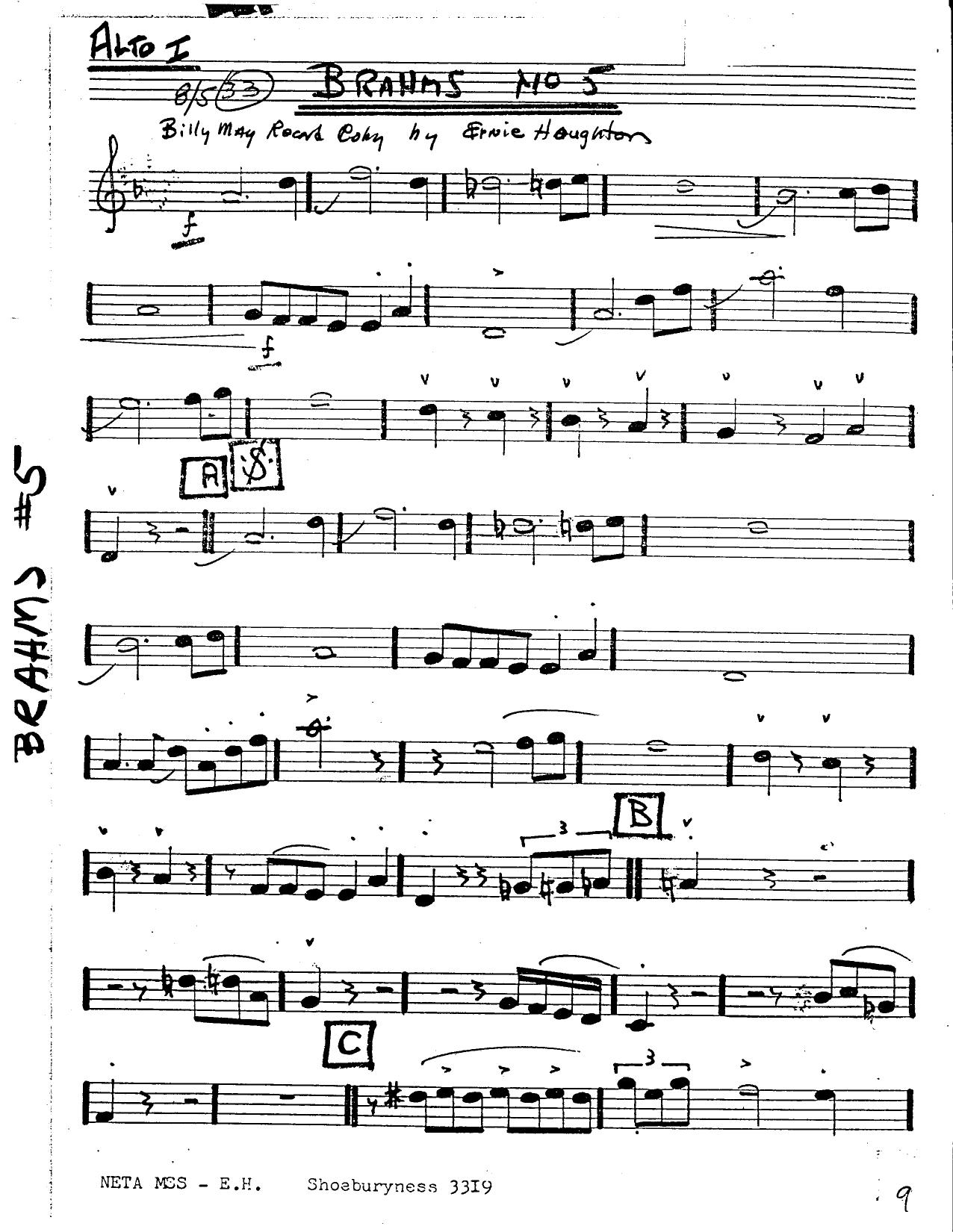
Brahm's No 5 Dance (B.May)
Composed by Johannes Brahms
Arranged by Billy May
- Ensemble: Big Band
- Pages: 30
- Instruments (17): Alto Saxophone I, Alto Saxophone II, Tenor Saxophone I, Tenor Saxophone II, Baritone Saxophone, Trumpet I, Trumpet II, Trumpet III, Trumpet IV, Trombone I, Trombone II, Trombone III, Trombone IV, Piano, Guitar, Bass, Drums
- Difficulty: medium
- Content: Individual Parts
- Format: PDF Download (Instant)
- Price: $24.99
Johannes Brahms’ legendary *Hungarian Dances* have crossed genre boundaries for well over a century, but few treatments are as exhilarating or brilliantly conceived as the jazz big band interpretation crafted by master arranger Billy May. Originally published as part of May’s celebrated mid-century library, this setting reimagines Brahms’ fifth and most famous Hungarian dance through a high-octane, swinging lens that fuses 19th-century Romantic nationalism with the explosive energy of Capitol Records-era swing. Billy May, renowned for his innovative use of "luminescence" sax voicings, slurred brass effects, and driving, relentless forward momentum, takes the familiar gypsy-infused thematic material and treats it with both virtuosic respect and biting wit. Operating at a brisk, driving tempo, the arrangement opens with the unmistakable galloping motif recast in a snappy, syncopated 4/4 swing feel. The harmonic landscape shifts dynamically between the minor urgency of the original themes and rich, extended major-mode resolutions typical of advanced big band writing. May utilizes the ensemble's 9-instrument configuration with astonishing economy and brilliance, ensuring that every voice—from the searing lead trumpet to the anchoring baritone saxophone—carries substantial weight. The reeds handle lightning-fast, classically-inspired scalar passages that have been swung to perfection, while the brass interject with punchy, aggressive stabs and signature May-esque plunger effects that inject a vibrant, theatrical personality into the performance. Throughout the chart, the melody is passed seamlessly between the saxophone section and the upper brass, creating a vibrant texture that never feels thin despite the compact 9-piece instrumentation. A standout feature of the arrangement is its clever use of tempo rubato combined with sudden, explosive re-entries into strict swing time, mimicking the traditional gypsy performance practice of *gyors* and *lassú* (fast and slow sections) within a modern jazz framework. Featured solo space allows frontline horn players to stretch out over driving rhythm section changes, building high-energy tension that resolves into a thunderous, tightly-knit shout chorus. This climactic section showcases complex polyrhythms and soaring high-note writing that demands absolute precision and stamina from the brass section. Advanced high school, collegiate, and professional jazz ensembles will find this 30-page arrangement to be an exceptional vehicle for showcasing technical agility, stylistic versatility, and comedic timing. Because of the sophisticated interplay between classical counterpoint and swing articulation, it serves as an extraordinary masterclass in stylistic contrast. Performing this piece rewards bands that possess crisp articulation, acute dynamic awareness, and a deep appreciation for the crossover brilliance of the golden era of big band arranging. Conductors approaching Billy May’s treatment of Brahms must prioritize crisp articulation and a relentless, driving swing feel. The tempo should be kept brisk and buoyant, avoiding any tendency to drag during the dense scalar passages in the woodwinds. The primary technical challenge lies in balancing the classical-derived velocity of the written lines with a relaxed jazz phrasing. Saxophones must execute fast unison passages with absolute lightness, ensuring that sixteenth-note runs remain clean and unaccented on the weaker beats. Brass players should master the required stylistic colorations—including half-valve effects, gentle scoops, and subtle plunger work—without sacrificing core tone quality or intonation. Rehearsal should begin at a reduced tempo, isolating the dynamic shifts between the lyrical, rubato-esque interludes and the explosive swing breaks. Pay close attention to the rhythm section: the drummer should drive the ensemble with a crisp ride cymbal pattern that honors the underlying gypsy dance pulse while maintaining a solid 4/4 jazz groove. Balance is crucial; because of the compact 9-instrument scoring, inner voices must project clearly to articulate May's clever harmonic inner movements against the bold primary melodies. Q: What instruments and parts are included in this 9-instrument arrangement? A: The instrumentation features a 9-piece big band lineup comprising Alto Saxophone, Tenor Saxophone, Baritone Saxophone, Trumpet, Trombone, and a complete rhythm section, spanning a comprehensive 30-page score and part set. Q: What is the difficulty level of this Billy May arrangement? A: This arrangement is best suited for advanced high school, collegiate, and professional jazz ensembles due to its fast tempos, intricate scalar woodwind passages, and demands for precise articulation and stamina. Q: What is the musical style and historical context of this piece? A: It is a high-energy jazz big band adaptation of Johannes Brahms' famous *Hungarian Dance No. 5*, merging 19th-century Romantic classical themes with the witty, brass-heavy swing style pioneered by arranger Billy May in the mid-20th century. Q: What makes this specific arrangement unique within big band literature? A: It uniquely bridges European classical nationalism and American swing by applying Billy May's signature arranging techniques—such as slurred brass effects, dynamic rubato transitions, and clever harmonic reharmonizations—to familiar classical motifs. Q: What is the approximate performance duration and tempo feel of the piece? A: The arrangement is performed at a brisk, driving tempo with an energetic swing feel, typically lasting around 3 to 4 minutes depending on the chosen tempo and improvised solo choruses.
Questions and answers
- What is included in the Brahm's No 5 Dance (B.May) PDF?
- The verified current file contains individual parts across 30 pages.
- How many instruments or parts are listed for Brahm's No 5 Dance (B.May)?
- The verified instrumentation list contains 17 entries for this Big Band arrangement.
- Who is credited for Brahm's No 5 Dance (B.May)?
- Composer: Johannes Brahms. Arranger: Billy May.
- What difficulty is listed for Brahm's No 5 Dance (B.May)?
- The verified difficulty level is medium.
- Can I preview Brahm's No 5 Dance (B.May) before buying?
- Yes. The product page provides a preview generated from the current PDF file.
- How is Brahm's No 5 Dance (B.May) delivered?
- After successful payment, the digital PDF is made available for download. The displayed price is $24.99.
Musicians Also Search For
Brahm's No 5 Dance Billy May PDF • Brahm's No 5 Dance Billy May sheet music • Brahm's No 5 Dance arranged by Billy May • Billy May big band charts • Billy May jazz arrangements PDF • Brahm's No 5 Dance Johannes Brahms sheet music • Brahm's No 5 Dance Johannes Brahms big band arrangements • Johannes Brahms big band charts • Brahm's No 5 Dance big band arrangements • Brahm's No 5 Dance big band PDF download • Brahm's No 5 Dance jazz sheet music • big band sheet music download • Brahm's No 5 Dance individual parts download • Brahm's No 5 Dance sheet music PDF • buy Brahm's No 5 Dance sheet music • download Brahm's No 5 Dance PDF • Brahm's No 5 Dance jazz charts • best Billy May big band arrangements • Johannes Brahms arranged by Billy May • Brahm's No 5 Dance printable sheet music • big band repertoire PDF