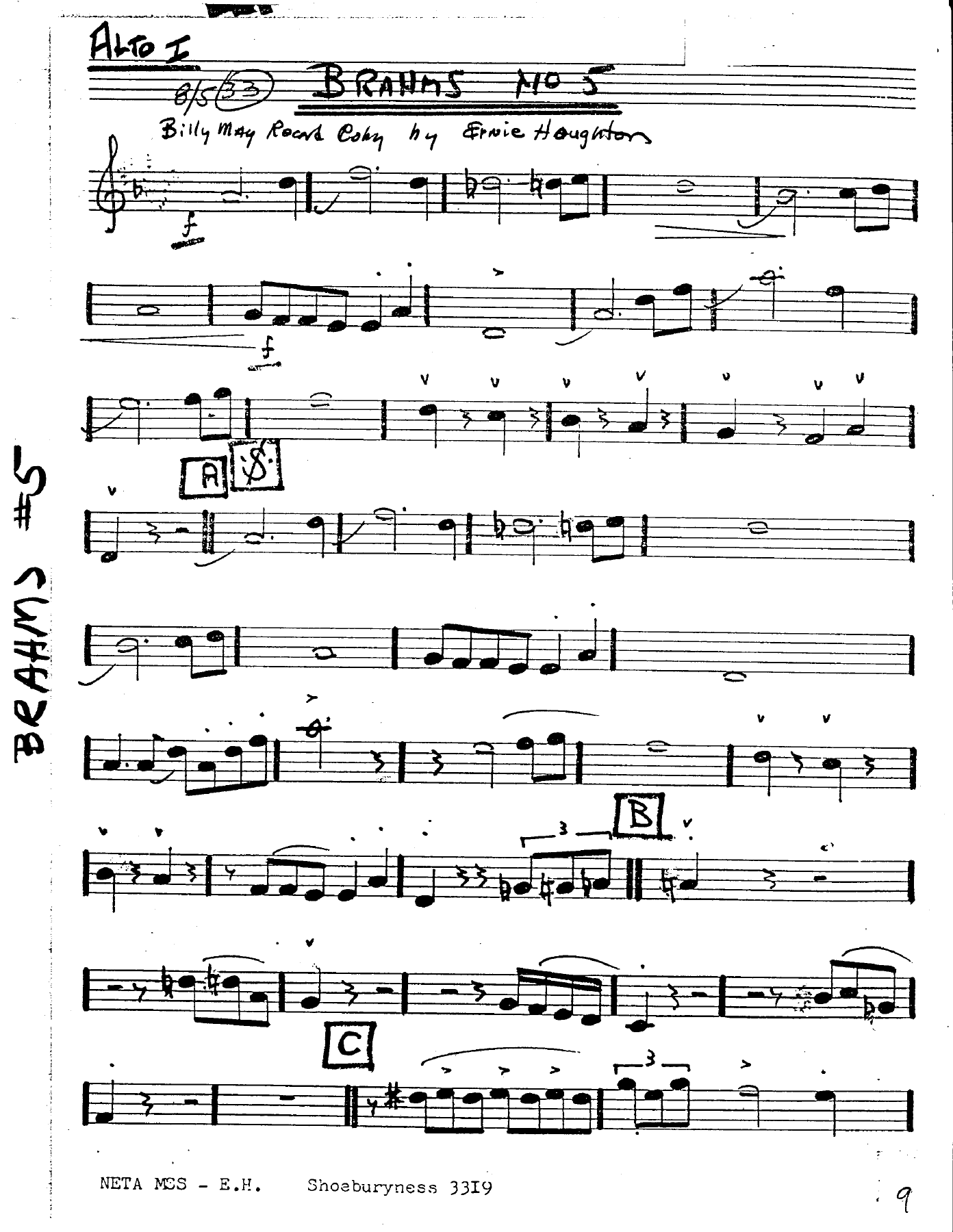
Brahm's No 5 Dance (B.May)
Composed by Johannes Brahms
Arranged by B.May
- Ensemble: Big Band
- Style: Jazz Standard
- Pages: 30
- Instruments (17): Alto Saxophone I, Alto Saxophone II, Tenor Saxophone I, Tenor Saxophone II, Baritone Saxophone, Trumpet I, Trumpet II, Trumpet III, Trumpet IV, Trombone I, Trombone II, Trombone III, Trombone IV, Piano, Guitar, Bass, Drums
- Difficulty: medium
- Content: Individual Parts
- Format: PDF Download (Instant)
- Price: $24.99
Johannes Brahms's Hungarian Dances, originally composed for piano four-hands between 1869 and 1880, stand as iconic examples of 19th-century Romantic nationalism, weaving folk melodies and rhythms into a classical framework. Among these, Hungarian Dance No. 5 in G minor is arguably the most recognizable, its fiery, melancholic, and ultimately exhilarating themes having captivated audiences for over a century. While not a jazz standard in its original form, its enduring melodic strength and rhythmic vitality have made it a fertile ground for reinterpretation across diverse genres. This particular arrangement by B.May reimagines Brahms's impassioned work through the lens of a contemporary jazz big band, transforming its classical essence into a vibrant, swinging narrative that speaks to both tradition and innovation. B.May's "Brahms No 5 Dance" is an exhilarating up-tempo swing arrangement, primarily in 4/4 time, that maintains the original's dramatic flair while infusing it with a distinct jazz sensibility. The piece opens with a driving, energetic feel, establishing a bright, optimistic mood that contrasts with the original's initial brooding character. The arrangement skillfully navigates through various sections, from powerful full-ensemble statements to intricate soli passages, creating a dynamic soundscape. The primary key is G minor, but B.May employs sophisticated harmonic extensions and reharmonizations typical of modern jazz, adding layers of color and tension that resolve with satisfying clarity. The overall energy is infectious, designed to evoke excitement and showcase the band's collective virtuosity. B.May's distinctive arranging approach is evident throughout this treatment. Rather than merely orchestrating the original, B.May deconstructs and reconstructs Brahms's themes, utilizing complex voicings that are rich in jazz harmony, featuring tight, often dissonant, clusters that resolve beautifully. The melody is initially carried by the alto saxophone 1, before being passed to various sections, including a powerful brass soli and a saxophone soli that demands precision and blend. A standout feature is the meticulously crafted shout chorus, which builds in intensity, culminating in a powerful climax that combines intricate counterpoint with a driving rhythmic pulse. B.May frequently employs sudden dynamic shifts and rhythmic displacements, injecting a sense of spontaneity and surprise while maintaining structural integrity. The arrangement also features an extended improvised solo section for tenor saxophone 1, providing an opportunity for individual expression over a sophisticated harmonic progression derived from Brahms's original material. Performing "Brahms No 5 Dance" is a rewarding challenge for a well-rehearsed college, community, or professional big band. The technical demands are considerable, particularly in the fast-paced saxophone soli and the intricate brass lines, requiring excellent articulation, breath control, and ensemble precision. The rhythm section must maintain a relentless, driving swing feel throughout, providing a solid foundation for the complex horn lines. The piece's dynamic contrasts and stylistic nuances require careful attention from the conductor and musicians to fully realize B.May's vision. Successfully navigating its blend of classical grandeur and jazz improvisation offers a profound sense of accomplishment, making it a spectacular concert opener or closer that will captivate audiences with its unique fusion of styles. This arrangement demands a high level of precision and energy from all sections. The primary technical challenge lies in maintaining a consistent, driving up-tempo swing feel while executing the intricate articulations and complex rhythms, particularly within the saxophone and brass soli sections. Conductors should emphasize rhythmic accuracy and unified phrasing, especially in the fast sixteenth-note passages. The improvised tenor saxophone solo should be encouraged to explore the harmonic richness of the underlying changes, which are rooted in Brahms's original but reharmonized for a contemporary jazz context. Dynamic contrasts are crucial; ensure the band observes the sudden shifts from forte to piano and the gradual crescendos to build tension effectively. Rehearsal time should focus on sectional work for the soli passages, followed by careful blending and balancing within the full ensemble. Pay close attention to the brass attacks and releases, aiming for crisp, unified sounds. Q: What instruments and parts are included in this arrangement? A: This arrangement is scored for a standard 17-instrument big band, including Alto Saxophone 1 & 2, Tenor Saxophone 1 & 2, Baritone Saxophone, Trumpet 1, 2, 3 & 4, Trombone 1, 2, 3 & 4, Piano, Bass, Drums, and Guitar. Q: What is the difficulty level of "Brahms No 5 Dance (B.May)"? A: This arrangement is considered advanced, suitable for college, community, or professional big bands. It features challenging technical passages, complex harmonies, and requires a strong command of up-tempo swing style. Q: What is the musical style and historical context of this arrangement? A: This arrangement reimagines Johannes Brahms's classical "Hungarian Dance No. 5" as an up-tempo jazz big band piece. It blends the melodic and thematic elements of the 19th-century Romantic original with modern jazz harmonies and a driving swing feel. Q: What makes B.May's arrangement of "Brahms No 5 Dance" unique? A: B.May's arrangement is unique for its sophisticated reharmonization of Brahms's original themes, intricate voicings, dynamic shout chorus, and the seamless integration of classical motifs into a contemporary jazz big band setting, creating a fresh and exciting interpretation. Q: What is the approximate performance duration and tempo of this piece? A: The approximate performance duration for "Brahms No 5 Dance (B.May)" is around 4-5 minutes, depending on the length of the improvised solo. It is an up-tempo swing piece, typically performed at a brisk tempo around ♩=180-200 BPM.
Questions and answers
- What is included in the Brahm's No 5 Dance (B.May) PDF?
- The verified current file contains individual parts across 30 pages.
- How many instruments or parts are listed for Brahm's No 5 Dance (B.May)?
- The verified instrumentation list contains 17 entries for this Big Band arrangement.
- Who is credited for Brahm's No 5 Dance (B.May)?
- Composer: Johannes Brahms. Arranger: B.May.
- What difficulty is listed for Brahm's No 5 Dance (B.May)?
- The verified difficulty level is medium.
- What style is listed for Brahm's No 5 Dance (B.May)?
- The catalog lists the style as Jazz Standard.
- Can I preview Brahm's No 5 Dance (B.May) before buying?
- Yes. The product page provides a preview generated from the current PDF file.
- How is Brahm's No 5 Dance (B.May) delivered?
- After successful payment, the digital PDF is made available for download. The displayed price is $24.99.
Musicians Also Search For
Brahm's No 5 Dance B.May PDF • Brahm's No 5 Dance B.May sheet music • Brahm's No 5 Dance arranged by B.May • B.May big band charts • B.May jazz arrangements PDF • Brahm's No 5 Dance Johannes Brahms sheet music • Brahm's No 5 Dance Johannes Brahms big band arrangements • Johannes Brahms big band charts • Brahm's No 5 Dance big band arrangements • Brahm's No 5 Dance big band PDF download • Brahm's No 5 Dance jazz sheet music • big band sheet music download • Brahm's No 5 Dance individual parts download • Brahm's No 5 Dance sheet music PDF • Brahm's No 5 Dance Jazz Standard charts • Jazz Standard big band arrangements • buy Brahm's No 5 Dance sheet music • download Brahm's No 5 Dance PDF • Brahm's No 5 Dance jazz charts • best B.May big band arrangements • Johannes Brahms arranged by B.May • Brahm's No 5 Dance printable sheet music • big band repertoire PDF