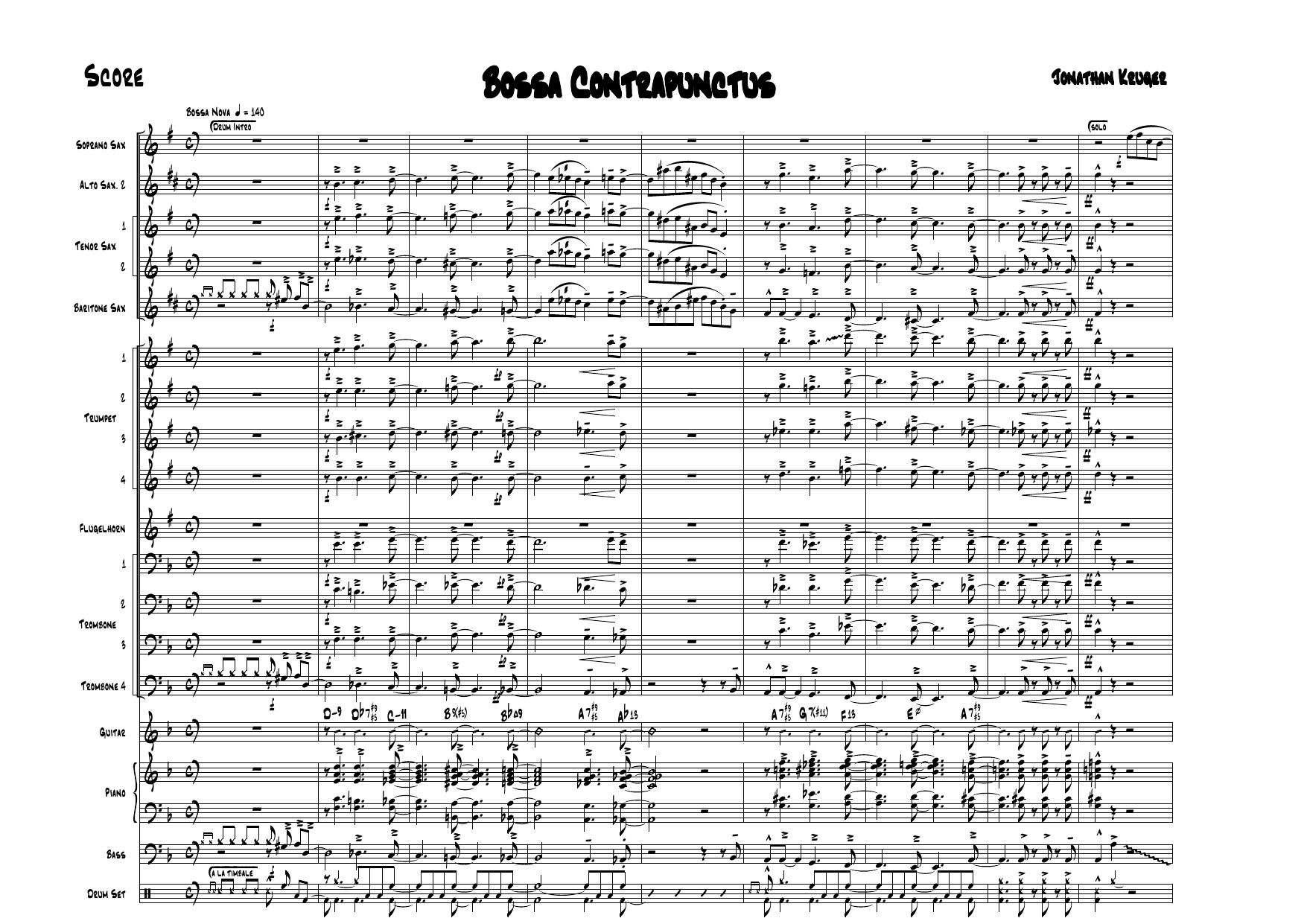
Bossa Contrapunctus (J.Kruger)
Composed by J. Kruger
Arranged by J.Kruger
- Ensemble: Big Band
- Pages: 63
- Instruments (18): Soprano Sax, Alto Sax 2, Tenor Sax 1, Tenor Sax 2, Baritone Sax, Trumpet 1, Trumpet 2, Trumpet 3, Trumpet 4, Flugelhorn, Trombone 1, Trombone 2, Trombone 3, Trombone 4, Guitar, Piano, Bass, Drum Set
- Difficulty: advanced
- Content: Individual Parts
- Format: PDF Download (Instant)
- Price: $24.99
Bridging the timeless structural rigor of Baroque counterpoint with the sultry, syncopated warmth of modern Latin jazz, "Bossa Contrapunctus" reimagines classical polyphony through an inventive bossa nova lens. While traditional contrapuntal forms trace their lineage back centuries to masterworks of European art music, this unique fusion reimagines independent melodic voices as an interconnected horn conversation, propelled by the effortless, undulating groove pioneered by Antônio Carlos Jobim and João Gilberto in late-1950s Rio de Janeiro. This juxtaposition creates a sophisticated yet highly accessible repertoire piece that honors classical architecture while embracing rich, contemporary jazz harmonic extensions. Flowing at a relaxed yet purposeful medium bossa nova tempo (around 126 BPM), the arrangement opens with a delicate, hypnotic rhythm section vamp establishing the signature nylon-string guitar-style pulse over a lush, extended-chord foundation. The harmonic landscape shifts fluidly between minor-mode tension and sun-drenched major resolutions, evoking an atmosphere of refined introspection blended with tropical elegance. Rather than relying on heavy, driving swing energy, the mood remains cool, breezy, and deeply lyrical, allowing intricate inner lines to weave through the texture without ever sacrificing the infectious, swaying groove required by the style. J.Kruger approaches this unusual synthesis with a masterclass in modern big band orchestration, distributing contrapuntal subject entries democratically across the entire ensemble. Instead of confining the melody to the upper reeds, Kruger treats the 18-instrument instrumentation as a living polyphonic organism; lines pass seamlessly from the soprano and alto saxophones down to the baritone and trombone section, creating shifting layers of counter-melody that demand active listening from every section. The arrangement sidesteps conventional, bombastic shout choruses in favor of a breathtaking, harmonically dense developmental section where voice-leading takes precedence over sheer volume, culminating in a shimmering chordal climax before dissolving back into the gentle opening vamp. Carrying the thematic material requires agile execution, particularly in the saxophone and upper brass sections, where intertwined melodic strands call for clean articulation and precise breath support. Featured solo space allows a featured tenor saxophone or trumpet soloist to stretch out over smooth, modal-leaning bossa changes, supported by sophisticated background pads that echo the main theme's counter-motives. Advanced high school, collegiate, and professional jazz orchestras will find this chart deeply rewarding; it serves as an exceptional pedagogical tool for developing sectional independence and stylistic versatility, while offering audiences a refreshing and intellectually stimulating departure from standard big band literature. The primary technical challenge in "Bossa Contrapunctus" lies in maintaining independent linear momentum while locking tightly with the rhythm section's bossa nova clave feel. Conductors should ensure the underlying eighth-note subdivision remains even and relaxed—avoiding any tendency to swing the straight sixteenths or dotted eighth-sixteenth figures inherent to the style. The rhythm section is the anchor: the drummer should utilize a subtle cross-stick pattern on the rim with a gentle ride cymbal pulse, while the bass player maintains a steady, hypnotic two-bar bossa ostinato without overplaying. Horn players must approach their contrapuntal entrances with a lightweight, vocal articulation, ensuring that secondary and tertiary melodies never obscure the primary voice. Balance is paramount; because the counter-lines are distributed across different sections simultaneously, dynamic markings must be strictly observed, allowing inner voices to bloom naturally through the ensemble texture. No special mutes or extended effects are required, allowing the natural warmth and blend of the acoustic instruments to shine. Q: What instruments and parts are included in this big band arrangement? A: The 63-page complete package includes a full conductor score and individual parts for a standard 18-instrument big band lineup, featuring Soprano Saxophone, Alto Saxophone 2, Tenor Saxophone 1, Tenor Saxophone 2, Baritone Saxophone, plus full brass and rhythm sections. Q: What is the difficulty level of "Bossa Contrapunctus"? A: This arrangement is graded as advanced, making it ideal for high school jazz ensembles looking for a challenge, as well as collegiate and professional bands seeking sophisticated programming material. Q: What is the musical style and historical context of this piece? A: The arrangement blends classical Baroque-style counterpoint with a relaxed, modern bossa nova groove, creating a fresh stylistic bridge between European polyphonic traditions and mid-20th-century Latin jazz. Q: What makes J.Kruger's arrangement unique compared to standard big band charts? A: Kruger uniquely distributes contrapuntal subject entries across the entire 18-piece ensemble rather than focusing solely on traditional lead sections, emphasizing intricate voice-leading and linear independence over conventional shout choruses. Q: What is the performance duration and recommended tempo for this arrangement? A: The piece runs approximately 4 to 5 minutes and is anchored by a relaxed medium bossa nova tempo set around 126 beats per minute.
Questions and answers
- What is included in the Bossa Contrapunctus (J.Kruger) PDF?
- The verified current file contains a conductor score and individual parts across 63 pages.
- How many instruments or parts are listed for Bossa Contrapunctus (J.Kruger)?
- The verified instrumentation list contains 18 entries for this Big Band arrangement.
- Who is credited for Bossa Contrapunctus (J.Kruger)?
- Composer: J. Kruger. Arranger: J.Kruger.
- What difficulty is listed for Bossa Contrapunctus (J.Kruger)?
- The verified difficulty level is advanced.
- Can I preview Bossa Contrapunctus (J.Kruger) before buying?
- Yes. The product page provides a preview generated from the current PDF file.
- How is Bossa Contrapunctus (J.Kruger) delivered?
- After successful payment, the digital PDF is made available for download. The displayed price is $24.99.
Musicians Also Search For
Bossa Contrapunctus J.Kruger PDF • Bossa Contrapunctus J.Kruger sheet music • Bossa Contrapunctus arranged by J.Kruger • J.Kruger big band charts • J.Kruger jazz arrangements PDF • Bossa Contrapunctus J. Kruger sheet music • Bossa Contrapunctus J. Kruger big band arrangements • J. Kruger big band charts • Bossa Contrapunctus big band arrangements • Bossa Contrapunctus big band PDF download • Bossa Contrapunctus jazz sheet music • big band sheet music download • Bossa Contrapunctus conductor score PDF • Bossa Contrapunctus individual parts download • Bossa Contrapunctus sheet music PDF • buy Bossa Contrapunctus sheet music • download Bossa Contrapunctus PDF • Bossa Contrapunctus jazz charts • best J.Kruger big band arrangements • J. Kruger arranged by J.Kruger • Bossa Contrapunctus printable sheet music • big band repertoire PDF