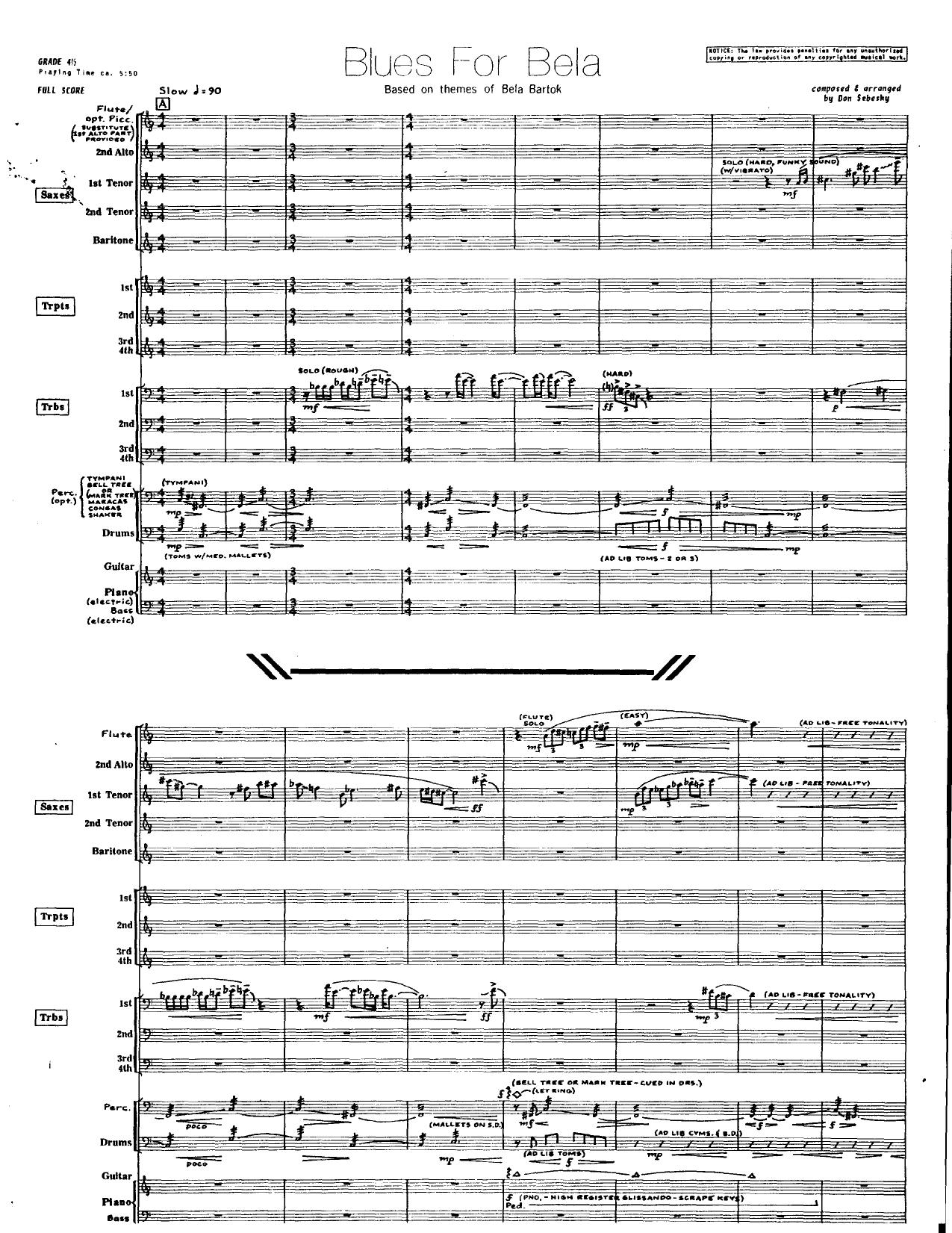
Blues For Bela (D.Sebesky)
Composed by Don Sebesky
Arranged by Don Sebesky
- Ensemble: Big Band
- Pages: 48
- Instruments (18): 1st Eb Alto Sax (substitute for Flute/Piccolo), 2nd Eb Alto Sax, 1st Bb Tenor Sax, 2nd Bb Tenor Sax, Eb Baritone Sax, 1st Bb Trumpet, 2nd Bb Trumpet, 3rd Bb Trumpet, 4th Bb Trumpet, 1st Trombone, 2nd Trombone, 3rd Trombone, 4th Trombone, Electric Piano, Guitar (opt.), Electric Bass, Drums, Percussion (opt.) (Tympani, Bell Tree, Maracas, Congas, Shaker)
- Difficulty: medium
- Content: Individual Parts
- Format: PDF Download (Instant)
- Price: $24.99
Master arranger and composer Don Sebesky brings his legendary sophistication and orchestral depth to the big band canvas with "Blues For Bela," a compelling contemporary jazz work that showcases the intricate harmonic vocabulary and textural brilliance defining his storied career. Conceived in the post-bop era when the traditional boundaries between straight-ahead jazz and lush orchestral arranging were fluidly expanding, this chart reflects Sebesky’s signature penchant for cinematic scope, rich chromatic voicings, and meticulous dynamic control. Known widely for his landmark work with Creed Taylor at CTI Records, Sebesky infuses this composition with the same high-gloss production aesthetic, sophisticated color palettes, and structural integrity that elevated arrangements for jazz royalty like Freddie Hubbard, Wes Montgomery, and Bill Evans. Driven by an infectious, sophisticated groove, "Blues For Bela" operates on a sophisticated medium-up swing framework interspersed with modal explorations and contemporary harmonic shifts. The mood shifts fluidly between understated, cool introspection and high-octane, brass-driven intensity. Sebesky avoids a standard, predictable twelve-bar blues roadmap, instead treating the form as an elastic foundation for expansive melodic statements and shifting textures. The arrangement opens with an atmospheric, tension-building introduction before settling into a confident groove where the ensemble interplay takes center stage. Listeners will experience a masterclass in dynamic contrast, where delicate counterpoint lines weave beneath primary themes, eventually building toward a commanding, multi-layered climax that tests the ensemble's collective stamina and expressive range. Sebesky’s distinctive arranging approach shines through the clever distribution of thematic material across the compact nine-instrument ensemble. Rather than relying on massive wall-of-sound tutti sections, Sebesky utilizes transparent, harmonically rich voicings that allow individual sections—encompassing alto, tenor, and baritone saxophones, trumpet, and trombone—to project with clarity and distinct character. The 48-page manuscript is packed with intricate horn solis, clever metric modulations, and sophisticated chord extensions involving sharp elevenths and altered dominants. Featured solo spaces are strategically integrated into the chart, providing designated improvisers ample room to stretch out over harmonically stimulating changes while the rhythm section maintains a sophisticated, interactive pulse beneath the horn lines. Advanced collegiate, professional, and elite community big bands will find "Blues For Bela" an immensely rewarding addition to their repertoire, while ambitious high school ensembles with strong section players and mature lead trumpet capabilities can tackle it with careful rehearsal. The technical challenges lie primarily in executing clean, unison rhythmic figures at varying tempos, navigating intricate modulations, and blending unconventional chord voicings across a compact horn section. Because the arrangement relies heavily on precise articulation, balance, and nuanced dynamic shading rather than sheer volume, it serves as an exceptional vehicle for developing an ensemble's internal listening skills, stylistic versatility, and sophisticated modern jazz phrasing. Conducting and performing "Blues For Bela" successfully requires a deep commitment to internal ensemble balance and stylistic precision. The primary technical challenge rests in the execution of Sebesky’s dense, contemporary chord voicings, which demand pristine intonation across the saxophone, trumpet, and trombone sections to ensure the upper extensions ring clearly. The tempo should be kept steady and forward-moving, maintaining a relaxed yet urgent pocket that avoids rushing during dense tutti passages. Conductor focus should be placed on dynamic tiering; ensure that background figures dynamically drop beneath featured soloists without losing their rhythmic bite. Pay close attention to articulation markings—contrasting smooth legato lines with crisp, pointed staccatos is essential for capturing Sebesky’s signature modern jazz flavor. Section rehearsals should isolate the complex syncopated figures before integrating them with the rhythm section's underlying groove. Q: What instruments and parts are included in this arrangement? A: This arrangement is scored for a specialized 9-instrument big band lineup, featuring parts for Alto Saxophone, Tenor Saxophone, Baritone Saxophone, Trumpet, Trombone, and a complete rhythm section rhythm framework across its 48 pages. Q: What is the difficulty level of this piece? A: This chart is best suited for advanced high school, collegiate, and professional jazz ensembles due to its sophisticated harmonic language, intricate inner-voices, and demanding ensemble interplay. Q: What is the musical style and historical context of "Blues For Bela"? A: Composed and arranged by Don Sebesky, this piece reflects the sophisticated, cinematic post-bop jazz style that defined Sebesky's acclaimed arranging work during the CTI Records era. Q: What makes this Don Sebesky arrangement unique? A: It stands out through Sebesky’s masterful orchestration for a compact 9-piece horn section, utilizing transparent, extended chord voicings, intricate solis, and shifting textures rather than standard heavy tutti walls of sound. Q: What is the performance duration and tempo feel of the piece? A: The arrangement is built around a confident, driving medium-up swing tempo and generally runs between 5 to 6 minutes, depending on the length of the open improvised solo sections.
Questions and answers
- What is included in the Blues For Bela (D.Sebesky) PDF?
- The verified current file contains a conductor score and individual parts across 48 pages.
- How many instruments or parts are listed for Blues For Bela (D.Sebesky)?
- The verified instrumentation list contains 18 entries for this Big Band arrangement.
- Who is credited for Blues For Bela (D.Sebesky)?
- Composer: Don Sebesky. Arranger: Don Sebesky.
- What difficulty is listed for Blues For Bela (D.Sebesky)?
- The verified difficulty level is medium.
- Can I preview Blues For Bela (D.Sebesky) before buying?
- Yes. The product page provides a preview generated from the current PDF file.
- How is Blues For Bela (D.Sebesky) delivered?
- After successful payment, the digital PDF is made available for download. The displayed price is $24.99.
Musicians Also Search For
Blues For Bela Don Sebesky PDF • Blues For Bela Don Sebesky sheet music • Blues For Bela arranged by Don Sebesky • Don Sebesky big band charts • Don Sebesky jazz arrangements PDF • Blues For Bela Don Sebesky big band arrangements • Blues For Bela big band arrangements • Blues For Bela big band PDF download • Blues For Bela jazz sheet music • big band sheet music download • Blues For Bela conductor score PDF • Blues For Bela individual parts download • Blues For Bela sheet music PDF • buy Blues For Bela sheet music • download Blues For Bela PDF • Blues For Bela jazz charts • best Don Sebesky big band arrangements • Blues For Bela printable sheet music • big band repertoire PDF