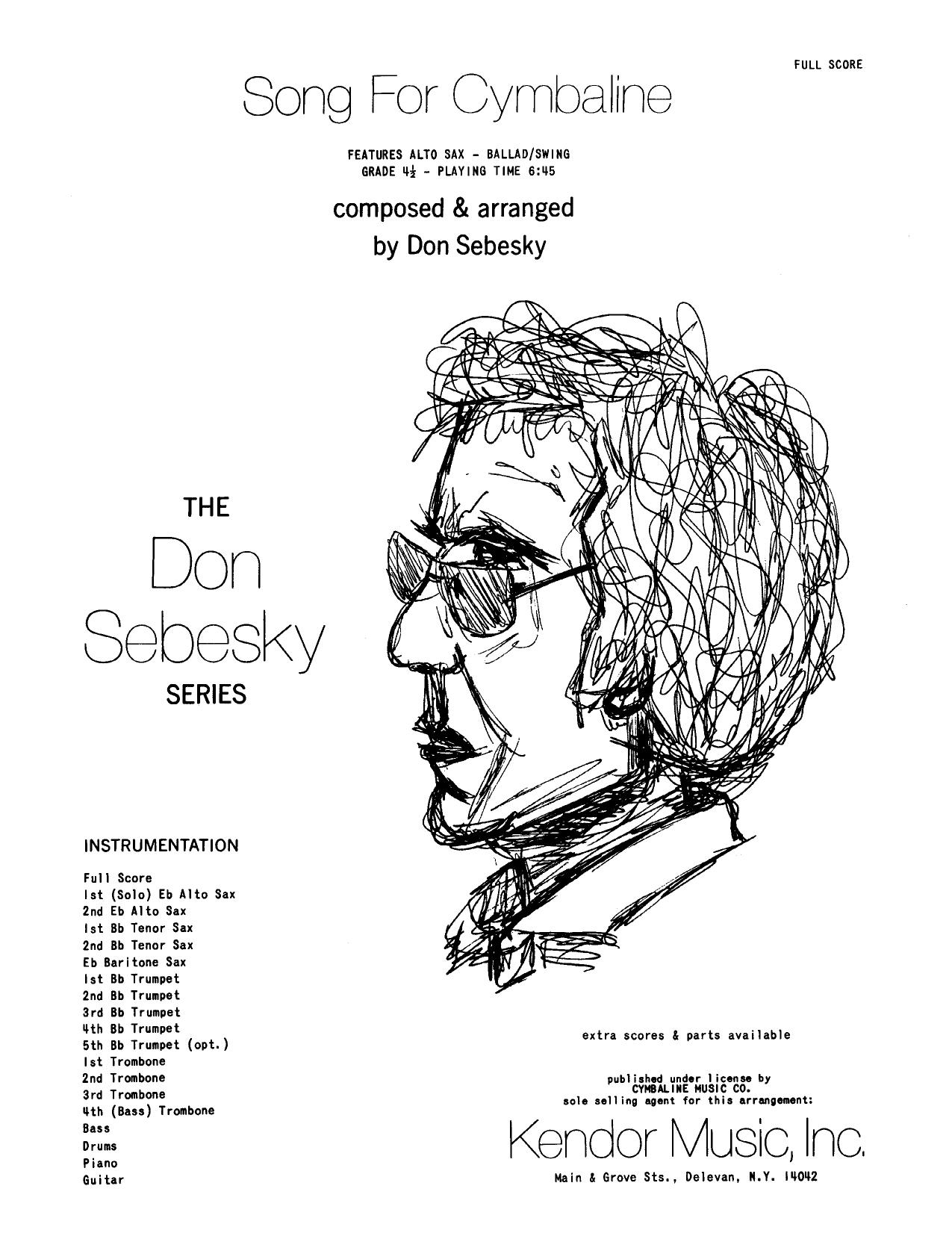
Song For Cymbaline (D.Sebesky) sheet music preview

Song For Cymbaline (D.Sebesky)

Composed by Don Sebesky

Arranged by Don Sebesky

  • Ensemble: Big Band
  • Pages: 47
  • Instruments (18): 1st (Solo) Eb Alto Sax, 2nd Eb Alto Sax, 1st Bb Tenor Sax, 2nd Bb Tenor Sax, Eb Baritone Sax, 1st Bb Trumpet, 2nd Bb Trumpet, 3rd Bb Trumpet, 4th Bb Trumpet, 5th Bb Trumpet (opt.), 1st Trombone, 2nd Trombone, 3rd Trombone, 4th (Bass) Trombone, Piano, Bass, Drums, Guitar
  • Difficulty: medium
  • Content: Individual Parts
  • Format: PDF Download (Instant)
  • Price: $24.99

Don Sebesky’s masterful composition and arrangement of "Song For Cymbaline" stands as a brilliant testament to the sophisticated, cinematic orchestrations that defined the arranger’s legendary career with Creed Taylor’s CTI Records ecosystem and beyond. Emerging from an era where big band jazz frequently intersected with lush modal harmony, impressionistic textures, and contemporary pop sensibilities, Sebesky crafted a sophisticated canvas that bridges traditional jazz ensemble writing with rich, classical-leaning impressionism. Known for his work with giants like Wes Montgomery, Freddie Hubbard, and Bill Evans, Sebesky brought a distinctively refined symphonic ear to the jazz orchestra, making his original compositions prized vehicles for advanced ensembles seeking depth, nuance, and structural integrity. "Song For Cymbaline" unfolds with a captivating, reflective mood, driven by a flowing contemporary groove that balances introspective lyricism with sweeping dynamic expansion. The harmonic language is intensely colorful, relying on extended chord structures, lush woodwind doublings, and subtle chromatic movement rather than straightforward blues or rhythm changes. The emotional arc moves from a serene, meditative introduction into vibrant, soaring climaxes, evoking a cinematic journey filled with poignant contrasts. Sebesky’s signature arranging hand is instantly recognizable in the meticulous voice-leading, inventive horn-to-reed cross-voicing, and seamless transitions between exposed solo passages and thick, multi-layered ensemble textures. At the heart of the arrangement is a prominent feature for Alto Saxophone 1, which carries the primary thematic weight and serves as the emotional anchor for the entire chart. The orchestration demands a high degree of technical control and stylistic maturity, particularly from the saxophone and brass sections, who must navigate intricate soli sections and demanding upper-register demands with pristine intonation. The rhythm section functions as an active textural contributor rather than a mere time-keeping unit, requiring a sensitive pianist and drummer capable of interpreting rubato-esque feels alongside driving contemporary swing and modal grooves. Because of its demanding harmonic vocabulary, sophisticated scoring, and requirement for absolute balance across all 18 instruments, this chart is ideally suited for advanced college/university jazz ensembles, elite high school honor bands, and professional or ambitious community big bands. Performing "Song For Cymbaline" rewards the ensemble with a profound sense of dynamic interplay and stylistic breadth, offering audiences a rare masterclass in modern big band composition from one of the genre's most innovative orchestrators. Achieving a successful performance of "Song For Cymbaline" requires meticulous attention to blend, intonation, and dynamic shading, as Don Sebesky’s dense, impressionistic voicings rely heavily on precise vertical tuning. The conductor should spend initial rehearsals isolating sections to ensure that internal harmony notes within the saxophone and muted brass are balanced cleanly against the lead voices. The tempo must remain fluid yet grounded; resist the urge to rush the transitional rubato passages, allowing the modal vamps to breathe naturally before locking into the underlying groove. The featured Alto Saxophone 1 soloist should approach the primary melodic statements with a vocal, unhurried phrasing style, matching the cinematic contours of the surrounding orchestration. Rhythm section players must treat their parts with a high degree of coloristic awareness: the pianist should voice chords cleanly without overcrowding the middle register, while the drummer needs to utilize dynamic cymbal work and subtle mallet textures rather than heavy-handed timekeeping during the quieter developmental sections. Ensure that all dynamic markings—ranging from delicate whispers to soaring, harmonized shout sections—are exaggerated to capture the piece's dramatic narrative arc. Q: What instrumentation and parts are included in this arrangement? A: This arrangement is scored for a standard 18-instrument big band, including Alto Saxophone 1 (Solo), Alto Saxophone 2, Tenor Saxophone 1, Tenor Saxophone 2, Baritone Saxophone, standard brass, and a complete rhythm section, accompanied by a 47-page conductor score. Q: What is the difficulty level of this arrangement? A: This piece is graded as advanced, making it best suited for collegiate, professional, and elite high school jazz ensembles capable of handling complex harmonies, delicate balance work, and demanding lead alto and brass ranges. Q: What is the musical style and historical context of "Song For Cymbaline"? A: Composed and arranged by Don Sebesky, this piece reflects the sophisticated, cinematic jazz-orchestra style of the 1970s CTI Records era, blending modal jazz harmony, impressionistic textures, and contemporary groove elements. Q: What makes this Don Sebesky arrangement unique? A: The arrangement stands out for its lush, symphonic voicings, innovative woodwind cross-scoring, and a seamless integration of classical impressionism with modern jazz orchestration, all anchored by a prominent Alto Saxophone 1 feature. Q: What is the performance duration and tempo approach for this piece? A: While performance duration varies slightly based on the chosen rubato pacing, the piece utilizes an expressive, flowing tempo feel that requires careful conductor control to navigate transitions between meditative modal sections and driving grooves.

Questions and answers

What is included in the Song For Cymbaline (D.Sebesky) PDF?
The verified current file contains a conductor score and individual parts across 47 pages.
How many instruments or parts are listed for Song For Cymbaline (D.Sebesky)?
The verified instrumentation list contains 18 entries for this Big Band arrangement.
Who is credited for Song For Cymbaline (D.Sebesky)?
Composer: Don Sebesky. Arranger: Don Sebesky.
What difficulty is listed for Song For Cymbaline (D.Sebesky)?
The verified difficulty level is medium.
Can I preview Song For Cymbaline (D.Sebesky) before buying?
Yes. The product page provides a preview generated from the current PDF file.
How is Song For Cymbaline (D.Sebesky) delivered?
After successful payment, the digital PDF is made available for download. The displayed price is $24.99.

Musicians Also Search For

Song For Cymbaline Don Sebesky PDFSong For Cymbaline Don Sebesky sheet musicSong For Cymbaline arranged by Don SebeskyDon Sebesky big band chartsDon Sebesky jazz arrangements PDFSong For Cymbaline Don Sebesky big band arrangementsSong For Cymbaline big band arrangementsSong For Cymbaline big band PDF downloadSong For Cymbaline jazz sheet musicbig band sheet music downloadSong For Cymbaline conductor score PDFSong For Cymbaline individual parts downloadSong For Cymbaline sheet music PDFbuy Song For Cymbaline sheet musicdownload Song For Cymbaline PDFSong For Cymbaline jazz chartsbest Don Sebesky big band arrangementsSong For Cymbaline printable sheet musicbig band repertoire PDF

All arrangements by Don Sebesky All Don Sebesky sheet music