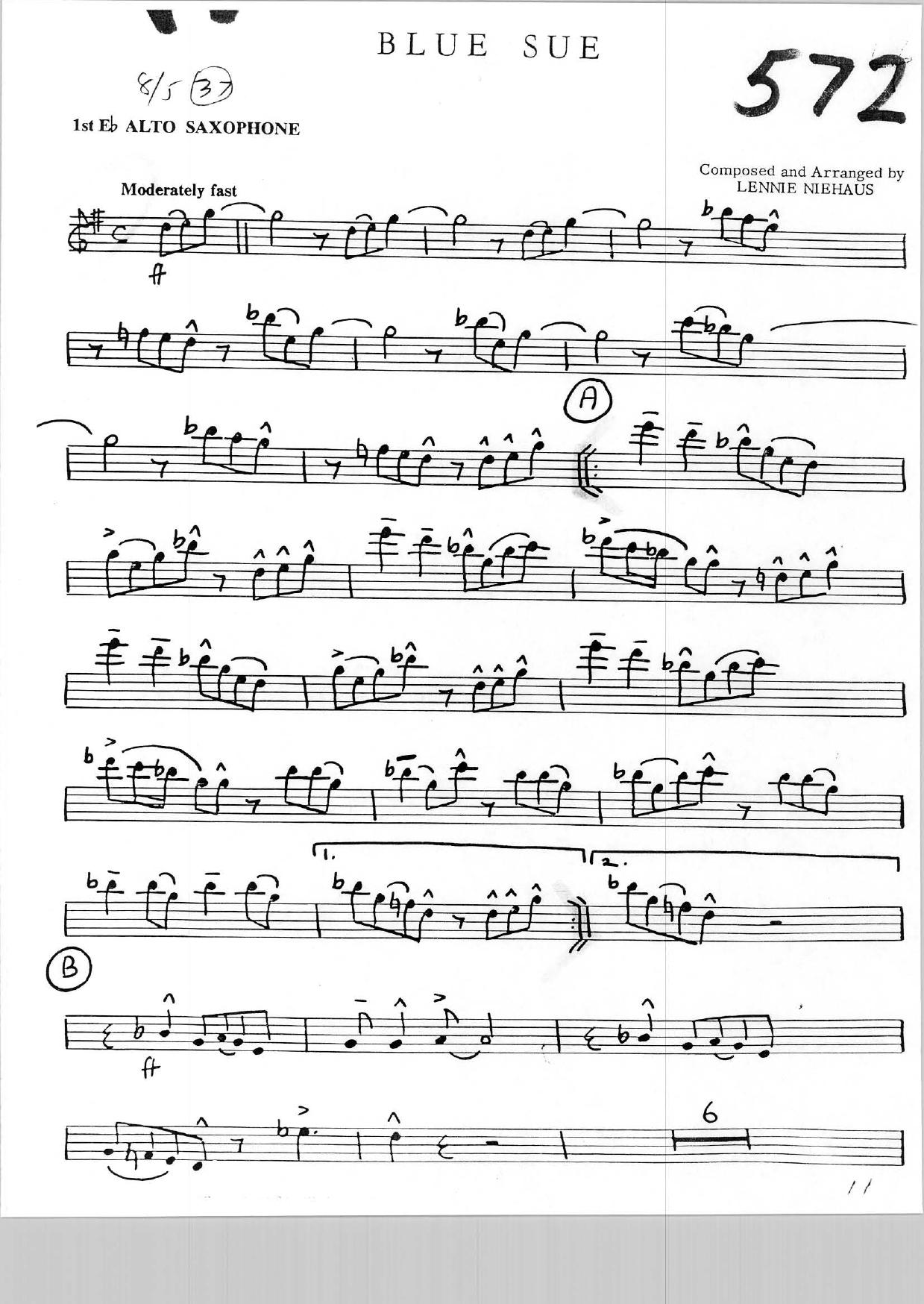
Blue Sue (L.Niehaus)
Composed by Lennie Niehaus
Arranged by Lennie Niehaus
- Ensemble: Big Band
- Pages: 37
- Instruments (17): 1st Eb Alto Saxophone, 2nd Eb Alto Saxophone, 1st Bb Tenor Saxophone, 2nd Bb Tenor Saxophone, Eb Baritone Saxophone, 1st Bb Trumpet, 2nd Bb Trumpet, 3rd Bb Trumpet, 4th Bb Trumpet, 1st Trombone, 2nd Trombone, 3rd Trombone, 4th Trombone, Piano, Guitar, String Bass, Drums
- Difficulty: medium
- Content: Individual Parts
- Format: PDF Download (Instant)
- Price: $24.99
Lennie Niehaus penned "Blue Sue" as a sterling example of West Coast cool jazz meeting the swinging momentum of modern big band writing. Emerging from an era where Niehaus was a pivotal alto saxophonist and arranger for the Stan Kenton Orchestra, compositions like this reflect a sophisticated approach to harmonic movement and linear counterpoint. While not a traditional Tin Pan Alley standard, Niehaus originals from this period have become treasured staples in contemporary jazz education and performance libraries, celebrated for their witty thematic development, tight ensemble interlocking, and clever nod to traditional blues and bop idioms. Driving forward with a bright, infectious medium-up swing feel in 4/4 time, "Blue Sue" exudes a sophisticated, upbeat energy that balances West Coast intellectualism with high-octane straight-ahead swing. The mood is playfully optimistic and effortlessly cool, opening with a snappy, memorable melodic statement that immediately grabs the listener's attention. The harmonic language features characteristic Niehaus extensions, modal flavorings, and crisp diatonic shifts that evoke the sun-drenched, sophisticated atmosphere of 1950s California jazz clubs while maintaining a timeless vitality. True to Lennie Niehaus’s signature compositional voice, the arrangement prioritizes transparent, linear writing over dense, bombastic wall-of-sound orchestration. The saxophones are treated with exquisite care, often utilized in tight, harmonized block-chord soli sections that demand absolute precision, excellent intonation, and a lightweight, agile articulation. The brass writing is similarly economical yet punchy, utilizing rhythmic syncopation and articulate staccato figures to create momentum without overwhelming the rhythm section. Transitions between sections are seamless, driven by clever countermelodies in the inner voices and crisp, conversational responses between the brass and reeds. Melodic duties are shared fluidly across the ensemble, though the alto and tenor saxophones frequently take the lead, echoing Niehaus's own instrumental pedigree. Solo opportunities are structured to showcase improvisers over straightforward blues-inflected or rhythm changes-derived changes, keeping the performance dynamic and engaging for both players and audience members. Technically, the chart demands strong reading skills, familiarity with bebop-inflected eighth-note lines, and precise ensemble synchronization, particularly regarding dynamic control and articulation matching. Advanced high school, collegiate, and professional community big bands will find "Blue Sue" an exceptionally rewarding addition to their repertoire. It serves as an ideal vehicle for developing a lighter, more transparent big band swing concept—moving away from heavy Count Basie or Kenton power-blowing toward the refined, articulation-conscious style of the West Coast modernists. Conductors should approach "Blue Sue" with a primary focus on lightness, clarity, and articulation discipline. The tempo should be kept steady and forward-moving, avoiding any tendency to drag, as the energy relies heavily on crisp, buoyant quarter and eighth-note pulses. - **Articulation:** Emphasize a clean, detached bebop articulation. Accents should be sharp but not overblown, and short notes must be clipped precisely together across all sections. - **Soli Sections:** The saxophone soli requires meticulous balance and unified phrasing. Players should match the lead alto player's vibrato and tone color closely. - **Rhythm Section:** The piano and guitar should comp with sparse, modern chord voicings, avoiding heavy block chords that could muddy Niehaus's linear counterpoint. The bass line should walk with a strong, acoustic pulse, locking tightly with the drummer's ride cymbal and hi-hat on beats two and four. - **Dynamics:** Pay close attention to dynamic contrast; Niehaus builds excitement through smart orchestration and rhythmic interplay rather than sheer volume. Q: What instruments and parts are included in this big band arrangement? A: The arrangement is scored for a standard 16-instrument big band instrumentation, featuring Alto Sax 1, Alto Sax 2, Tenor Sax 1, Tenor Sax 2, Baritone Sax, four trumpets, four trombones, and a full four-piece rhythm section (piano, bass, drums, and optional guitar). Q: What is the difficulty level of this chart? A: This arrangement is graded as advanced-intermediate to advanced, making it best suited for accomplished high school, collegiate, and professional jazz ensembles due to its fast swing tempo, intricate saxophone solis, and required reading proficiency. Q: What style and historical era does "Blue Sue" represent? A: Composed and arranged by Lennie Niehaus, "Blue Sue" firmly represents the West Coast cool jazz and modern bebop movements of the 1950s, blending sophisticated counterpoint with a swinging, accessible groove. Q: What makes this particular Lennie Niehaus arrangement unique? A: Its uniqueness lies in Niehaus's trademark linear writing, which treats the big band like an expanded small group, prioritizing transparent harmonic voicings, conversational brass-and-reed interplay, and agile, bebop-infused horn lines over dense, loud block chords. Q: What is the recommended performance tempo and duration for this piece? A: "Blue Sue" is designed to be performed at a bright, driving medium-up swing tempo (approximately quarter note = 180-192 BPM), resulting in a performance duration of roughly 3 to 4 minutes depending on solo rotations.
Questions and answers
- What is included in the Blue Sue (L.Niehaus) PDF?
- The verified current file contains individual parts across 37 pages.
- How many instruments or parts are listed for Blue Sue (L.Niehaus)?
- The verified instrumentation list contains 17 entries for this Big Band arrangement.
- Who is credited for Blue Sue (L.Niehaus)?
- Composer: Lennie Niehaus. Arranger: Lennie Niehaus.
- What difficulty is listed for Blue Sue (L.Niehaus)?
- The verified difficulty level is medium.
- Can I preview Blue Sue (L.Niehaus) before buying?
- Yes. The product page provides a preview generated from the current PDF file.
- How is Blue Sue (L.Niehaus) delivered?
- After successful payment, the digital PDF is made available for download. The displayed price is $24.99.
Musicians Also Search For
Blue Sue Lennie Niehaus PDF • Blue Sue Lennie Niehaus sheet music • Blue Sue arranged by Lennie Niehaus • Lennie Niehaus big band charts • Lennie Niehaus jazz arrangements PDF • Blue Sue Lennie Niehaus big band arrangements • Blue Sue big band arrangements • Blue Sue big band PDF download • Blue Sue jazz sheet music • big band sheet music download • Blue Sue individual parts download • Blue Sue sheet music PDF • buy Blue Sue sheet music • download Blue Sue PDF • Blue Sue jazz charts • best Lennie Niehaus big band arrangements • Blue Sue printable sheet music • big band repertoire PDF