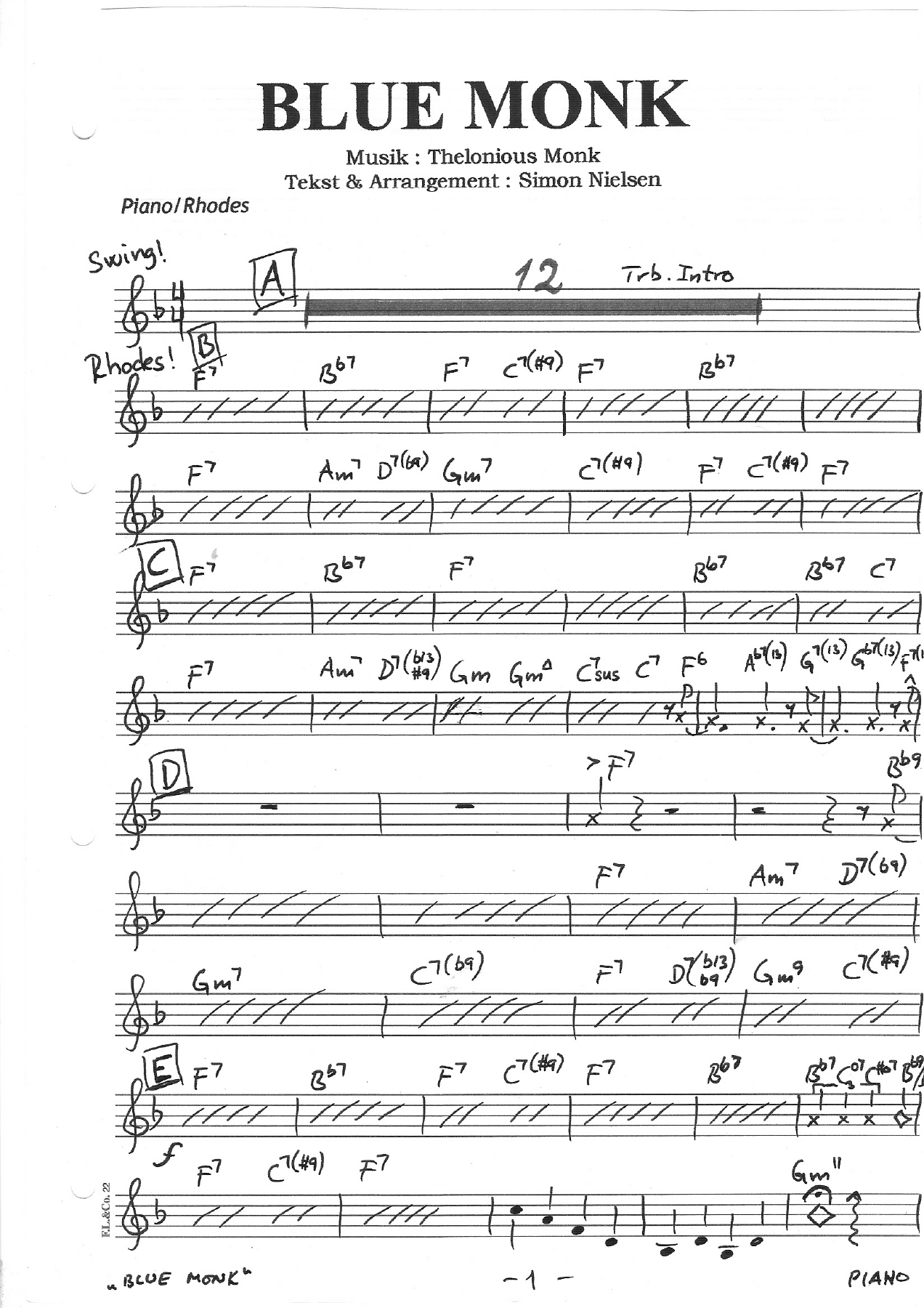
Blue Monk (S.Nielsen)
Composed by Thelonious Monk
Arranged by Simon Nielsen
- Ensemble: Big Band Vocal
- Style: Jazz Standard
- Pages: 49
- Instruments (17): Alto Saxophone 1, Alto Saxophone 2, Tenor Saxophone 1, Tenor Saxophone 2, Baritone Saxophone, Trumpet in Bb 1, Trumpet in Bb 2, Trumpet in Bb 3, Trumpet in Bb 4, Trombone 1, Trombone 2, Trombone 3, Trombone 4, Guitar, Piano, Bass, Drum Set
- Difficulty: easy
- Content: Individual Parts
- Format: PDF Download (Instant)
- Price: $24.99
Thelonious Monk's "Blue Monk," composed in 1954, stands as an enduring pillar of the jazz standard repertoire, renowned for its deceptively simple yet profoundly swinging 12-bar blues form. This piece emerged during an era of significant innovation in jazz, showcasing Monk's singular genius in blending traditional blues structures with his idiosyncratic harmonic and rhythmic sensibilities. Monk's original recording, featuring Art Blakey on drums and Percy Heath on bass, established the tune's iconic status, and it has since been embraced by countless jazz luminaries, becoming one of the most frequently performed and recorded jazz compositions after Duke Ellington's works. Its melodic motif—a four-note chromatic rise in eighth notes—is instantly recognizable and serves as a springboard for improvisation, embodying Monk's characteristic use of space, repetition, and rhythmic displacement. This big band vocal arrangement by Simon Nielsen reimagines "Blue Monk" with a medium swing feel, maintaining the original's bluesy essence while infusing it with the rich textures and dynamic power of a full jazz orchestra. The arrangement is primarily set in the key of Bb, a common key for the piece, which allows for comfortable vocal ranges and brass voicings. Nielsen's approach is characterized by intelligent voicings that honor Monk's harmonic language, often employing clusters and angular melodic lines within the ensemble. Expect sophisticated soli sections that weave through the brass and saxophone families, creating intricate counterpoint and call-and-response passages that build excitement. The mood is one of joyful, yet sophisticated, blues expression, evoking the playful wit and deep soul inherent in Monk's original. Nielsen's distinctive arranging style frequently features a thoughtful interplay between ensemble sections and solo features, ensuring every part of the band has moments to shine. In this arrangement, the vocal melody takes center stage during the initial presentation of the theme, allowing for expressive interpretation. Following this, there are ample opportunities for featured instrumental solos, typically for tenor saxophone and trumpet, over the familiar 12-bar blues progression, providing soloists with a classic framework for creative improvisation. Technical challenges include precise rhythmic articulation, especially in the tight ensemble passages, and navigating Nielsen's harmonically rich voicings which demand strong intonation and blend. The rewarding aspect lies in performing a beloved standard with a fresh, powerful big band treatment that respects its roots while offering new sonic dimensions. This arrangement is ideally suited for college-level jazz ensembles, advanced community big bands, and professional groups. Its blend of traditional jazz elements with contemporary big band arranging techniques provides a robust learning experience for developing musicians, focusing on ensemble precision, harmonic awareness, and improvisational skills. The vocal feature adds an extra layer of performance opportunity, making it a versatile addition to any ensemble's repertoire. The detailed scoring and dynamic shifts require a mature understanding of jazz phrasing and ensemble dynamics, ensuring a challenging yet highly gratifying performance for both musicians and audience members. Conductors should emphasize a relaxed, yet precise, medium swing feel throughout, ensuring the rhythm section lays down a solid, grooving foundation. The primary tempo should be around 120-130 BPM, allowing the bluesy melody to breathe while maintaining forward momentum. Key technical challenges include achieving tight rhythmic unison in the saxophone and brass soli sections, particularly where Nielsen employs Monk-esque angular figures. Encourage musicians to articulate these passages with a crisp, percussive attack, reminiscent of Monk's piano style. Intonation in the extended harmonies requires careful attention, especially in sustained chord voicings. Rehearsal should focus on balancing the vocal line with the ensemble, ensuring the vocalist is always prominent without sacrificing the band's dynamic impact. Soloists should be encouraged to draw inspiration from Monk's melodic and rhythmic vocabulary, utilizing space and thematic development over sheer speed. Q: What instruments and parts are included in this arrangement? A: This big band vocal arrangement includes standard instrumentation for a jazz orchestra: 5 saxophones (2 altos, 2 tenors, 1 baritone), 4 trumpets, 4 trombones, piano, bass, drums, and a dedicated vocal part. Q: What is the difficulty level of this arrangement? A: This arrangement is rated as advanced intermediate to advanced, suitable for college-level jazz ensembles, advanced community bands, and professional groups due to its intricate voicings, demanding soli passages, and the need for sophisticated rhythmic precision. Q: What musical style and historical context does "Blue Monk" represent? A: "Blue Monk" is a quintessential jazz standard composed by Thelonious Monk in 1954, embodying the blues form with Monk's unique bebop-era harmonic and rhythmic innovations. It blends traditional blues with a distinctive, angular melodic and harmonic approach. Q: What makes Simon Nielsen's arrangement of "Blue Monk" unique? A: Simon Nielsen's arrangement distinguishes itself by providing a rich big band vocal treatment of the classic, featuring sophisticated voicings, dynamic soli sections, and dedicated instrumental solo opportunities, all while preserving the original's bluesy character and Monk's unique harmonic language. Q: What is the typical performance duration and tempo for this arrangement? A: The typical performance duration for this arrangement is approximately 4-5 minutes, depending on the length of the improvised solos. It is designed to be performed at a medium swing tempo, ideally between 120-130 beats per minute.
Questions and answers
- What is included in the Blue Monk (S.Nielsen) PDF?
- The verified current file contains a conductor score and individual parts across 49 pages.
- How many instruments or parts are listed for Blue Monk (S.Nielsen)?
- The verified instrumentation list contains 17 entries for this Big Band Vocal arrangement.
- Who is credited for Blue Monk (S.Nielsen)?
- Composer: Thelonious Monk. Arranger: Simon Nielsen.
- What difficulty is listed for Blue Monk (S.Nielsen)?
- The verified difficulty level is easy.
- What style is listed for Blue Monk (S.Nielsen)?
- The catalog lists the style as Jazz Standard.
- Can I preview Blue Monk (S.Nielsen) before buying?
- Yes. The product page provides a preview generated from the current PDF file.
- How is Blue Monk (S.Nielsen) delivered?
- After successful payment, the digital PDF is made available for download. The displayed price is $24.99.
Musicians Also Search For
Blue Monk Simon Nielsen PDF • Blue Monk Simon Nielsen sheet music • Blue Monk arranged by Simon Nielsen • Simon Nielsen big band vocal charts • Simon Nielsen jazz arrangements PDF • Blue Monk Thelonious Monk sheet music • Blue Monk Thelonious Monk big band vocal arrangements • Thelonious Monk big band vocal charts • Blue Monk big band vocal arrangements • Blue Monk big band vocal PDF download • Blue Monk jazz sheet music • big band vocal sheet music download • Blue Monk conductor score PDF • Blue Monk individual parts download • Blue Monk sheet music PDF • Blue Monk Jazz Standard charts • Jazz Standard big band vocal arrangements • buy Blue Monk sheet music • download Blue Monk PDF • Blue Monk jazz charts • best Simon Nielsen big band vocal arrangements • Thelonious Monk arranged by Simon Nielsen • Blue Monk printable sheet music • big band vocal repertoire PDF