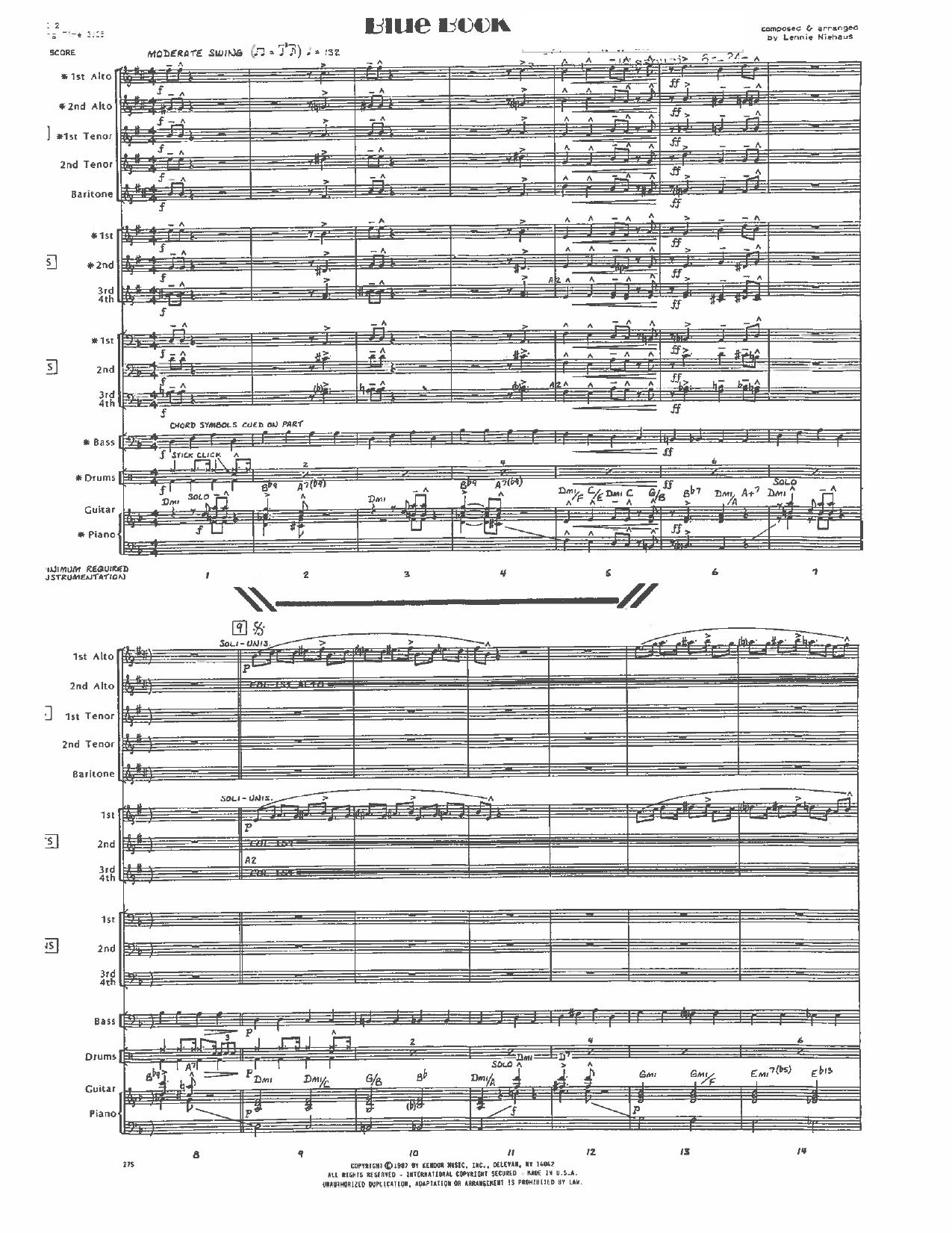
Blue Book (L.Niehaus)
Composed by Lennie Niehaus
Arranged by Lennie Niehaus
- Ensemble: Big Band
- Pages: 38
- Instruments (15): 1st Eb Alto Sax, 2nd Eb Alto Sax, 1st Bb Tenor Sax, Eb Baritone Sax, 1st Bb Trumpet, 2nd Bb Trumpet, 3rd Bb Trumpet, 4th Bb Trumpet, 1st Trombone, 2nd Trombone, 3rd Trombone, 4th Trombone, Piano, Guitar, Drums
- Difficulty: medium
- Content: Individual Parts
- Format: PDF Download (Instant)
- Price: $24.99
West Coast cool jazz pioneer Lennie Niehaus crafted "Blue Book" as a masterclass in linear writing, counterpoint, and sophisticated harmonic economy. Emerging from the vibrant 1950s California jazz scene where Niehaus was a central figure—both through his extensive work with the Stan Kenton Orchestra and his prolific small-group recordings—this chart embodies the intellectual rigor and effortless swing characteristic of the Lighthouse All-Stars era. While not every Niehaus chart achieved ubiquitous standard status, his compositions for big band serve as vital historical links between the bebop revolution and the tightly orchestrated West Coast modernism that defined the decade. Propelled by a driving, articulate medium-up swing feel in 4/4 time, "Blue Book" radiates an urbane, high-energy mood that balances cerebral counterpoint with irrepressible foot-tapping momentum. The harmonic landscape is rich with clever chromatic voice-leading, extended tertian structures, and signature Niehaus parallel motion, evoking the cool sophistication of a late-night Los Angeles club session. Rather than relying on bombastic, brass-heavy volume to create excitement, the chart builds tension through linear interplay, rhythmic displacement, and crisp articulation that demands absolute precision from the entire ensemble. Niehaus approaches the big band instrumentation with a chamber-jazz sensibility, treating the 16-piece ensemble not as contrasting blocks of sound, but as an interlocking organism. The saxophone section—featuring two altos, two tenors, and baritone—frequently acts as the primary vehicle for intricate, harmonically dense solis that showcase Niehaus’s alto-player's ear for idiomatic wind writing. The brass cues are economically scored to maximize transparency, avoiding muddy mid-range congestion and allowing the rhythm section's underlying comping to breathe. A brilliantly structured shout chorus later in the chart breaks open the texture, utilizing dynamic contrasts and syncopated punch lines before gracefully steering the ensemble back to the main thematic material. Melodic duties are shared fluidly across the front line, with the saxophones handling the litop-heavy, bebop-infused heads while the brass punctuates with sharp, articulate stabs. Designated solo spaces provide a platform for feature performers to stretch out over standard changes, requiring soloists with a strong grasp of linear-based improvisation. Technically, the chart demands agile tongue-fingering coordination, particularly in the woodwinds navigating rapid scalar passages and accidentals. The reward for the ensemble lies in experiencing the sheer kinetic joy of Niehaus’s peerless phrasing, where every inner voice feels purposeful and alive. Advanced high school, collegiate, and professional community jazz orchestras will find "Blue Book" to be an ideal vehicle for developing ensemble cohesion and style awareness. Because the chart relies heavily on stylistic uniformity, light and dry articulation, and clean section balance rather than sheer brute force, it acts as a phenomenal diagnostic tool for directors wanting to elevate their band's reading and stylistic maturity. Conductors approaching "Blue Book" should immediately establish a crisp, metric medium-up swing tempo where the ride cymbal dictates the pulse and the half-note is felt strongly. The primary technical hurdle lies in the execution of Niehaus’s dense, linear saxophone solis; players must prioritize ultra-clean articulation, matching the bebop-inspired phrasing of the lead alto down to the baritone. Avoid heavy vibrato, aiming instead for a lean, focused "cool school" tone across all sections. Brass players should keep their volume in check during ensemble passages to ensure the inner saxophone voicings remain audible through the texture. Staccato notes must be played short and dry without being clipped or forced. Rehearsals should initially focus on sectional isolation, particularly getting the rhythm section locked into a buoyant, unhurried groove before layering in the horns. Pay close attention to dynamic markings; the contrast between whispered background figures and assertive shout choruses defines the architecture of this chart. Q: What instruments and parts are included in this arrangement? A: This 38-page big band chart is scored for a standard 16-instrument ensemble, consisting of Alto Saxophone 1, Alto Saxophone 2, Tenor Saxophone 1, Tenor Saxophone 2, Baritone Saxophone, Trumpet parts, Trombone parts, and a full rhythm section. Q: What is the difficulty level of "Blue Book"? A: This arrangement is best suited for advanced high school, collegiate, and professional jazz ensembles due to its fast-moving linear lines, sophisticated West Coast harmonies, and high demand for precise articulation. Q: What style and historical era does this piece represent? A: Composed by West Coast jazz icon Lennie Niehaus, the piece represents the sophisticated 1950s cool jazz and modern bebop-infused big band tradition associated with California modernism. Q: What makes this Lennie Niehaus arrangement unique? A: Its uniqueness lies in Niehaus's chamber-jazz approach to the 16-piece instrumentation, utilizing intricate saxophone solis, transparent brass voicings, and counterpoint that treats the big band as an interlocking linear organism. Q: What is the performance tempo and duration of the piece? A: The arrangement is set to a driving medium-up swing feel in 4/4 time, offering a substantial performance length designed to feature both ensemble interplay and individual soloists.
Questions and answers
- What is included in the Blue Book (L.Niehaus) PDF?
- The verified current file contains a conductor score and individual parts across 38 pages.
- How many instruments or parts are listed for Blue Book (L.Niehaus)?
- The verified instrumentation list contains 15 entries for this Big Band arrangement.
- Who is credited for Blue Book (L.Niehaus)?
- Composer: Lennie Niehaus. Arranger: Lennie Niehaus.
- What difficulty is listed for Blue Book (L.Niehaus)?
- The verified difficulty level is medium.
- Can I preview Blue Book (L.Niehaus) before buying?
- Yes. The product page provides a preview generated from the current PDF file.
- How is Blue Book (L.Niehaus) delivered?
- After successful payment, the digital PDF is made available for download. The displayed price is $24.99.
Musicians Also Search For
Blue Book Lennie Niehaus PDF • Blue Book Lennie Niehaus sheet music • Blue Book arranged by Lennie Niehaus • Lennie Niehaus big band charts • Lennie Niehaus jazz arrangements PDF • Blue Book Lennie Niehaus big band arrangements • Blue Book big band arrangements • Blue Book big band PDF download • Blue Book jazz sheet music • big band sheet music download • Blue Book conductor score PDF • Blue Book individual parts download • Blue Book sheet music PDF • buy Blue Book sheet music • download Blue Book PDF • Blue Book jazz charts • best Lennie Niehaus big band arrangements • Blue Book printable sheet music • big band repertoire PDF