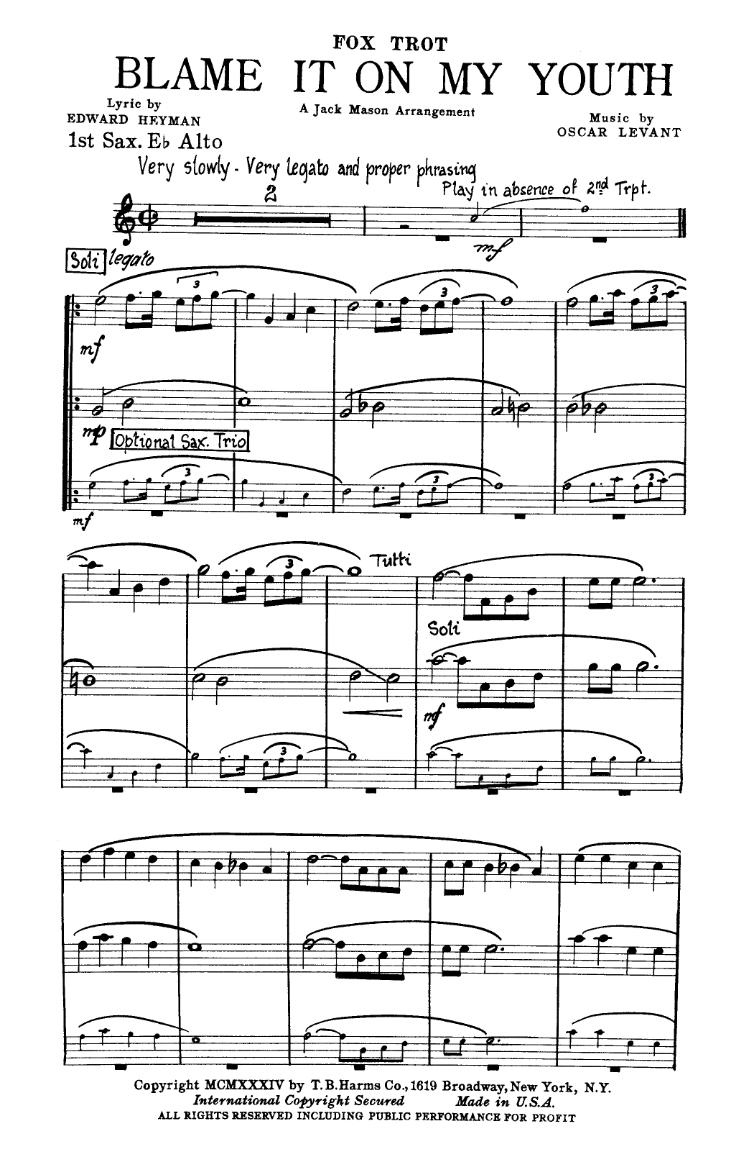
Blame It On My Youth (J.Mason)
Composed by Oscar Levant, Edward Heyman
Arranged by Jack Mason
- Ensemble: Big Band Dance
- Style: Foxtrot
- Pages: 26
- Instruments (11): Alto Saxophone 1, Tenor Saxophone 2, Alto Saxophone 3, Trombone, Trumpet 1, Trumpet 2, Piano, Tenor Banjo, Bass, Drum Set, Violin 1
- Difficulty: medium
- Content: Individual Parts
- Format: PDF Download (Instant)
- Price: $24.99
"Blame It On My Youth," a poignant ballad penned by Oscar Levant and Edward Heyman in 1934, emerged during the golden age of American popular song. Originally a bittersweet reflection on youthful indiscretions, its melancholic yet tender melody quickly found favor with vocalists and instrumentalists alike, solidifying its place in the Great American Songbook. While not an immediate chart-topper, its enduring quality led to its adoption as a jazz standard, famously interpreted by artists such as Frank Sinatra, Chet Baker, and particularly Nat King Cole, whose iconic 1957 recording brought it widespread recognition and cemented its reputation as a timeless classic. The song embodies the sophisticated harmonic language and lyrical depth characteristic of the 1930s foxtrot and ballad tradition, offering a rich canvas for jazz interpretation. J. Mason's arrangement of "Blame It On My Youth" for big band dance ensemble masterfully reimagines this classic as a medium-slow foxtrot, maintaining its inherent tenderness while infusing it with a subtle, swinging pulse. The arrangement is set in the original, comfortable key of F major, preserving the song's intimate character. Mason's distinctive approach is evident in the lush, sophisticated voicings that characterize the ensemble sections, particularly the brass and saxophone solis. He employs extended harmonies and artful counterpoint to create a rich textural tapestry, avoiding overly dense or jarring modernisms, instead opting for a sound that is both fresh and respectful of the tune's heritage. The overall mood is one of nostalgic elegance, evoking the ambiance of a classic ballroom or a sophisticated supper club. This 17-instrument arrangement is designed to highlight the full expressive capabilities of a big band. The melody is initially carried by the lead alto saxophone, offering a warm, lyrical interpretation, before being passed to the trombone section for a smooth soli statement. A featured tenor saxophone solo provides a moment for improvisation, allowing a skilled soloist to explore the tune's harmonic nuances over a gently supportive ensemble. Mason strategically builds dynamics and intensity, culminating in a tastefully restrained shout chorus that provides a satisfying emotional arc without ever becoming overbearing. Technical challenges include achieving precise balance and blend within the intricate voicings, maintaining a consistent, relaxed foxtrot feel, and navigating the subtle dynamic shifts. The reward lies in performing a truly beautiful and evocative arrangement that resonates deeply with audiences. This arrangement is ideally suited for college-level jazz ensembles, advanced community big bands, or professional groups seeking a refined and emotionally resonant addition to their repertoire. Its sophisticated harmonic content and nuanced ensemble passages provide excellent teaching and performance opportunities, fostering a deep understanding of ballad interpretation and big band dynamics. While demanding precision and musical sensitivity, the arrangement's inherent beauty makes the rehearsal process highly rewarding, allowing musicians to delve into the artistry of classic jazz and popular song. Conductors should emphasize a relaxed, medium-slow foxtrot feel, ensuring the rhythm section lays down a steady, unhurried foundation without dragging. The tempo should be around quarter note = 100-110 BPM. Key technical challenges include achieving precise intonation and blend within the rich, often close-voiced saxophone and brass solis; meticulous attention to dynamics is crucial for shaping the emotional arc. Encourage brass players to use a warm, dark tone, avoiding excessive brightness, especially in the initial melody statements. The tenor saxophone soloist should be encouraged to play lyrically, focusing on melodic embellishment rather than purely technical display. Rehearsal time should be dedicated to balancing the inner voices of the ensemble sections and ensuring smooth transitions between melodic statements and the improvisational section. No special techniques like plungers or doits are explicitly notated, allowing the focus to remain on musicality and ensemble cohesion. Q: What instruments and parts are included in this arrangement? A: This arrangement is scored for a full 17-piece big band dance ensemble, including Alto Saxophone 1 & 2, Tenor Saxophone 1 & 2, Baritone Saxophone, Trumpet 1-4, Trombone 1-4, Piano, Bass, Guitar, and Drums. Q: What is the difficulty level of J. Mason's "Blame It On My Youth" arrangement? A: This arrangement is rated as medium-advanced. It requires good ensemble precision, expressive soloing capabilities from the tenor saxophone, and a mature understanding of dynamics and blend, making it suitable for college or advanced community bands. Q: What is the musical style and historical context of this arrangement? A: This arrangement presents "Blame It On My Youth" as a medium-slow foxtrot. The original song was composed in 1934 by Oscar Levant and Edward Heyman, becoming a beloved jazz standard known for its melancholic yet tender character. Q: What makes J. Mason's arrangement of "Blame It On My Youth" unique? A: Mason's approach is characterized by lush, sophisticated voicings, particularly in the saxophone and brass solis, and a respectful yet fresh interpretation that highlights the song's inherent beauty. It provides a tasteful blend of classic big band sound with modern harmonic sensibilities. Q: What is the approximate performance duration and recommended tempo for this piece? A: The approximate performance duration for this arrangement is 3:30 to 4:00 minutes, depending on the soloist's improvisation. It should be performed at a medium-slow foxtrot tempo, around quarter note = 100-110 BPM.
Musicians Also Search For
Blame It On My Youth Jack Mason PDF • Blame It On My Youth Jack Mason sheet music • Blame It On My Youth arranged by Jack Mason • Jack Mason big band dance charts • Jack Mason jazz arrangements PDF • Blame It On My Youth Oscar Levant, Edward Heyman sheet music • Blame It On My Youth Oscar Levant, Edward Heyman big band dance arrangement • Oscar Levant, Edward Heyman big band dance charts • Blame It On My Youth big band dance arrangement • Blame It On My Youth big band dance PDF download • Blame It On My Youth jazz ensemble sheet music • big band dance sheet music instant download • Blame It On My Youth individual parts download • Blame It On My Youth sheet music with parts • Blame It On My Youth Foxtrot chart • Foxtrot big band dance arrangements • buy Blame It On My Youth sheet music online • download Blame It On My Youth PDF • Blame It On My Youth jazz chart • best Jack Mason big band dance arrangements • Oscar Levant, Edward Heyman songs arranged by Jack Mason • Blame It On My Youth printable sheet music • big band dance repertoire PDF