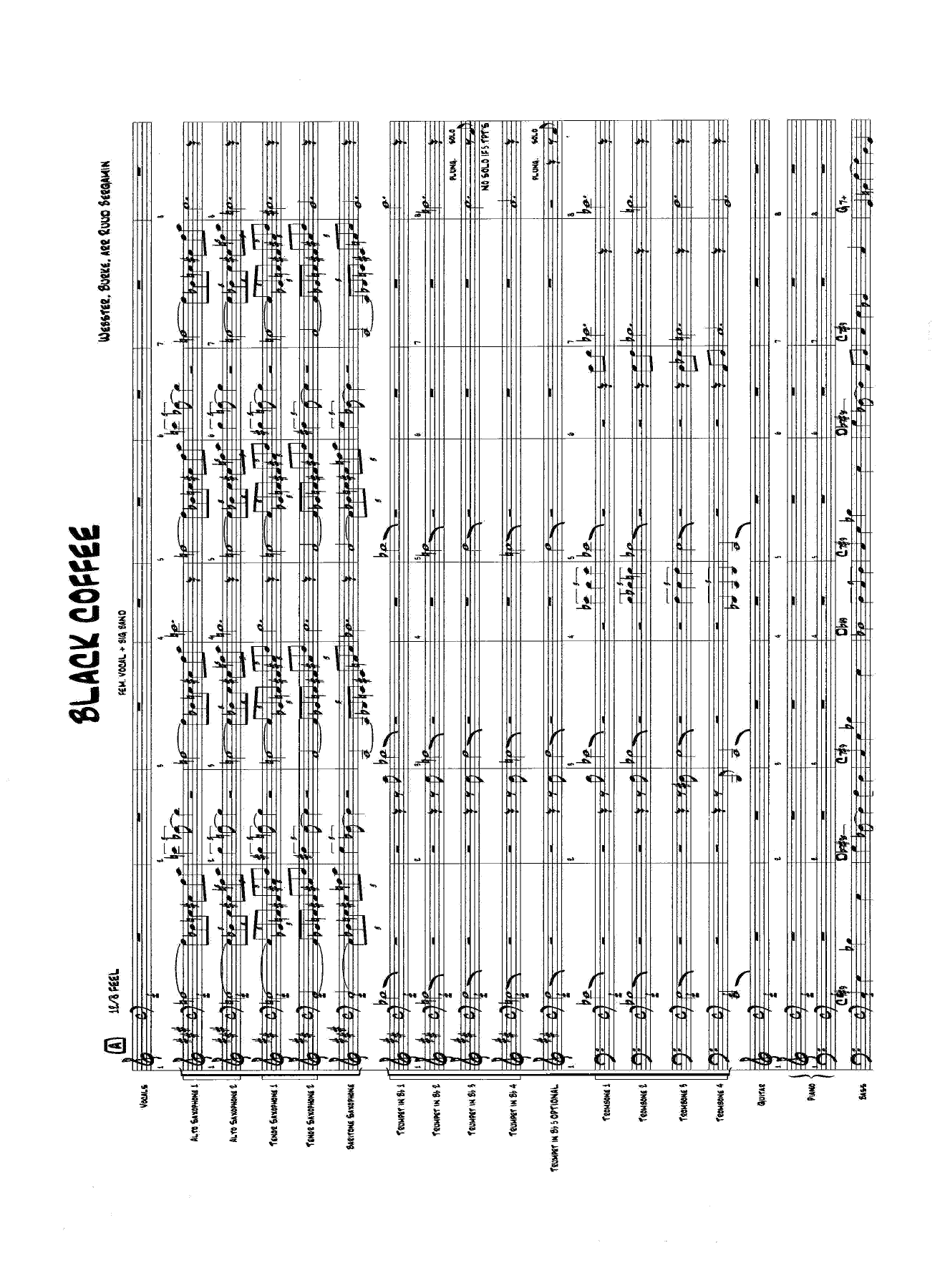
Black Coffee(R.Bergamin) sheet music preview

Black Coffee(R.Bergamin)

Composed by Sonny Burke, Paul Francis Webster

Arranged by Ruud Sergamin

  • Ensemble: Big Band Vocal
  • Style: Jazz Standard
  • Pages: 42
  • Difficulty: medium
  • Content: Sheet Music
  • Format: PDF Download (Instant)
  • Price: $24.99

"Black Coffee," composed by Sonny Burke with lyrics by Paul Francis Webster, emerged in 1948 as a quintessential jazz standard, perfectly encapsulating the melancholic torch song tradition of the post-war era. First recorded by Sarah Vaughan in 1949, whose rendition became a hit, the song truly solidified its iconic status with Peggy Lee's critically acclaimed 1953 recording, which became the title track of her album. The piece is renowned for its bluesy, languid melody and evocative lyrics that paint a vivid picture of romantic disillusionment and solitude, using the imagery of strong, bitter coffee as a metaphor for heartbreak and late-night yearning. Its enduring appeal lies in its profound emotional depth and its ability to resonate with themes of loneliness and unfulfilled love, making it a cornerstone of vocal jazz repertoire and inspiring countless interpretations by legends such as Ella Fitzgerald and Julie London. Ruud Sergamin's arrangement of "Black Coffee" for big band with vocal soloist masterfully captures the song's inherent mood while infusing it with fresh, sophisticated voicings and dynamic contrasts. Set as a slow, expressive ballad in 4/4 meter, the arrangement immediately establishes a smoky, introspective atmosphere. Sergamin's distinctive approach often involves rich, extended harmonies that color the original melody without obscuring its bluesy essence. Expect lush saxophone soli sections that weave intricate counter-melodies around the vocal line, and carefully constructed brass voicings that provide both warmth and subtle dramatic punctuation. The arrangement likely features a key that complements the vocal range, allowing the soloist to fully explore the song's emotional landscape. The performance of this arrangement demands a high level of musical sensitivity and technical proficiency from all sections. The vocal melody, carried primarily by the soloist, is supported by nuanced ensemble work, requiring precise articulation and blend from the wind sections. While the core melody remains with the vocalist, Sergamin introduces instrumental features, potentially including a featured solo for a tenor saxophone or trumpet, offering an opportunity for improvisation that builds on the arrangement's established mood. Technical challenges include maintaining a consistent, deep pocket at a slow tempo, executing intricate inner-voice movements in the horn sections, and achieving seamless transitions between ensemble passages and solo sections. The reward lies in delivering a deeply moving and polished interpretation of a timeless standard, allowing the band to showcase its expressive capabilities and mature musicality. This arrangement is ideally suited for advanced high school, college, community, or professional big bands. Its musical depth and technical demands provide an excellent vehicle for developing ensemble cohesion, expressive phrasing, and sophisticated harmonic understanding. The blend of a classic vocal jazz standard with Sergamin's refined arranging style makes it a compelling choice for concert programs, offering both familiar appeal and artistic challenge. The detailed scoring, spanning 42 pages, indicates a comprehensive treatment that allows for a truly immersive and impactful performance. Conductors should emphasize a deep, unhurried slow ballad feel, ensuring the rhythm section lays down a solid, yet flexible, foundation in 4/4. The primary technical challenge lies in achieving precise intonation and blend within the dense harmonic voicings, particularly in the saxophone and trombone sections. Encourage musicians to listen across sections to maintain balance and clarity. Dynamic control is paramount; subtle swells and decays will enhance the melancholic mood. The vocal soloist should be encouraged to interpret the lyrics with genuine emotion, allowing for rubato within the established tempo. If an improvised solo is featured, ensure the soloist understands the harmonic progression and the emotional arc of the piece. Rehearsal time should focus on balancing the vocal line with the accompanying ensemble, ensuring the band provides a supportive, atmospheric backdrop rather than overpowering the soloist. Pay close attention to articulation markings, especially sustained notes and delicate releases, to maintain the song's tender quality. Q: What instruments are included in this arrangement? A: This arrangement includes parts for a full big band, typically consisting of 5 saxophones (2 alto, 2 tenor, 1 baritone), 4 trumpets, 4 trombones, piano, bass, drums, guitar, and a dedicated vocal soloist part. Q: What is the difficulty level of this arrangement? A: This arrangement is rated as advanced, suitable for high school, college, community, or professional big bands due to its sophisticated harmonic language, nuanced dynamics, and the requirement for expressive interpretation from both the ensemble and the vocal soloist. Q: What is the musical style and historical context of "Black Coffee"? A: "Black Coffee" is a classic jazz standard from 1948, composed by Sonny Burke and Paul Francis Webster. It embodies the torch song tradition, characterized by its melancholic, bluesy ballad style exploring themes of loneliness and heartbreak. Q: What makes Ruud Sergamin's arrangement of "Black Coffee" unique? A: Ruud Sergamin's arrangement is distinguished by its rich, extended harmonies, lush saxophone soli sections, and carefully crafted brass voicings that enhance the song's emotional depth while providing a sophisticated and modern big band sound. Q: What is the typical performance duration and tempo for this arrangement? A: As a slow ballad, the performance duration typically ranges from 4 to 6 minutes, depending on the length of any improvised solos and the overall interpretive tempo. The feel is a slow, expressive 4/4 ballad.

Musicians Also Search For

Black Coffee Ruud Sergamin PDFBlack Coffee Ruud Sergamin sheet musicBlack Coffee arranged by Ruud SergaminRuud Sergamin big band vocal chartsRuud Sergamin jazz arrangements PDFBlack Coffee Sonny Burke, Paul Francis Webster sheet musicBlack Coffee Sonny Burke, Paul Francis Webster big band vocal arrangementSonny Burke, Paul Francis Webster big band vocal chartsBlack Coffee big band vocal arrangementBlack Coffee big band vocal PDF downloadBlack Coffee jazz ensemble sheet musicbig band vocal sheet music instant downloadBlack Coffee sheet music with partsBlack Coffee Jazz Standard chartJazz Standard big band vocal arrangementsbuy Black Coffee sheet music onlinedownload Black Coffee PDFBlack Coffee jazz chartbest Ruud Sergamin big band vocal arrangementsSonny Burke, Paul Francis Webster songs arranged by Ruud SergaminBlack Coffee printable sheet musicbig band vocal repertoire PDF

All arrangements by Ruud Sergamin All Sonny Burke, Paul Francis Webster sheet music