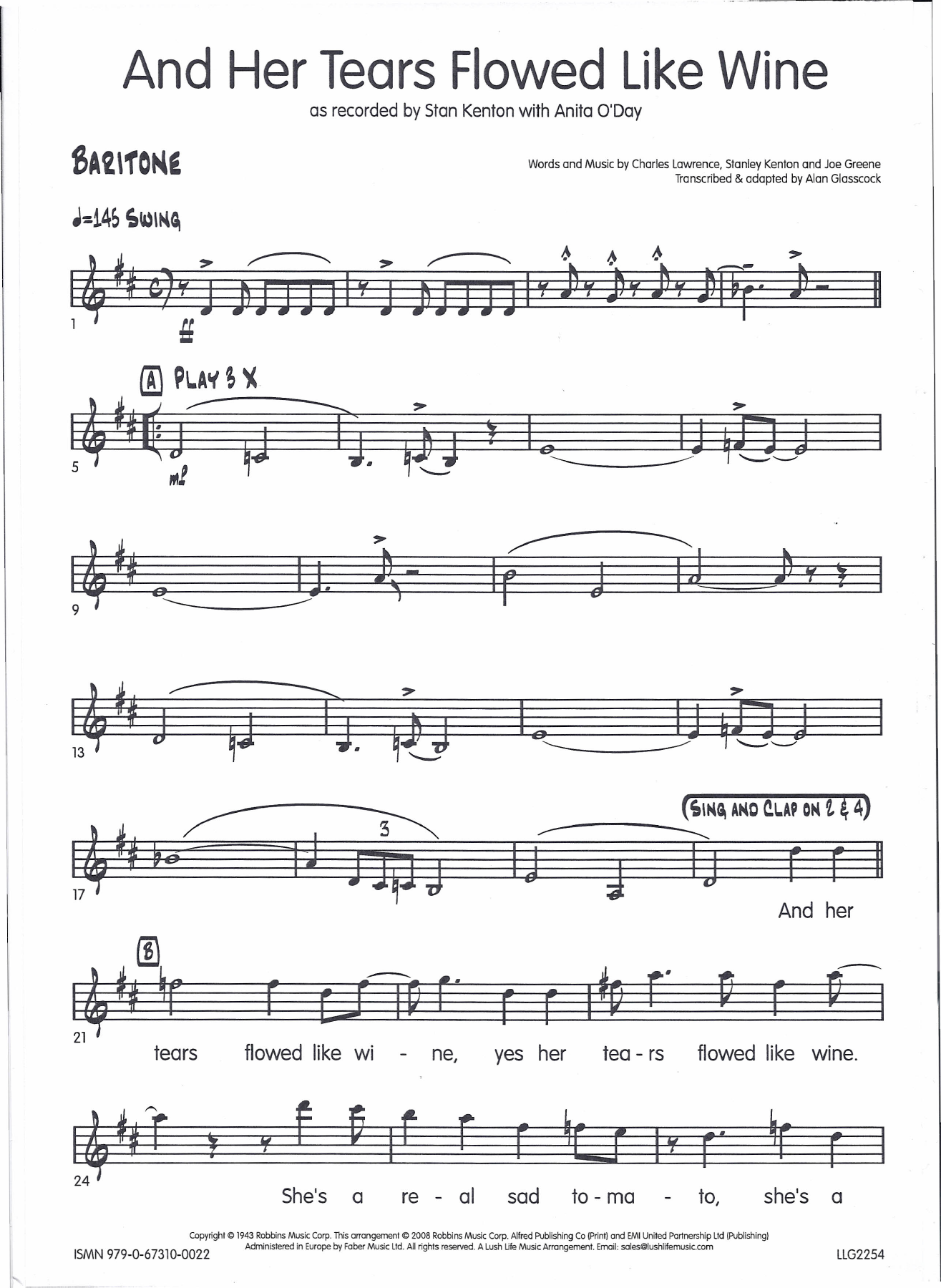
Baritone Sax (A.Glasscock)
Composed by Charles Lawrence, Stanley Kenton and Joe Greene
Arranged by Alan Glasscock
- Ensemble: Big Band Vocal
- Style: Jazz Standard
- Pages: 31
- Instruments (17): Alto Saxophone 1, Alto Saxophone 2, Tenor Saxophone 1, Tenor Saxophone 2, Baritone Saxophone, Trumpet 1, Trumpet 2, Trumpet 3, Trumpet 4, Trombone 1, Trombone 2, Trombone 3, Trombone 4, Keyboard, Guitar, Bass, Drums
- Difficulty: easy
- Content: Individual Parts
- Format: PDF Download (Instant)
- Price: $12.99
The jazz standard "Baritone Sax" (often associated with titles like "Jumpin' with Symphony Sid" or "Boplicity" in its various incarnations, though here referring to a specific vocal arrangement) emerges from the vibrant post-WWII bebop and cool jazz eras. Originally credited to Charles Lawrence, Stanley Kenton, and Joe Greene, the tune gained significant traction through iconic recordings by artists like George Shearing and particularly King Pleasure's vocalese rendition of "Jumpin' with Symphony Sid" in the early 1950s. This period marked a crucial transition in jazz, moving from the dance-oriented swing of the big bands to more intricate, improvisational, and harmonically sophisticated styles. The original instrumental versions often showcased the virtuosity of soloists, while vocal adaptations like this one transform its energetic melodic lines into a compelling narrative, solidifying its place as a cornerstone of the jazz vocal repertoire. Alan Glasscock's arrangement of "Baritone Sax" for big band and vocalist captures the quintessential medium-up swing feel of the era, set firmly in the key of F major. The overall mood is one of sophisticated exuberance, blending the infectious rhythmic drive of swing with the cool, articulate phrasing characteristic of the tune. Glasscock masterfully crafts an arrangement that is both historically authentic and musically engaging. His signature approach often involves meticulously voiced brass and saxophone sections that provide a rich, supportive, yet dynamically interesting backdrop for the soloist. Expect crisp ensemble figures, well-defined counter-melodies, and a sense of forward momentum that propels the piece from start to finish. This arrangement places the vocalist squarely in the spotlight, carrying the primary melodic statement with ample opportunity for stylistic interpretation. Following the vocal exposition, Glasscock introduces a vibrant saxophone soli, showcasing the section's tight articulation and blend before transitioning into a dedicated solo section. The arrangement features a written solo for tenor saxophone, providing a solid foundation for less experienced improvisers while also serving as a springboard for more advanced players to develop their own ideas. A powerful shout chorus builds dynamic intensity, leading to a final, impactful statement from the vocalist. Technical challenges include precise articulation in the brass, maintaining a consistent, driving swing feel throughout, and navigating the sometimes intricate melodic lines of the head. The rewarding aspect lies in the collective energy generated by the ensemble and the sheer joy of performing a true jazz classic. "Baritone Sax (A.Glasscock)" is ideally suited for college and advanced high school jazz ensembles, as well as community and professional big bands. Its balanced demands on both the ensemble and the vocalist make it an excellent choice for developing musicianship across all sections. The arrangement offers a fantastic opportunity to explore authentic swing articulation, ensemble precision, and the art of accompanying a vocalist, making it a valuable addition to any big band's repertoire. Conductors should emphasize a consistent, driving medium-up swing feel from the outset, ensuring the rhythm section lays down a solid groove in 4/4. Articulation is paramount, particularly in the brass; short, precise stabs and crisp releases will define the character. Encourage the saxophones to play with a light, unified sound, especially during the soli sections, focusing on blend and intonation. The vocalist's entrance should be confident and stylistically informed, with the band providing a supportive, yet articulate, accompaniment. Pay close attention to dynamic contrasts, building intensity through the shout chorus and allowing moments for the vocalist to shine. The written tenor saxophone solo can be played as written for educational purposes or used as a guide for improvisation, encouraging melodic development over harmonic complexity. Rehearsal time should be dedicated to locking in the ensemble figures, ensuring clean entrances and releases, and refining the overall dynamic shape of the piece. Q: What instruments and parts are included in this arrangement? A: This big band vocal arrangement includes parts for a standard big band instrumentation: 5 saxophones (AATTB), 4 trumpets, 4 trombones, guitar, piano, bass, drums, and a dedicated vocal lead sheet. Q: What is the difficulty level of "Baritone Sax (A.Glasscock)"? A: This arrangement is rated as medium-advanced. It requires a solid understanding of swing articulation, good ensemble precision, and a capable vocalist and tenor saxophone soloist. Q: What is the musical style and historical context of this piece? A: This is a medium-up swing jazz standard from the post-WWII bebop/cool jazz era, famously associated with artists like King Pleasure and George Shearing, embodying the energetic and sophisticated sound of the early 1950s. Q: What makes Alan Glasscock's arrangement of "Baritone Sax" unique? A: Glasscock's arrangement is distinguished by its meticulously voiced brass and saxophone sections, a prominent saxophone soli, a written tenor saxophone solo, and a powerful shout chorus that provides a vibrant, authentic backdrop for the vocalist. Q: What is the approximate performance duration and tempo of this arrangement? A: The approximate performance duration is 3:00-3:30 minutes, depending on the length of improvisation. The tempo should be a consistent medium-up swing, around 180-200 BPM.
Questions and answers
- What is included in the Baritone Sax (A.Glasscock) PDF?
- The verified current file contains individual parts across 31 pages.
- How many instruments or parts are listed for Baritone Sax (A.Glasscock)?
- The verified instrumentation list contains 17 entries for this Big Band Vocal arrangement.
- Who is credited for Baritone Sax (A.Glasscock)?
- Composer: Charles Lawrence, Stanley Kenton and Joe Greene. Arranger: Alan Glasscock.
- What difficulty is listed for Baritone Sax (A.Glasscock)?
- The verified difficulty level is easy.
- What style is listed for Baritone Sax (A.Glasscock)?
- The catalog lists the style as Jazz Standard.
- Can I preview Baritone Sax (A.Glasscock) before buying?
- Yes. The product page provides a preview generated from the current PDF file.
- How is Baritone Sax (A.Glasscock) delivered?
- After successful payment, the digital PDF is made available for download. The displayed price is $12.99.
Musicians Also Search For
Baritone Sax Alan Glasscock PDF • Baritone Sax Alan Glasscock sheet music • Baritone Sax arranged by Alan Glasscock • Alan Glasscock big band vocal charts • Alan Glasscock jazz arrangements PDF • Baritone Sax Charles Lawrence, Stanley Kenton and Joe Greene sheet music • Baritone Sax Charles Lawrence, Stanley Kenton and Joe Greene big band vocal arrangements • Charles Lawrence, Stanley Kenton and Joe Greene big band vocal charts • Baritone Sax big band vocal arrangements • Baritone Sax big band vocal PDF download • Baritone Sax jazz sheet music • big band vocal sheet music download • Baritone Sax individual parts download • Baritone Sax sheet music PDF • Baritone Sax Jazz Standard charts • Jazz Standard big band vocal arrangements • buy Baritone Sax sheet music • download Baritone Sax PDF • Baritone Sax jazz charts • best Alan Glasscock big band vocal arrangements • Charles Lawrence, Stanley Kenton and Joe Greene arranged by Alan Glasscock • Baritone Sax printable sheet music • big band vocal repertoire PDF