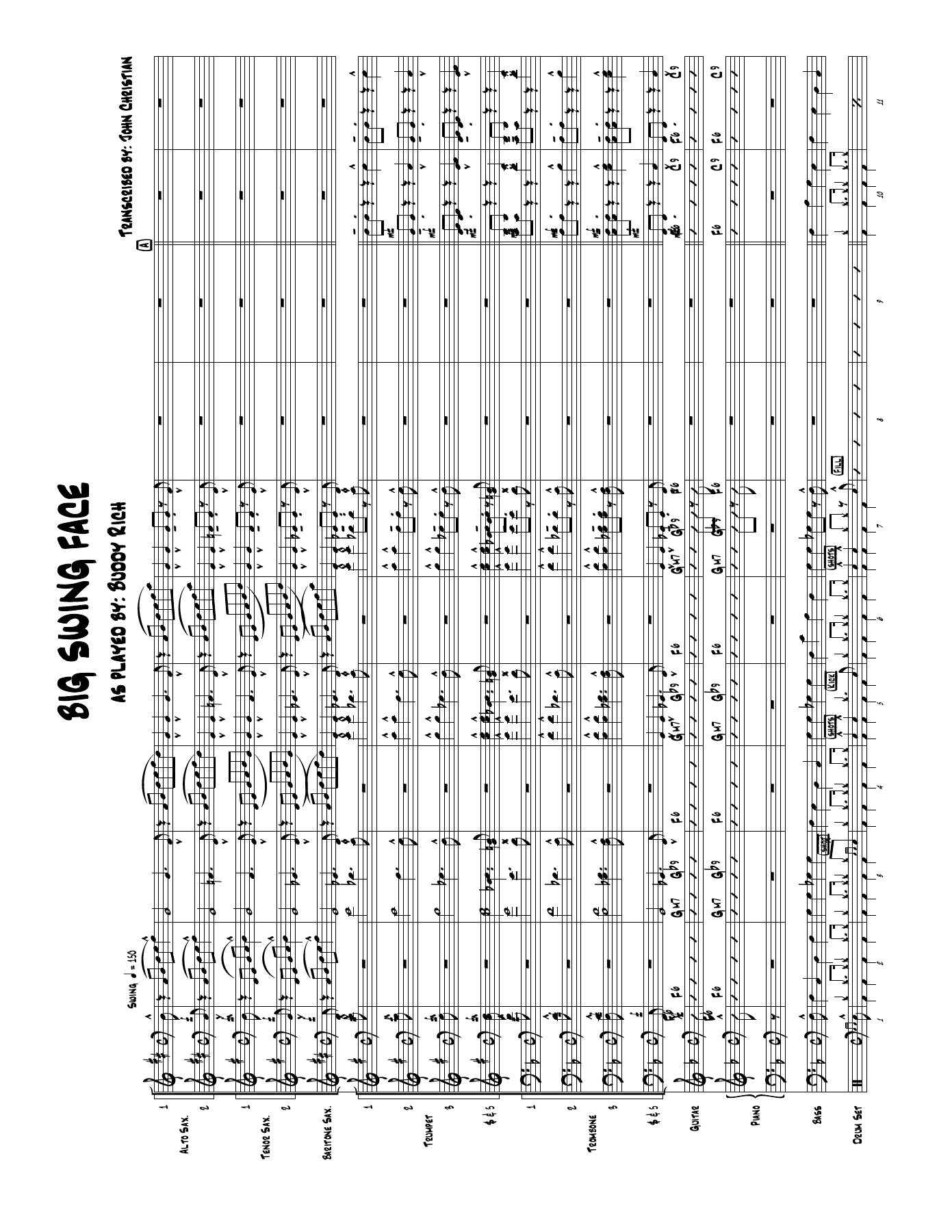
Big Swing Face (J.Christian) sheet music preview

Big Swing Face (J.Christian)

Composed by Bill Potts

Arranged by Bill Potts

  • Ensemble: Big Band
  • Style: Jazz Standard
  • Pages: 56
  • Instruments (19): Alto Sax 1, Alto Sax 2, Tenor Sax 1, Tenor Sax 2, Baritone Sax, Trumpet 1, Trumpet 2, Trumpet 3, Trumpet 4, Trumpet 5, Trombone 1, Trombone 2, Trombone 3, Trombone 4, Trombone 5 (Tuba), Guitar, Piano, Bass, Drum Set
  • Difficulty: advanced
  • Content: Individual Parts
  • Format: PDF Download (Instant)
  • Price: $24.99

"Big Swing Face," composed and arranged by the legendary Bill Potts, is a quintessential big band chart that embodies the vibrant energy and sophisticated harmonic language of late 1960s jazz. While Potts was a prolific composer and arranger, perhaps best known for his groundbreaking "Jazz Soul of Porgy and Bess" album, "Big Swing Face" gained widespread fame as the title track of the iconic 1967 live album by the Buddy Rich Big Band. This era marked a dynamic period for big band jazz, where traditional swing elements fused with more contemporary harmonic and rhythmic ideas, pushing the boundaries of the ensemble sound. The piece stands as a testament to Potts's innovative mind and his ability to craft charts that are both challenging and immensely rewarding for performers and listeners alike. Musically, "Big Swing Face" is an exhilarating up-tempo swing number, typically performed in a bright 4/4 meter with an infectious, driving feel. The original recording by Buddy Rich showcases a relentless rhythmic propulsion, characteristic of the bandleader's drumming prowess. The chart is primarily in a bright major key, exuding an optimistic and high-energy mood that is perfect as an opener or a show-stopping feature in any concert program. It evokes a feeling of joyous, unbridled swing, demanding precision and exuberance from every section. The piece's structure allows for sustained tension and release, building through powerful ensemble passages and dynamic solo features. Bill Potts's arranging style is immediately recognizable in this chart. Known for his bold, brassy, and swinging approach, Potts masterfully weaves intricate voicings and powerful soli sections throughout "Big Swing Face." Expect tightly-voiced brass figures that cut through the ensemble, contrasted with rich, harmonically dense saxophone soli passages. The arrangement features compelling melodic lines that are passed between sections, creating a dynamic interplay. There are ample opportunities for featured solos, typically for tenor saxophone, trumpet, and piano, allowing individual musicians to showcase their improvisational skills over a driving rhythm section. Potts’s signature use of extended harmonies and blues-based figures gives the piece a sophisticated yet deeply rooted jazz sensibility. Performing "Big Swing Face" is a thrilling experience. The lead trumpet often reaches up to a B-flat above the staff, requiring a strong, confident player. The saxophone section navigates fast-moving lines and precise articulations, while the trombones contribute powerful punches and smooth legato phrases. The rhythm section is the engine of this piece, demanding a drummer with exceptional drive and stamina, a walking bass line that is both solid and agile, and a pianist who can comp dynamically and deliver an impactful solo. The technical demands are significant, making it suitable for medium-advanced to advanced ensembles. College and professional bands will find this arrangement particularly appropriate, offering a challenging yet incredibly rewarding performance experience that highlights the virtuosity and cohesion of the ensemble. "Big Swing Face" thrives on a relentless, driving up-tempo swing feel, ideally around 180-200 BPM. The conductor should emphasize rhythmic precision and a unified articulation style across all sections, particularly in the brass. Technical challenges include fast chromatic runs in the saxophone section, demanding clean fingerwork and breath support. Brass players must focus on strong, clear attacks and precise releases, especially in the punchy ensemble figures. Lead trumpet requires excellent range and endurance, with sustained notes in the upper register. Solos, typically for tenor saxophone, trumpet, and piano, should be approached with a strong understanding of blues scales and bebop vocabulary, maintaining the energetic character of the piece. Rehearsal should focus on tightening ensemble unisons and soli sections, ensuring that the rhythmic interplay between the sections is crisp and cohesive. Dynamic contrasts are crucial; practice bringing out the subtle nuances within the powerful shout choruses to maximize impact. Q: What instruments are included in this arrangement? A: This arrangement is scored for a standard big band, comprising 19 instruments: Alto Saxophone 1, Alto Saxophone 2, Tenor Saxophone 1, Tenor Saxophone 2, Baritone Saxophone, Trumpet 1, Trumpet 2, Trumpet 3, Trumpet 4, Trombone 1, Trombone 2, Trombone 3, Trombone 4, Guitar, Piano, Bass, and Drums. A full conductor's score is also included. Q: What is the difficulty level of "Big Swing Face"? A: This arrangement is considered medium-advanced to advanced (Grade 4-5). It requires strong technical proficiency from all sections, particularly in terms of range, articulation, and rhythmic accuracy, making it ideal for college, community, and professional jazz ensembles. Q: What musical style and historical context does this arrangement represent? A: "Big Swing Face" is an up-tempo jazz standard in the swing style, composed and arranged by Bill Potts. It gained prominence as the title track of the Buddy Rich Big Band's 1967 album, embodying the powerful and sophisticated big band sound of that era. Q: What makes this Bill Potts arrangement unique? A: Bill Potts's arrangement of "Big Swing Face" is characterized by its bold, brassy voicings, intricate saxophone soli passages, and powerful shout choruses. It features ample solo space for multiple instruments and showcases Potts's distinctive harmonic language and driving rhythmic energy. Q: What is the typical performance duration and tempo for this piece? A: "Big Swing Face" is an up-tempo swing chart, typically performed at a brisk tempo of 180-200 BPM. Its performance duration usually ranges from 4 to 6 minutes, depending on the number and length of improvised solos.

Questions and answers

What is included in the Big Swing Face (J.Christian) PDF?
The verified current file contains a conductor score and individual parts across 56 pages.
How many instruments or parts are listed for Big Swing Face (J.Christian)?
The verified instrumentation list contains 19 entries for this Big Band arrangement.
Who is credited for Big Swing Face (J.Christian)?
Composer: Bill Potts. Arranger: Bill Potts.
What difficulty is listed for Big Swing Face (J.Christian)?
The verified difficulty level is advanced.
What style is listed for Big Swing Face (J.Christian)?
The catalog lists the style as Jazz Standard.
Can I preview Big Swing Face (J.Christian) before buying?
Yes. The product page provides a preview generated from the current PDF file.
How is Big Swing Face (J.Christian) delivered?
After successful payment, the digital PDF is made available for download. The displayed price is $24.99.

Musicians Also Search For

Big Swing Face Bill Potts PDFBig Swing Face Bill Potts sheet musicBig Swing Face arranged by Bill PottsBill Potts big band chartsBill Potts jazz arrangements PDFBig Swing Face Bill Potts big band arrangementsBig Swing Face big band arrangementsBig Swing Face big band PDF downloadBig Swing Face jazz sheet musicbig band sheet music downloadBig Swing Face conductor score PDFBig Swing Face individual parts downloadBig Swing Face sheet music PDFBig Swing Face Jazz Standard chartsJazz Standard big band arrangementsbuy Big Swing Face sheet musicdownload Big Swing Face PDFBig Swing Face jazz chartsbest Bill Potts big band arrangementsBig Swing Face printable sheet musicbig band repertoire PDF

All arrangements by Bill Potts All Bill Potts sheet music