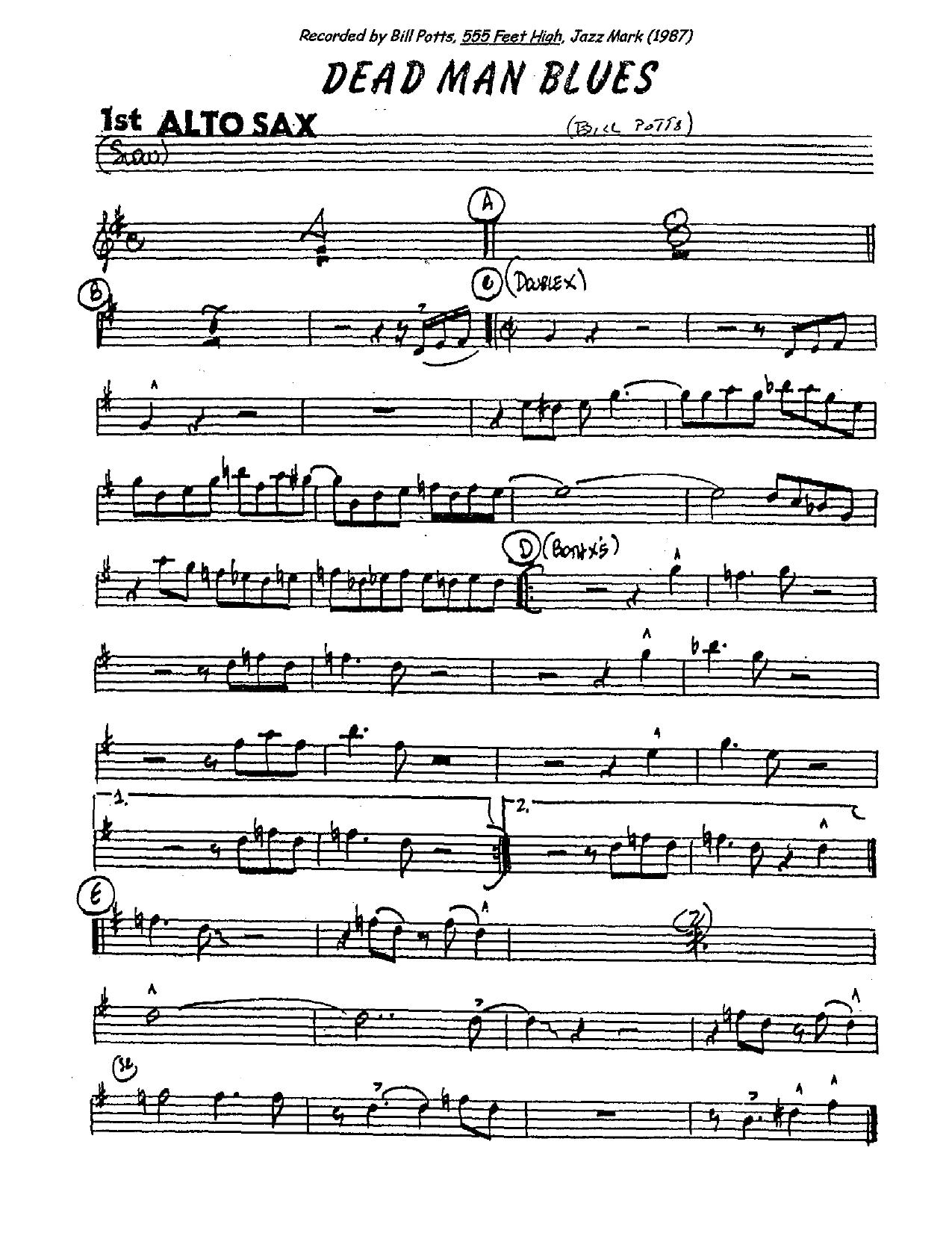
Dead Man's Blues (B.Potts) sheet music preview

Dead Man's Blues (B.Potts)

Composed by Bill Potts

Arranged by Bill Potts

  • Ensemble: Big Band
  • Pages: 34
  • Instruments (15): 1st Alto Saxophone, 2nd Alto Saxophone, 1st Tenor Saxophone, 2nd Tenor Saxophone, Baritone Saxophone, 1st Trumpet, 2nd Trumpet, 3rd Trumpet, 4th Trumpet, 1st Trombone, 2nd Trombone, 3rd Trombone, 4th Trombone, Piano/Guitar/Bass, Drums
  • Difficulty: medium
  • Content: Individual Parts
  • Format: PDF Download (Instant)
  • Price: $24.99

Brimming with the dark, subterranean energy of mid-century modern jazz composition, "Dead Man’s Blues" stands as a compelling showcase of Bill Potts's brilliant arranging pedigree. Emerging from an era where large ensemble jazz was evolving past simple dance-band formulas into sophisticated concert art, this chart captures the gritty, nocturnal atmosphere of classic small-group blues while filtering it through the rich, expansive palette of a dynamic big band. Bill Potts, celebrated widely for his monumental orchestration work (most notably his transformation of the *Jazz Soul of Porgy and Bess*), infuses this piece with an uncommon textural depth, balancing greasy blues inflections with modernist harmonic tension. Right from the initial downbeat, the arrangement establishes a sultry, menacing medium-slow groove driven by a low-register-heavy accompaniment. The key centers around a moody, blues-drenched tonality that immediately invokes a smoky, after-hours ambience. The harmonic landscape is peppered with altered dominants, pungent minor seconds, and lush parallel voicings that recall the sophisticated writing of the Gerry Mulligan Concert Jazz Band and late-fifties Kenton workshops. The energy ebbs and flows masterfully, shifting from sparse, hauntingly quiet interludes where the rhythm section drives a minimalist pulse, to roaring, brass-heavy ensemble peaks that demand absolute authority and control from every section. Potts distributes the thematic material inventively across the ensemble rather than relying solely on traditional trumpet-and-saxophone pairings. Rich sax-soli sections showcase tight, interlocking counterpoint, while the trombones provide a warm, velvety cushion that anchors the bottom end. The arrangement features designated solo space for key frontline members, allowing ample room for improvisers to stretch out over blues changes that gradually increase in intensity. The climax of the chart is built upon a masterclass in shout-chorus construction, where stacked brass chords clash and resolve against a relentless drumming foundation, driving the momentum to a breathless peak before pulling back sharply for a signature, enigmatic final cadence. Advanced high school, collegiate, and professional big bands will find this 34-page chart to be an exceptionally rewarding addition to their repertoire. Because success relies heavily on stylistic unity, subtle dynamic control, and a deep understanding of swing subdivision at a relaxed tempo, it serves as an ideal vehicle for stretching a band's maturity. Ensembles capable of locking in a heavy, authentic groove while navigating sophisticated extended tertian harmonies will discover that "Dead Man’s Blues" offers a masterclass in mood, texture, and large-ensemble storytelling. Conductors approaching Bill Potts's "Dead Man’s Blues" must prioritize a heavy, unhurried swing feel; rushing the tempo will instantly dismantle the sultry, ominous atmosphere the arranger carefully builds. The rhythm section is the engine here—the bassist and drummer must maintain a deep, subterranean pocket, avoiding any tendency to push the quarter note. Horn players should focus on a seamless blend within section unisons, paying careful attention to dynamic markings that range from a whispered *subito piano* to scorching, open-horn roars. Special care is required for the stylistic articulation of the blues lines; use articulated tongue-slurs and expressive downward fall-offs on designated phrase endings, but avoid over-exaggerating effects to maintain the sophisticated noir aesthetic. In rehearsal, isolate the sax soli to ensure absolute rhythmic precision and intonation alignment before integrating the brass backing figures. Balance is critical during the dense chordal clusters—ensure the inner voices of the saxophone and trombone sections project clearly without masking the primary melodic statements or the featured soloist. Q: What instrumentation and parts are included in this arrangement? A: Scored for an 8-instrument core plus rhythm section configuration, the arrangement specifically features parts for Alto Saxophone, Tenor Saxophone, Baritone Saxophone, Trumpet, and Trombone within its comprehensive 34-page publication. Q: What is the difficulty level of this Bill Potts arrangement? A: This chart is best suited for advanced high school, collegiate, and professional big bands that possess strong sectional blend, mature improvisers, and the stylistic maturity required for nuanced slow-to-medium swing playing. Q: What is the musical style and historical context of "Dead Man's Blues"? A: Written and arranged by Bill Potts, this piece embodies the sophisticated, modern-blues aesthetic of the late-1950s and 1960s big band era, bridging traditional blues forms with advanced, cinematic jazz harmonies. Q: What makes this specific arrangement unique? A: Potts’s distinctive treatment shines through his inventive use of low-register textures, dense harmonic voicings, and a masterfully constructed shout chorus that creates a dark, nocturnal mood distinct from standard swing-era arrangements. Q: What is the recommended performance tempo and duration? A: The piece is anchored by a relaxed, medium-slow swing feel with a performance duration averaging roughly 4 to 5 minutes, depending on the length of the improvised solo choruses.

Questions and answers

What is included in the Dead Man's Blues (B.Potts) PDF?
The verified current file contains individual parts across 34 pages.
How many instruments or parts are listed for Dead Man's Blues (B.Potts)?
The verified instrumentation list contains 15 entries for this Big Band arrangement.
Who is credited for Dead Man's Blues (B.Potts)?
Composer: Bill Potts. Arranger: Bill Potts.
What difficulty is listed for Dead Man's Blues (B.Potts)?
The verified difficulty level is medium.
Can I preview Dead Man's Blues (B.Potts) before buying?
Yes. The product page provides a preview generated from the current PDF file.
How is Dead Man's Blues (B.Potts) delivered?
After successful payment, the digital PDF is made available for download. The displayed price is $24.99.

Musicians Also Search For

Dead Man's Blues Bill Potts PDFDead Man's Blues Bill Potts sheet musicDead Man's Blues arranged by Bill PottsBill Potts big band chartsBill Potts jazz arrangements PDFDead Man's Blues Bill Potts big band arrangementsDead Man's Blues big band arrangementsDead Man's Blues big band PDF downloadDead Man's Blues jazz sheet musicbig band sheet music downloadDead Man's Blues individual parts downloadDead Man's Blues sheet music PDFbuy Dead Man's Blues sheet musicdownload Dead Man's Blues PDFDead Man's Blues jazz chartsbest Bill Potts big band arrangementsDead Man's Blues printable sheet musicbig band repertoire PDF

All arrangements by Bill Potts All Bill Potts sheet music