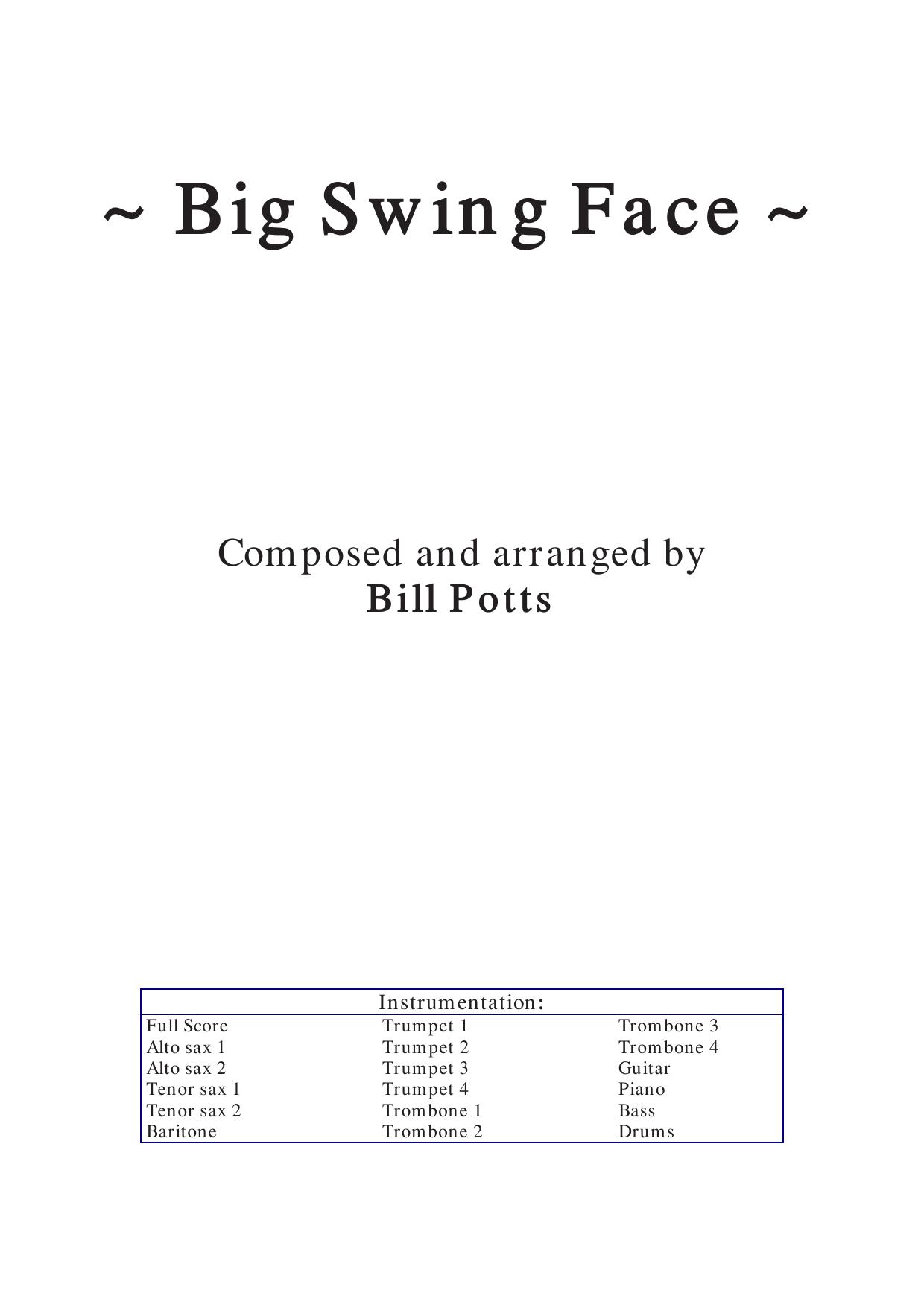
Big Swing Face (B.Potts)
Composed by Bill Potts
Arranged by Bill Potts
- Ensemble: Big Band
- Pages: 85
- Instruments (16): Alto Saxophone 1 (Solo), Alto Saxophone 2, Tenor Saxophone 1, Tenor Saxophone 2, Baritone Saxophone, Trumpet 1, Trumpet 2 (Solo), Trumpet 3, Trumpet 4, Trombone 1, Trombone 2, Trombone 3, Bass Trombone 4, Piano (Solo), Bass, Drums
- Difficulty: advanced
- Content: Individual Parts
- Format: PDF Download (Instant)
- Price: $24.99
Immortalized on the legendary 1967 Buddy Rich Big Band album of the same name, "Big Swing Face" stands as a cornerstone of high-octane modern big band literature. Composed and arranged by Bill Potts—whose celebrated writing credits span icons like Woody Herman and Ella Fitzgerald—this composition captures the blistering energy, swagger, and precision of the late-1960s powerhouse jazz orchestra era. Potts crafted the chart to showcase formidable ensemble firepower, blending aggressive post-bop harmonies with relentless swing drive that immediately challenges both players and audiences. It remains a definitive statement of big band muscle, celebrated for its relentless forward momentum and intricate, driving thematic hooks. Driving forward at a brisk medium-up tempo, the chart is anchored by a high-energy swing groove that demands supreme rhythmic crispness from every section. The harmonic language is rich with extended alterations, sharp chromatic passing tones, and blistering modal shifts typical of Potts' signature writing style. Emotional intensity remains high throughout, shifting seamlessly between taut, coiled tension in the background figures and explosive, wide-open liberation during the climactic ensemble shout choruses. The arrangement creates an atmosphere of high-wire excitement, requiring absolute synchronization across the entire brass and reed sections to pull off its rapid-fire unison lines and punchy, syncopated stabs. Potts constructs the arrangement with masterclass economy, utilizing a tightly knit saxophone soli that serves as the centerpiece of the chart's middle section, reminiscent of the stylings brought to life by players like Ernie Watts. The brass writing utilizes pointed, aggressive voicings that cut cleanly through the texture, while the rhythm section functions as an active, interchanging partner rather than a simple timekeeping unit. Featured solo opportunities are carved out strategically for alto saxophone, piano, and trumpet, allowing standout improvisers to stretch out over driving changes. The architecture of the chart culminates in a magnificent, high-intensity shout chorus that builds steadily in volume and density, forcing the ensemble to balance raw power with precise articulation right down to the final hit. Advanced high school ensembles, collegiate jazz orchestras, and professional big bands will find this 85-page configuration to be an exhilarating challenge that reaps massive performance rewards. The primary technical hurdles lie in executing rapid swing eighth-note passages cleanly at tempo, navigating wide dynamic swings, and maintaining immaculate intonation during dense harmonic clusters. Because the arrangement relies heavily on section unity and stylistic uniformity, it serves as an exceptional vehicle for developing collective time-feel and articulation discipline. Any ambitious jazz orchestra looking to feature its rhythm section and horn blocks will discover this chart to be a show-stopping crowd-pleaser that leaves a lasting impression. To capture the authentic 1967 Buddy Rich aesthetic, the ensemble must approach the primary tempo with an aggressive, driving medium-up swing feel where the underlying quarter note pushes forward without rushing. Rhythm section players need to lock in tightly; the drummer should utilize crisp hi-hat control on beats two and four alongside dynamic, conversational ride-cymbal patterns that echo the fire of a powerhouse big band setup. Brass players must pay meticulous attention to articulation markings, ensuring that short notes are clipped and accented notes are given full weight without distorting tone quality. Saxophones should focus on seamless blend and balance during the central soli section, matching vibrato widths and phrasing contours precisely. Directors should rehearse sectional passages independently before merging the full ensemble, paying special attention to the dynamic contrast leading into the final shout chorus to maximize its dramatic impact. Q: What instruments and specific parts are included in this 85-page arrangement? A: This comprehensive big band publication includes a full conductor score and individual parts for 8 core instruments/sections, featuring Alto Saxophone, Tenor Saxophone, Baritone Saxophone, Trumpet, Trombone, Piano, Bass, and Drums. Q: What is the difficulty level of this Bill Potts arrangement? A: This chart is pitched at a medium-difficult to advanced level (Grade 4–5), making it best suited for accomplished college, advanced high school, and professional jazz orchestras with strong soloists. Q: What is the historical style and background of "Big Swing Face"? A: Composed and arranged by Bill Potts, the piece is a definitive modern swing chart famously recorded and popularized by the Buddy Rich Big Band on their landmark 1967 album. Q: What makes this specific arrangement unique within big band literature? A: It is celebrated for its blistering tempo, sophisticated post-bop harmonic voicings, a intricate saxophone soli, and a powerhouse shout chorus that heavily showcases ensemble interplay and rhythmic punch. Q: What is the performance tempo and expected duration of the piece? A: The arrangement is set at a brisk, driving medium-up swing tempo and typically runs around 4 to 5 minutes depending on the length of the open improvised solo choruses.
Questions and answers
- What is included in the Big Swing Face (B.Potts) PDF?
- The verified current file contains a conductor score and individual parts across 85 pages.
- How many instruments or parts are listed for Big Swing Face (B.Potts)?
- The verified instrumentation list contains 16 entries for this Big Band arrangement.
- Who is credited for Big Swing Face (B.Potts)?
- Composer: Bill Potts. Arranger: Bill Potts.
- What difficulty is listed for Big Swing Face (B.Potts)?
- The verified difficulty level is advanced.
- Can I preview Big Swing Face (B.Potts) before buying?
- Yes. The product page provides a preview generated from the current PDF file.
- How is Big Swing Face (B.Potts) delivered?
- After successful payment, the digital PDF is made available for download. The displayed price is $24.99.
Musicians Also Search For
Big Swing Face Bill Potts PDF • Big Swing Face Bill Potts sheet music • Big Swing Face arranged by Bill Potts • Bill Potts big band charts • Bill Potts jazz arrangements PDF • Big Swing Face Bill Potts big band arrangements • Big Swing Face big band arrangements • Big Swing Face big band PDF download • Big Swing Face jazz sheet music • big band sheet music download • Big Swing Face conductor score PDF • Big Swing Face individual parts download • Big Swing Face sheet music PDF • buy Big Swing Face sheet music • download Big Swing Face PDF • Big Swing Face jazz charts • best Bill Potts big band arrangements • Big Swing Face printable sheet music • big band repertoire PDF