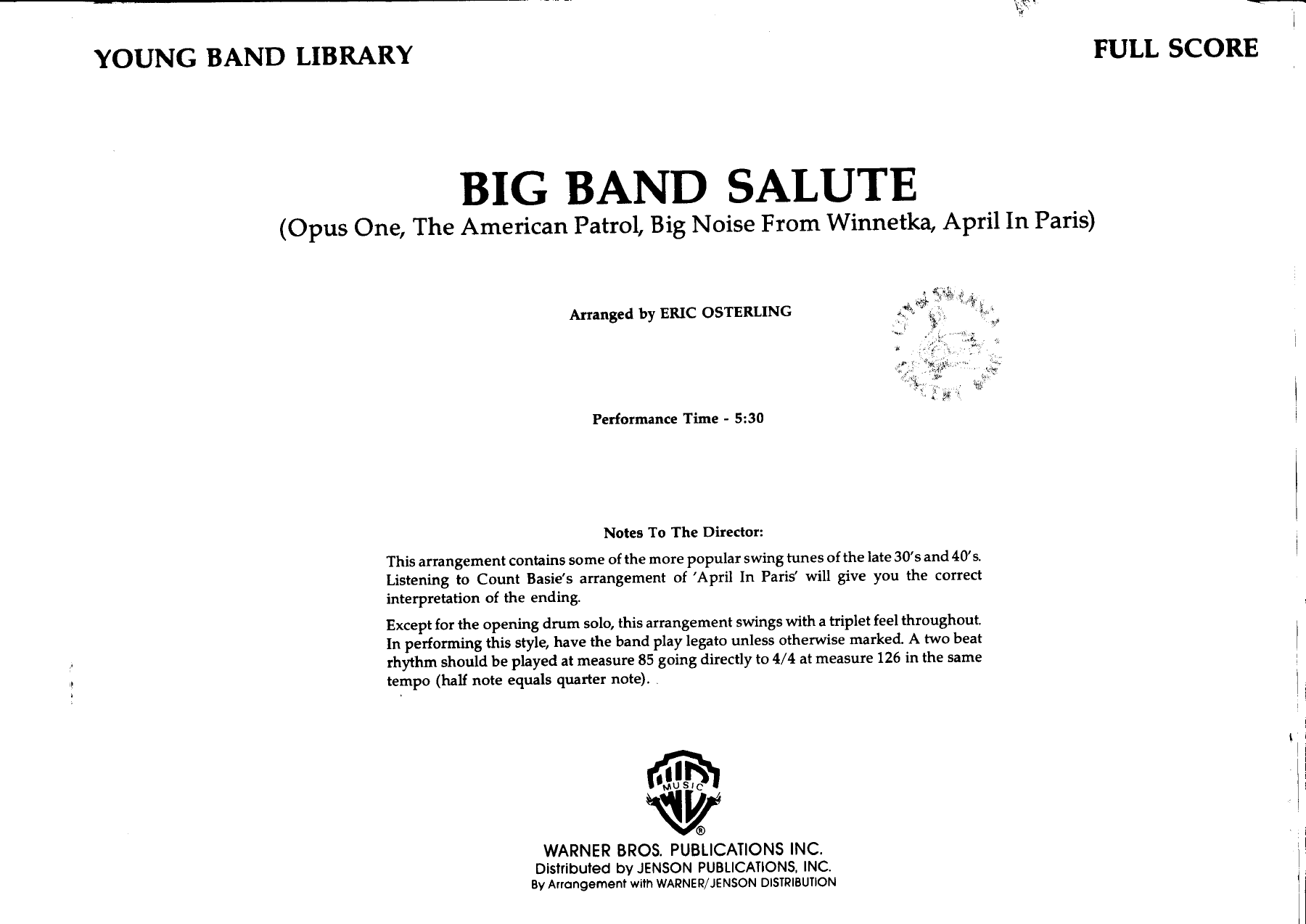
Big Band Salute (E.Osterling)
Composed by ERIC OSTERLING
Arranged by E.Osterling
- Ensemble: Concert Band
- Style: Swing
- Pages: 90
- Instruments (32): Flute (& Piccolo), Oboe, Bb Clarinet 1, Bb Clarinet 2, Bb Clarinet 3, Eb Alto Clarinet, Bb Bass Clarinet, Eb Alto Saxophone 1, Eb Alto Saxophone 2, Bb Tenor Saxophone, Eb Baritone Saxophone, Bassoon, Bb Trumpet 1, Bb Trumpet 2, Bb Trumpet 3, F Horn 1, F Horn 2, Trombone 1, Trombone 2, Baritone B.C., Baritone T.C., Tuba, String Bass, Percussion I, Percussion II, Mallet Percussion, Timpani, 1st Eb Horn, 2nd Eb Horn, 1st Bb Trombone (Treble Clef), 2nd Bb Trombone (Treble Clef), Bb Bass (Treble Clef)
- Difficulty: advanced
- Content: Individual Parts
- Format: PDF Download (Instant)
- Price: $22.99
"Big Band Salute," composed and arranged by the prolific Eric Osterling, stands as a quintessential example of mid-20th century American concert band literature, expertly capturing the vibrant energy and accessible melodies characteristic of the swing era. While not a jazz standard in the improvisational sense, Osterling's original compositions for concert band often drew heavily from the popular big band sound, making pieces like "Big Band Salute" a staple in school and community concert programs from the 1950s through the 1970s. This piece embodies the celebratory, optimistic spirit of post-war America, translating the infectious rhythms and brassy fanfares of swing into a format suitable for larger, non-jazz-specific ensembles. Osterling’s enduring legacy lies in his ability to craft engaging, pedagogically sound works that introduce young musicians to sophisticated musical concepts within an approachable framework, and "Big Band Salute" is a prime illustration of this talent. Musically, "Big Band Salute" is an exuberant and straightforward medium-up tempo swing piece, primarily set in a bright 4/4 meter. The overall mood is one of joyous fanfare and rhythmic drive, designed to evoke the grandeur and excitement of a classic big band performance. The harmonic language is firmly rooted in traditional tonal harmony, utilizing diatonic progressions with occasional blues-inflected voicings that lend it an authentic swing flavor. The piece maintains a consistent high energy level, driven by a walking bass line (often articulated by low brass and woodwinds) and a crisp, syncopated rhythmic foundation. Its bright key signature, typically Bb Major or Eb Major, contributes to its uplifting and accessible character, making it immediately appealing to both performers and audiences. Osterling's arrangement of "Big Band Salute" is a masterclass in adapting big band aesthetics for the concert band. He skillfully distributes melodic lines and rhythmic figures across the diverse instrumentation, ensuring every section has engaging material. Distinctive features include powerful brass fanfares that mimic big band shout choruses, often featuring layered voicings in the trumpets and trombones. Woodwind soli sections provide moments of intricate counterpoint and melodic interplay, showcasing the agility of flutes, clarinets, and saxophones, often doubling or harmonizing with brass. While not featuring extended improvised solos typical of jazz charts, the arrangement includes prominent melodic statements by various sections, often culminating in a full ensemble tutti. The technical demands are moderate, focusing on precise rhythmic articulation, clean ensemble entrances, and maintaining a consistent swing feel across all voices. This arrangement is ideally suited for high school and developing collegiate concert bands, as well as community ensembles seeking a spirited and accessible swing-style concert opener or closer. Its clear structure, engaging melodies, and well-distributed parts make it an excellent pedagogical tool for teaching swing rhythms, ensemble balance, and dynamic contrast within a larger ensemble context. The rewarding experience comes from achieving a unified, energetic sound that truly captures the "big band" spirit, making it a crowd-pleaser and a valuable addition to any concert program. To achieve an authentic performance of "Big Band Salute," conductors should emphasize a consistent, driving medium-up swing feel from the outset; avoid a straight eighth-note interpretation. Articulation is paramount: brass should play with crisp, accented attacks on syncopated figures, while woodwinds should maintain a light, flowing legato on melodic lines, contrasting with punchy staccatos where marked. Pay close attention to dynamic contrasts, particularly in the fanfares and shout choruses, building intensity through crescendos to powerful *fortissimo* climaxes. Rehearsal should focus on precise rhythmic alignment between sections, especially in the layered brass and woodwind soli passages. While no special techniques like plunger mutes are explicitly required, encouraging a slight vibrato in sustained brass and saxophone notes will enhance the swing aesthetic. Ensure the bass line (often shared by tuba, baritone, and low woodwinds) provides a solid, unwavering foundation. Q: What instrumentation is included in the "Big Band Salute (E.Osterling)" arrangement? A: This arrangement is scored for a standard concert band, typically including flutes, oboes, clarinets, bassoons, saxophones (alto, tenor, baritone), trumpets, French horns, trombones, euphonium, tuba, and a comprehensive percussion section. The 90 pages include a full score and individual parts for all standard instruments. Q: What is the difficulty level of "Big Band Salute (E.Osterling)"? A: "Big Band Salute" is considered a Grade 3 (medium) difficulty arrangement. It presents moderate technical challenges suitable for high school, developing collegiate, and community concert bands, focusing on rhythmic precision, ensemble balance, and dynamic control rather than extreme virtuosic demands. Q: What musical style and historical context does "Big Band Salute (E.Osterling)" represent? A: This piece is an original composition by Eric Osterling, written in the swing style of the mid-20th century. It captures the energetic and celebratory big band sound popular from the 1940s to 1960s, adapted for the concert band ensemble. Q: What makes Eric Osterling's arrangement of "Big Band Salute" unique? A: Osterling's arrangement is distinctive for its skillful adaptation of big band idioms for concert band, featuring powerful brass fanfares, intricate woodwind soli sections, and a driving swing feel distributed effectively across the full ensemble. It showcases his talent for creating pedagogically sound yet exciting music. Q: What is the typical performance duration and tempo of "Big Band Salute (E.Osterling)"? A: "Big Band Salute" typically performs at a medium-up swing tempo, around 120-144 beats per minute. The average performance duration is approximately 3 minutes, making it an excellent choice for a concert opener or closer.
Questions and answers
- What is included in the Big Band Salute (E.Osterling) PDF?
- The verified current file contains a conductor score and individual parts across 90 pages.
- How many instruments or parts are listed for Big Band Salute (E.Osterling)?
- The verified instrumentation list contains 32 entries for this Concert Band arrangement.
- Who is credited for Big Band Salute (E.Osterling)?
- Composer: ERIC OSTERLING. Arranger: E.Osterling.
- What difficulty is listed for Big Band Salute (E.Osterling)?
- The verified difficulty level is advanced.
- What style is listed for Big Band Salute (E.Osterling)?
- The catalog lists the style as Swing.
- Can I preview Big Band Salute (E.Osterling) before buying?
- Yes. The product page provides a preview generated from the current PDF file.
- How is Big Band Salute (E.Osterling) delivered?
- After successful payment, the digital PDF is made available for download. The displayed price is $22.99.
Musicians Also Search For
Big Band Salute E.Osterling PDF • Big Band Salute E.Osterling sheet music • Big Band Salute arranged by E.Osterling • E.Osterling concert band charts • E.Osterling jazz arrangements PDF • Big Band Salute ERIC OSTERLING sheet music • Big Band Salute ERIC OSTERLING concert band arrangements • ERIC OSTERLING concert band charts • Big Band Salute concert band arrangements • Big Band Salute concert band PDF download • Big Band Salute jazz sheet music • concert band sheet music download • Big Band Salute conductor score PDF • Big Band Salute individual parts download • Big Band Salute sheet music PDF • Big Band Salute Swing charts • Swing concert band arrangements • buy Big Band Salute sheet music • download Big Band Salute PDF • Big Band Salute jazz charts • best E.Osterling concert band arrangements • ERIC OSTERLING arranged by E.Osterling • Big Band Salute printable sheet music • concert band repertoire PDF