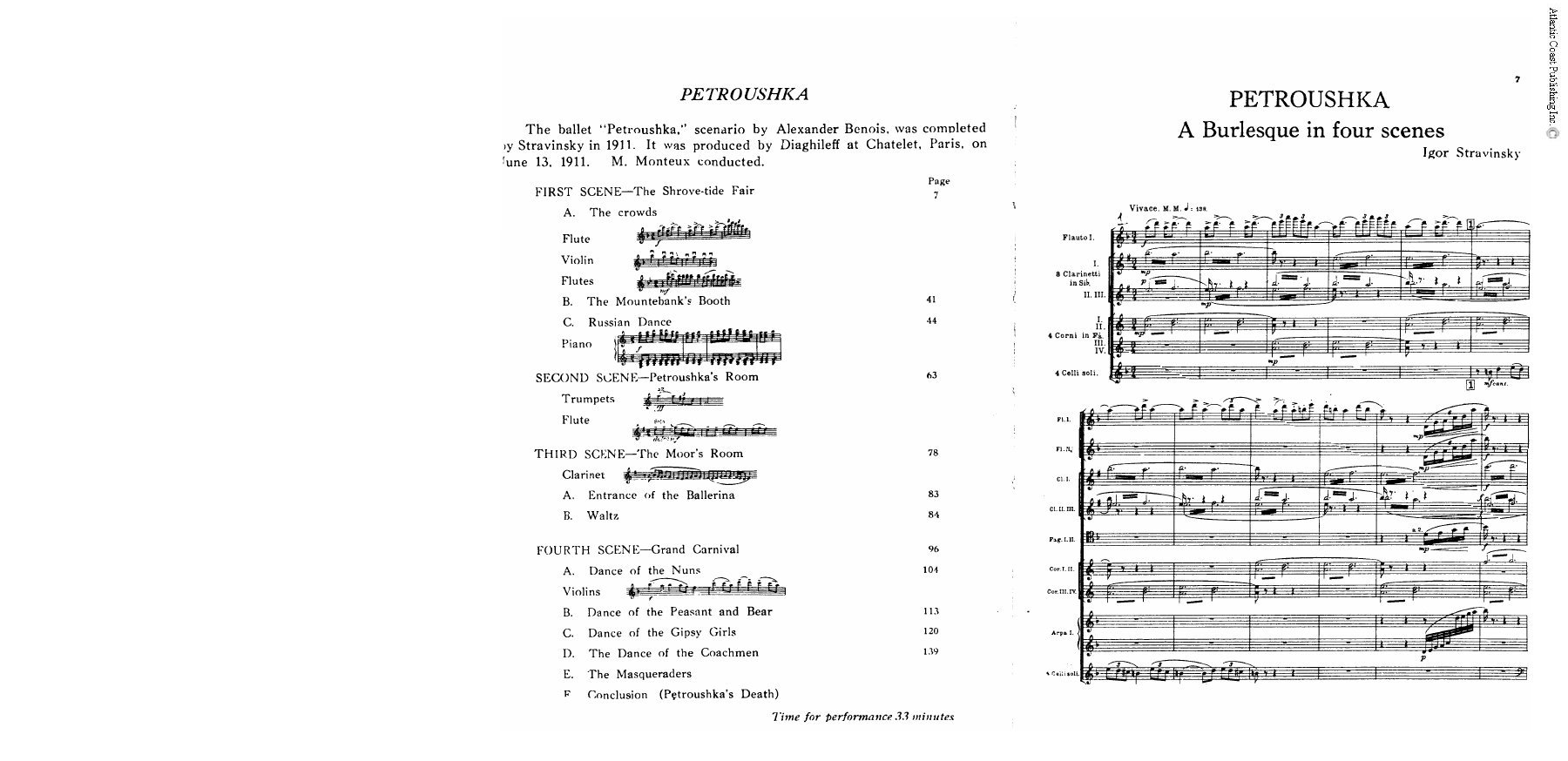
Stravinsky Petrushka (I.Stravinsky) sheet music preview

Stravinsky Petrushka (I.Stravinsky)

Composed by Igor Stravinsky

Arranged by Igor Stravinsky

  • Ensemble: Concert Band
  • Style: Traditional
  • Pages: 75
  • Instruments (46): Flute I, Flute II, Piccolo I, Piccolo II, Oboe I, Oboe II, Oboe III, English Horn, Clarinet I, Clarinet II, Clarinet III, Bass Clarinet, Bassoon I, Bassoon II, Bassoon III, Contrabassoon, Horn I, Horn II, Horn III, Horn IV, Trumpet I, Trumpet II, Cornet I, Cornet II, Trombone I, Trombone II, Trombone III, Tuba, Timpani, Triangle, Tambourine, Snare Drum, Cymbals, Bass Drum, Tam-tam, Xylophone, Glockenspiel, Harp I, Harp II, Piano, Celesta, Violin I, Violin II, Viola, Cello, Double Bass
  • Difficulty: advanced
  • Content: Individual Parts
  • Format: PDF Download (Instant)
  • Price: $22.99

Igor Stravinsky's *Petrushka*, a revolutionary ballet score from the early 20th century, stands as a cornerstone of the modernist movement in classical music. Composed in 1911 for Sergei Diaghilev's Ballets Russes, its premiere sent shockwaves through the Parisian musical scene, much like *The Rite of Spring* two years later. While not a jazz standard in the traditional sense, *Petrushka*'s groundbreaking use of polytonality, complex rhythms, and vivid orchestration profoundly influenced subsequent generations of composers across various genres, including those who would later define jazz's avant-garde. This specific arrangement, attributed to Stravinsky himself, presents the iconic first tableau of the ballet, "The Shrovetide Fair," adapted for the concert band medium, maintaining the original's vibrant, often chaotic, and deeply expressive character. This arrangement of *Petrushka* plunges the ensemble into a bustling, carnival-like atmosphere. The musical character is defined by its rapid shifts in mood, dynamic contrasts, and the famous "Petrushka chord" (C major and F# major simultaneously), which creates a distinctive dissonant yet colorful sound world. The tempo is generally allegro, often marked *Allegro giusto*, with frequent accelerandos and ritardandos that mimic the ebb and flow of a lively fairground. The piece is not in a single key but rather explores a polytonal landscape, demanding precise intonation and keen listening from all sections. The mood oscillates between whimsical playfulness, boisterous energy, and moments of poignant melancholy, particularly during Petrushka's own themes. While the original ballet is scored for a massive orchestra, this concert band transcription skillfully retains the essential timbres and dramatic sweep, translating Stravinsky's unique sound into the wind and percussion idiom. Stravinsky's approach to adapting his own work for concert band is characterized by meticulous attention to detail and an understanding of the ensemble's unique capabilities. Rather than merely transcribing, this arrangement re-orchestrates with an ear for the concert band's specific colors and dynamic range. The iconic melodies, such as the "Russian Dance" and Petrushka's own lament, are distributed across various sections—woodwinds, brass, and percussion—often in intricate counterpoint. There are no traditional "soli" sections in the jazz sense, but rather featured melodic lines that weave through the dense texture, demanding virtuosic execution from principal players. The technical challenges are considerable, including rapid articulation, complex rhythmic figures, demanding dynamic control, and the need for a cohesive ensemble sound amidst polytonal harmonies. Performing this piece is immensely rewarding, offering musicians the chance to engage with a landmark work of the 20th century, exploring its rhythmic vitality, harmonic audacity, and narrative power. This arrangement is ideally suited for advanced high school, collegiate, community, and professional concert bands. Its demands on individual technique, ensemble precision, and musical interpretation necessitate a highly skilled and dedicated group. Bands with strong woodwind and brass sections, capable of navigating intricate passages and maintaining clear articulation at high speeds, will find this piece particularly gratifying. The extensive percussion writing also requires a robust and well-equipped percussion section. It serves as an excellent vehicle for developing advanced ensemble skills, particularly in rhythmic accuracy, dynamic shaping, and understanding complex harmonic structures, making it a valuable addition to any serious concert band's repertoire. Navigating Stravinsky's *Petrushka* requires meticulous attention to rhythmic precision and dynamic contrast. Conductors should emphasize clarity in complex meters and polyrhythms, particularly in the opening "Shrovetide Fair" sections, where multiple rhythmic layers often occur simultaneously. The tempo marking is generally *Allegro giusto*, but flexibility is key, with frequent *accelerandos* and *ritardandos* dictating the narrative flow. Woodwind players must focus on crisp articulation and agile fingerwork for the rapid melodic passages, while brass sections need strong breath support for sustained, powerful chords and precise attacks. Intonation is paramount due to the polytonal nature of the work; encourage sectional tuning and careful listening across the ensemble. Percussionists are integral, needing a wide array of instruments and the ability to execute intricate, often sudden, rhythmic figures with precision and dramatic flair. Rehearsal should prioritize sectional work to solidify challenging passages before integrating into the full ensemble, focusing on dynamic shaping to highlight Stravinsky's vivid orchestration. Q: What instruments and parts are included in this arrangement of "Stravinsky Petrushka"? A: This concert band arrangement includes a full complement of standard wind instruments (flutes, oboes, clarinets, bassoons, saxophones), brass (trumpets, horns, trombones, tuba), and a comprehensive percussion section, totaling 75 pages of score and parts. Q: What is the difficulty level of this "Petrushka" arrangement for concert band? A: This arrangement is considered advanced to professional level, requiring highly skilled musicians due to its complex rhythms, challenging technical passages, polytonal harmonies, and demands for precise ensemble coordination and dynamic control. Q: What is the musical style and historical context of this piece? A: The musical style is Traditional, representing early 20th-century classical modernism. *Petrushka* was originally composed as a ballet in 1911 by Igor Stravinsky, known for its innovative orchestration, rhythmic vitality, and harmonic audacity. Q: What makes this specific arrangement of "Petrushka" unique? A: This arrangement is unique because it is attributed to Igor Stravinsky himself, offering an authentic re-orchestration of his original ballet score for the concert band medium, meticulously translating his iconic sound world and dramatic intent. Q: What is the approximate performance duration and overall tempo feel of this arrangement? A: The performance duration for this first tableau of *Petrushka* is approximately 8-10 minutes. The overall tempo feel is predominantly *Allegro giusto*, characterized by a bustling, carnival-like energy with frequent shifts in speed and mood.

Questions and answers

What is included in the Stravinsky Petrushka (I.Stravinsky) PDF?
The verified current file contains a conductor score across 75 pages.
How many instruments or parts are listed for Stravinsky Petrushka (I.Stravinsky)?
The verified instrumentation list contains 46 entries for this Concert Band arrangement.
Who is credited for Stravinsky Petrushka (I.Stravinsky)?
Composer: Igor Stravinsky. Arranger: Igor Stravinsky.
What difficulty is listed for Stravinsky Petrushka (I.Stravinsky)?
The verified difficulty level is advanced.
What style is listed for Stravinsky Petrushka (I.Stravinsky)?
The catalog lists the style as Traditional.
Can I preview Stravinsky Petrushka (I.Stravinsky) before buying?
Yes. The product page provides a preview generated from the current PDF file.
How is Stravinsky Petrushka (I.Stravinsky) delivered?
After successful payment, the digital PDF is made available for download. The displayed price is $22.99.

Musicians Also Search For

Stravinsky Petrushka Igor Stravinsky PDFStravinsky Petrushka Igor Stravinsky sheet musicStravinsky Petrushka arranged by Igor StravinskyIgor Stravinsky concert band chartsIgor Stravinsky jazz arrangements PDFStravinsky Petrushka Igor Stravinsky concert band arrangementsStravinsky Petrushka concert band arrangementsStravinsky Petrushka concert band PDF downloadStravinsky Petrushka jazz sheet musicconcert band sheet music downloadStravinsky Petrushka conductor score PDFStravinsky Petrushka sheet music PDFStravinsky Petrushka Traditional chartsTraditional concert band arrangementsbuy Stravinsky Petrushka sheet musicdownload Stravinsky Petrushka PDFStravinsky Petrushka jazz chartsbest Igor Stravinsky concert band arrangementsStravinsky Petrushka printable sheet musicconcert band repertoire PDF

All arrangements by Igor Stravinsky All Igor Stravinsky sheet music