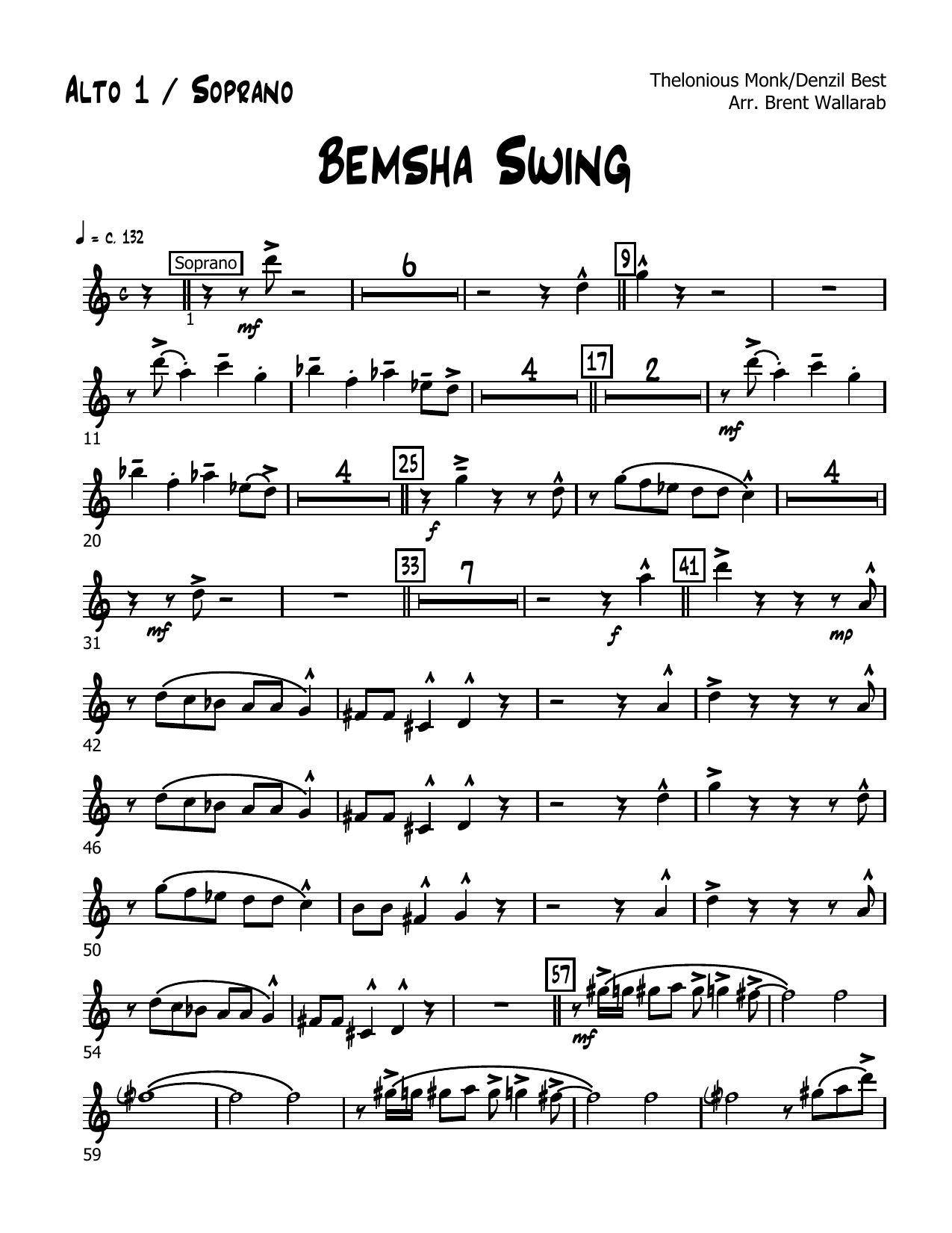
Bemsha Swing (B.Wallarab) sheet music preview

Bemsha Swing (B.Wallarab)

Composed by Thelonious Monk

Arranged by Thelonious Monk (arr.C.Byars)

  • Ensemble: Big Band
  • Pages: 78
  • Instruments (18): Alto 1 / Soprano Saxophone, Alto 2 Saxophone, Tenor 1 Saxophone, Tenor 2 Saxophone, Baritone Saxophone, Trumpet 1, Trumpet 2, Trumpet 3, Trumpet 4, Trumpet 5, Trombone 1, Trombone 2, Trombone 3 (Jazz), Trombone 4, Piano, Bass, Drums, Guitar
  • Difficulty: advanced
  • Content: Individual Parts
  • Format: PDF Download (Instant)
  • Price: $24.99

Composed by the legendary high priest of bebop, Thelonious Monk, alongside Denzil Best, "Bemsha Swing" first emerged during a pivotal era of modern jazz innovation and was famously documented on Monk’s landmark 1952 Blue Note sessions and his quintessential 1954 Prestige recording, *Monk*. As a cornerstone of the Monk repertoire, the composition stands out for its haunting, fragmented melody, angular intervals, and a hypnotic harmonic rhythm that dances deftly between traditional swing sensibilities and avant-garde abstraction. It challenges conventional tonal expectations while retaining an infectious, earthy groove that has captivated jazz aficionados and instrumentalists for over seven decades. Bebop modernism meets clever contemporary tailoring in this striking small-big-band interpretation crafted by C. Byars. The arrangement reimagines Monk's idiosyncratic piano architecture for a nimble seven-piece horn and rhythm ensemble, maintaining the composer's characteristic spiky tension while injecting a driving, medium-up swing pulse. The mood shifts effortlessly from playful, teasing unison statements to rich, dissonant chordal clusters that evoke the smoky ambiance of 1950s New York jazz clubs. Byars utilizes sparse, highly economical voicings that leave plenty of open air in the texture, allowing the inherent blues-infused irony and rhythmic displacement of Monk’s original concept to breathe and cut through the ensemble cleanly. Soli passages and thematic interplay are distributed dynamically across the front line, which includes Alto Saxophone, Tenor Saxophone, Trumpet, and Trombone, backed by a robust rhythm section featuring piano. The horns frequently trade jagged counter-melodies and tight, punchy background figures that challenge the players' internal clock and stylistic cohesion. Solo opportunities are structurally integrated to give improvisers ample space to stretch out over Monk’s deceptive changes, requiring performers to navigate unexpected harmonic turns with melodic logic rather than rote scale-running. The technical demands reside less in breakneck velocity and more in rhythmic precision, stylistic phrasing, and the ability to swing hard while executing asymmetrical accents. Advanced high school, collegiate, and professional jazz ensembles will find this 78-page publication an exceptional vehicle for developing modern harmonic awareness and ensemble listening. Because the configuration strips away the clutter of a traditional 17-piece big band, every player functions as a vital chamber jazz soloist, making individual accountability high and musical rewards exceptionally rich. Conductor and players alike will relish the chance to unpack Byars' clever reharmonizations and bring a fresh, chamber-scale vitality to one of modern jazz’s most enduringly idiosyncratic masterpieces. Unlocking the distinct character of this arrangement requires absolute rhythmic unity and a deep understanding of Monk's signature angular phrasing. The tempo should be kept at a comfortable, driving medium swing; rushing the pulse will dilute the inherent swagger and blues-drenched weight of the harmonies. Conductors must ensure the rhythm section—particularly the piano—embraces the sparse, percussive comping style style associated with Monk, avoiding over-playing to let the horns' chromatic voicings resonate. Horn players should pay close attention to articulation markings, treating short notes with crisp definition and accented notes with a bluesy lean. Rehearsals should initially isolate the tricky unison lines at a slower tempo to lock in intonation on the sharper, dissonant intervals before dialing up to performance speed. Emphasize dynamic contrast; the abrupt shifts from delicate, whispered comping to bold, assertive shout statements are what give this chart its theatrical edge. Q: What specific instruments and parts are included in this arrangement? A: This chart is scored for a 7-instrument ensemble featuring Alto Saxophone, Tenor Saxophone, Trumpet, Trombone, and a rhythm section anchored by Piano, spanning a comprehensive 78-page master score and parts set. Q: What is the difficulty level of this C. Byars arrangement? A: It is tailored for advanced high school, collegiate, and professional chamber jazz ensembles due to its sophisticated harmonic language, sparse textures, and requirement for precise stylistic cohesion. Q: What is the historical background of the underlying musical composition? A: "Bemsha Swing" is a celebrated jazz standard composed by Thelonious Monk and Denzil Best, famously recorded during Monk's formative early-1950s sessions for Blue Note and Prestige. Q: What makes this particular version by C. Byars unique? A: It cleverly scales down Monk's complex, idiosyncratic piano and small-group writing into a lean 7-instrument format, utilizing transparent, modern voicings that preserve the original's harmonic tension and angular charm. Q: What is the recommended tempo and general feel for performing this piece? A: The arrangement is designed for a driving, medium-up swing feel that prioritizes rhythmic pocket, dynamic contrast, and crisp articulation over sheer velocity.

Questions and answers

What is included in the Bemsha Swing (B.Wallarab) PDF?
The verified current file contains a conductor score and individual parts across 78 pages.
How many instruments or parts are listed for Bemsha Swing (B.Wallarab)?
The verified instrumentation list contains 18 entries for this Big Band arrangement.
Who is credited for Bemsha Swing (B.Wallarab)?
Composer: Thelonious Monk. Arranger: Thelonious Monk (arr.C.Byars).
What difficulty is listed for Bemsha Swing (B.Wallarab)?
The verified difficulty level is advanced.
Can I preview Bemsha Swing (B.Wallarab) before buying?
Yes. The product page provides a preview generated from the current PDF file.
How is Bemsha Swing (B.Wallarab) delivered?
After successful payment, the digital PDF is made available for download. The displayed price is $24.99.

Musicians Also Search For

Bemsha Swing Thelonious Monk (arr.C.Byars) PDFBemsha Swing Thelonious Monk (arr.C.Byars) sheet musicBemsha Swing arranged by Thelonious Monk (arr.C.Byars)Thelonious Monk (arr.C.Byars) big band chartsThelonious Monk (arr.C.Byars) jazz arrangements PDFBemsha Swing Thelonious Monk sheet musicBemsha Swing Thelonious Monk big band arrangementsThelonious Monk big band chartsBemsha Swing big band arrangementsBemsha Swing big band PDF downloadBemsha Swing jazz sheet musicbig band sheet music downloadBemsha Swing conductor score PDFBemsha Swing individual parts downloadBemsha Swing sheet music PDFbuy Bemsha Swing sheet musicdownload Bemsha Swing PDFBemsha Swing jazz chartsbest Thelonious Monk (arr.C.Byars) big band arrangementsThelonious Monk arranged by Thelonious Monk (arr.C.Byars)Bemsha Swing printable sheet musicbig band repertoire PDF

All arrangements by Thelonious Monk (arr.C.Byars) All Thelonious Monk sheet music