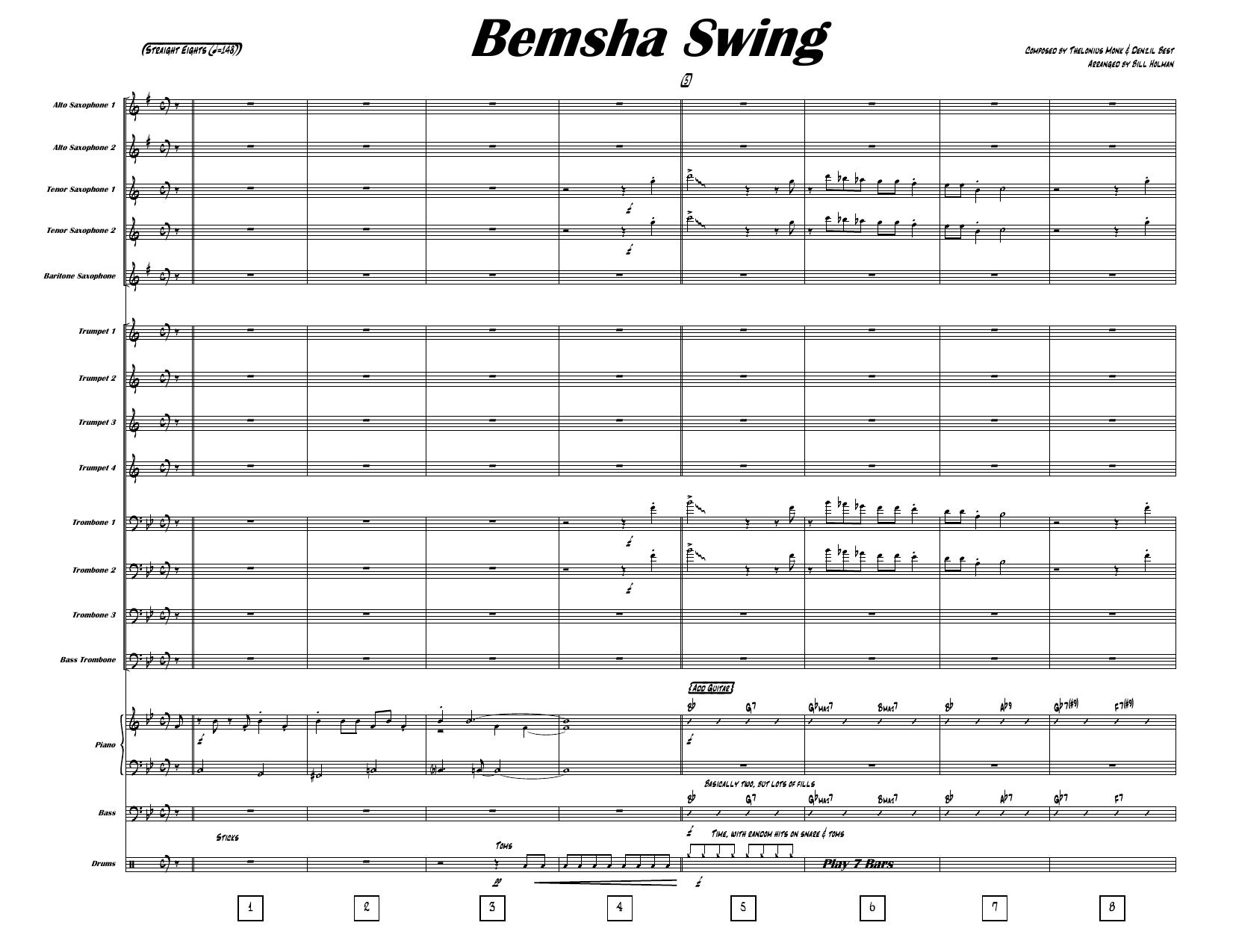
Bemsha Swing (B.Holman)
Composed by Thelonious Monk
Arranged by Bill Holman
- Ensemble: Big Band
- Pages: 79
- Instruments (17): Alto Saxophone 1, Alto Saxophone 2, Tenor Saxophone 1, Tenor Saxophone 2, Baritone Saxophone, Trumpet 1, Trumpet 2, Trumpet 3, Trumpet 4, Trombone 1, Trombone 2, Trombone 3, Bass Trombone, Piano, Guitar, Bass, Drums
- Difficulty: advanced
- Content: Individual Parts
- Format: PDF Download (Instant)
- Price: $24.99
Thelonious Monk’s angular masterpiece "Bemsha Swing," co-written with Denzil Best, first entered the modern jazz lexicon during the early 1950s, quickly establishing itself as a quintessential bebop and modal-leaning standard. Celebrated for its deceptive simplicity, haunting whole-tone colorations, and insistent rhythmic displacement, the tune challenges conventional harmonic expectations. When legendary West Coast arranger Bill Holman turned his pen toward this Monk classic, he seized upon the composition’s inherent structural quirks, transforming a sparse piano trio or small-group vehicle into a masterclass of ingenious big band architecture. Holman, renowned for his brilliant counterpoint, dynamic sectional interplay, and fearless harmonic re-imagining, treats the source material not merely as a melody to be harmonized, but as a living canvas for architectural development. Driven by a crisp, resilient medium-up swing feel in 4/4 time, this arrangement crackles with nervous energy, sophisticated wit, and an unmistakable modern jazz edge. The mood shifts fluidly between playful, angular head statements and towering, thunderous tutti blocks that showcase Holman’s signature dense voicings. Rather than relying on predictable swing-era clichés, the chart utilizes staggered entrances, jagged rhythmic unisons, and sharp dynamic contrasts to capture Monk’s idiosyncratic spirit. The saxophones and brass frequently trade brisk motivic fragments, creating a dense, interlocking tapestry of sound that demands absolute rhythmic precision and acute ears from every section in the ensemble. Holman’s unique methodology shines brightest in how he redistributes Monk’s original thematic material across the 17-piece big band. The melody is introduced through clever sectional fragmentation, with lower voices anchoring the surreal harmonic shifts while upper woodwinds and brass dart around the edges with dry articulation. Featured solo space allows improvisers to stretch out over changes that retain Monk's characteristic ambiguity, while the background figures behind the soloists provide a masterclass in modern modal accompaniment. The climax builds toward a quintessential Holman shout chorus—a structurally intricate, high-energy tour de force that tests the ensemble's stamina, range, and tuning before resolving into a sly, understated coda. Advanced college ensembles, top-tier high school groups, and professional regional big bands will find this chart an exhilarating addition to their repertoire. Because of its demanding inner-part writing, exposed sectional passages, and the requirement for a sophisticated, driving swing concept, it serves as an exceptional vehicle for festival performance or advanced concert programming. Performers and audiences alike will revel in the way Holman bridges the gap between East Coast bebop iconoclasm and West Coast cool sophistication, delivering a timeless arrangement that remains remarkably fresh and intellectually stimulating. Mastering Bill Holman’s arrangement of "Bemsha Swing" requires rigorous attention to articulation, balance, and a resilient, driving medium-up swing groove. The primary technical challenge lies in the execution of the angular, disjointed bebop lines; players must articulate short notes with dry, punchy precision without clipping the forward momentum of the time. The rhythm section is the anchor here—the drummer should maintain a conversational, highly interactive ride cymbal pattern in the style of Max Roach or Art Blakey, avoiding heavy-handed backbeats while keeping the tempo locked. Brass players must exercise extreme care with dynamic control during dense chordal clusters, ensuring that the primary melody cuts through without forcing the tone. Rehearsal should begin slowly, isolating the complex counterpoint between the saxophones and lower brass to lock in tuning and rhythmic alignment before pushing toward the performance tempo. Pay close attention to sudden dynamic shifts and unexpected accents, as these micro-surprises are essential to capturing Monk’s eccentric aesthetic through Holman’s sophisticated lens. Q: What instruments and parts are included in this big band arrangement? A: The arrangement is scored for a standard 17-piece big band instrumentation consisting of 2 alto saxophones, 2 tenor saxophones, 1 baritone saxophone, 4 trumpets, 4 trombones, piano, guitar, bass, and drums, plus a comprehensive conductor score spanning 79 pages. Q: What is the difficulty level of this chart? A: This arrangement is graded as advanced, making it best suited for top-tier college ensembles, advanced high school jazz bands, and professional organizations due to its complex counterpoint, exposed lines, and technical demands. Q: What is the musical style and historical context of the piece? A: It is a sophisticated modern big band jazz arrangement of Thelonious Monk’s classic bebop standard, filtered through Bill Holman’s signature West Coast compositional and arranging style. Q: What makes this specific arrangement by Bill Holman unique? A: Holman transforms Monk's sparse, angular small-group tune into a richly textured orchestral work utilizing inventive counterpoint, dense and unexpected harmonic voicings, and striking sectional fragmentation rather than standard, predictable big band clichés. Q: What is the recommended performance tempo and duration? A: The chart is designed to be performed at a driving medium-up swing tempo, with a typical performance duration running around 4 to 5 minutes depending on the length of the improvised solos.
Questions and answers
- What is included in the Bemsha Swing (B.Holman) PDF?
- The verified current file contains a conductor score and individual parts across 79 pages.
- How many instruments or parts are listed for Bemsha Swing (B.Holman)?
- The verified instrumentation list contains 17 entries for this Big Band arrangement.
- Who is credited for Bemsha Swing (B.Holman)?
- Composer: Thelonious Monk. Arranger: Bill Holman.
- What difficulty is listed for Bemsha Swing (B.Holman)?
- The verified difficulty level is advanced.
- Can I preview Bemsha Swing (B.Holman) before buying?
- Yes. The product page provides a preview generated from the current PDF file.
- How is Bemsha Swing (B.Holman) delivered?
- After successful payment, the digital PDF is made available for download. The displayed price is $24.99.
Musicians Also Search For
Bemsha Swing Bill Holman PDF • Bemsha Swing Bill Holman sheet music • Bemsha Swing arranged by Bill Holman • Bill Holman big band charts • Bill Holman jazz arrangements PDF • Bemsha Swing Thelonious Monk sheet music • Bemsha Swing Thelonious Monk big band arrangements • Thelonious Monk big band charts • Bemsha Swing big band arrangements • Bemsha Swing big band PDF download • Bemsha Swing jazz sheet music • big band sheet music download • Bemsha Swing conductor score PDF • Bemsha Swing individual parts download • Bemsha Swing sheet music PDF • buy Bemsha Swing sheet music • download Bemsha Swing PDF • Bemsha Swing jazz charts • best Bill Holman big band arrangements • Thelonious Monk arranged by Bill Holman • Bemsha Swing printable sheet music • big band repertoire PDF