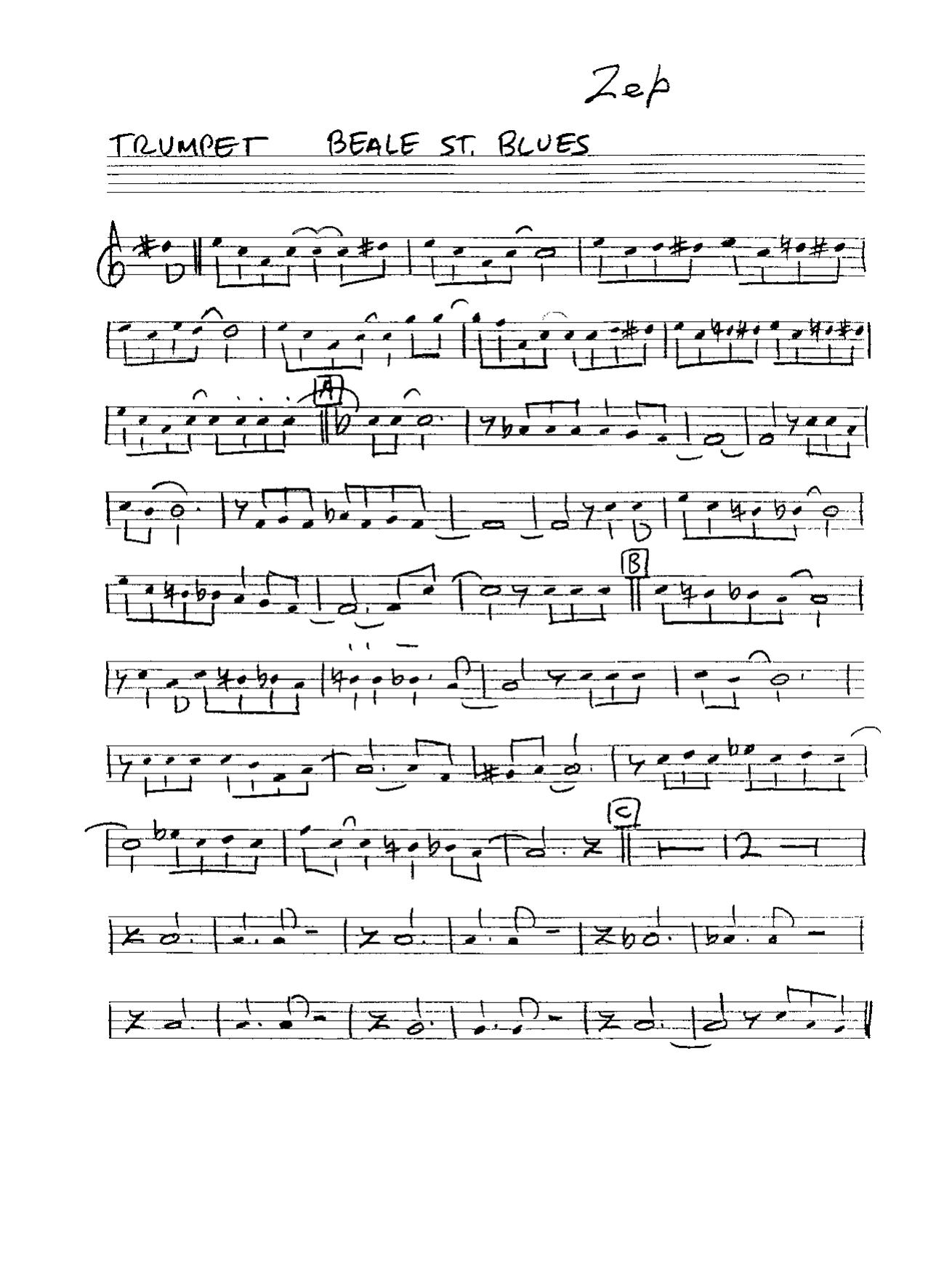
Beale Street Blues (Z.Meissner) sheet music preview

Beale Street Blues (Z.Meissner)

Composed by W.C. Handy

Arranged by Zep Meissner

  • Ensemble: Dixieland Band
  • Style: Blues
  • Pages: 14
  • Instruments (8): Trumpet, Clarinet, Tenor Saxophone, Trombone, Banjo, Piano, Bass, Drums
  • Difficulty: easy
  • Content: Individual Parts
  • Format: PDF Download (Instant)
  • Price: $18.99

W.C. Handy's seminal "Beale Street Blues," originally composed in 1916, stands as a cornerstone of the blues and an indispensable entry in the early jazz repertoire. This piece encapsulates the vibrant, often melancholic, yet ultimately resilient spirit of the historic Beale Street in Memphis, Tennessee, a crucible of African American music and culture. Handy, often hailed as the "Father of the Blues," was instrumental in formalizing and popularizing the blues form, transitioning it from an oral tradition to published sheet music. "Beale Street Blues" is a classic example of the 12-bar blues progression, infused with ragtime syncopation and a distinct melodic charm that made it an instant favorite among early jazz and blues artists, cementing its status as a timeless standard. Zep Meissner's arrangement of "Beale Street Blues" for Dixieland band masterfully captures the authentic feel of this foundational era. The musical character is defined by a medium-tempo, driving two-beat feel, typical of early jazz and New Orleans styles, often interpreted with a relaxed, swinging lilt. While the original is firmly in a blues aesthetic, Meissner's treatment infuses it with the joyous, collective improvisation spirit of Dixieland. The arrangement is primarily set in a comfortable concert F major, allowing for bright brass voicings and a warm, resonant clarinet tone. The mood is celebratory and nostalgic, evoking images of bustling dance halls and street parades, making it an energizing and historically resonant performance piece. Meissner's distinctive approach shines through in his thoughtful orchestration and adherence to period-appropriate techniques. The arrangement features the melody prominently carried by the trumpet and clarinet in unison or octaves during initial statements, often with a trombone counter-melody providing a rich harmonic foundation. Soli sections are expertly crafted, allowing the full ensemble to engage in tightly voiced, yet idiomatically correct, melodic passages that mimic the spontaneous interplay of early jazz. While not featuring extended harmonies or modulations beyond the blues form, Meissner's genius lies in his use of traditional Dixieland voicings and a clear, concise structure that provides ample space for featured soloists, typically the clarinet, trumpet, and trombone, to improvise over the familiar blues changes. The arrangement culminates in a spirited shout chorus, bringing the piece to an exhilarating close, characteristic of the genre. This arrangement is ideally suited for high school, college, and community Dixieland bands seeking an authentic and engaging performance experience. Its clear structure, manageable technical demands, and faithful rendition of the Dixieland style make it an excellent educational tool for understanding early jazz ensemble playing. The rewarding aspect lies in the opportunity for musicians to develop their collective improvisation skills within a structured framework and to connect with a pivotal piece of American musical heritage. The interplay between the front-line instruments and the driving rhythm section creates a vibrant, interactive performance that is both challenging and immensely satisfying. Conductors should emphasize a relaxed, yet driving two-beat feel from the rhythm section, ensuring the bass and tuba provide a solid foundation without rushing. The tempo should be kept at a medium clip, allowing for clarity in the melodic lines and comfortable improvisation. Technical challenges primarily involve maintaining clean articulation in the brass and woodwinds, particularly in the unison and octave melody lines. Encourage a light, swinging interpretation of eighth notes, rather than a straight feel. Special techniques like subtle falls and scoops in the brass and clarinet will enhance the authentic Dixieland sound. Rehearsal time should be dedicated to balancing the front-line voices during soli sections, ensuring each part is heard distinctly while contributing to the overall blend. Pay close attention to dynamics, building energy towards the shout chorus. Q: What instruments and parts are included in this arrangement? A: This Dixieland band arrangement typically includes parts for Bb Clarinet, Bb Trumpet, Trombone, Piano, Banjo/Guitar, Bass/Tuba, and Drums. Additional optional parts may be included for flexibility. Q: What is the difficulty level of Zep Meissner's "Beale Street Blues" arrangement? A: This arrangement is considered to be of a medium difficulty level, suitable for high school, college, and community Dixieland bands. It offers engaging parts for all musicians without presenting overly complex technical demands. Q: What is the musical style and historical context of this piece? A: "Beale Street Blues" is a classic 12-bar blues composition by W.C. Handy, arranged here in an authentic Dixieland style. It originates from the early 20th century, representing a foundational piece in the development of blues and early jazz. Q: What makes Zep Meissner's arrangement of "Beale Street Blues" unique? A: Meissner's arrangement stands out for its faithful adherence to traditional Dixieland voicings and structure, featuring well-crafted soli sections, clear melodic statements, and ample space for improvisation, all while maintaining a historically authentic two-beat feel. Q: What is the approximate performance duration or tempo for this arrangement? A: The performance duration will vary slightly based on the number and length of improvised solos, but typically ranges from 3:00 to 4:00 minutes. It is best performed at a medium, relaxed two-beat tempo, around 120-130 beats per minute.

Questions and answers

What is included in the Beale Street Blues (Z.Meissner) PDF?
The verified current file contains individual parts across 14 pages.
How many instruments or parts are listed for Beale Street Blues (Z.Meissner)?
The verified instrumentation list contains 8 entries for this Dixieland Band arrangement.
Who is credited for Beale Street Blues (Z.Meissner)?
Composer: W.C. Handy. Arranger: Zep Meissner.
What difficulty is listed for Beale Street Blues (Z.Meissner)?
The verified difficulty level is easy.
What style is listed for Beale Street Blues (Z.Meissner)?
The catalog lists the style as Blues.
Can I preview Beale Street Blues (Z.Meissner) before buying?
Yes. The product page provides a preview generated from the current PDF file.
How is Beale Street Blues (Z.Meissner) delivered?
After successful payment, the digital PDF is made available for download. The displayed price is $18.99.

Musicians Also Search For

Beale Street Blues Zep Meissner PDFBeale Street Blues Zep Meissner sheet musicBeale Street Blues arranged by Zep MeissnerZep Meissner dixieland band chartsZep Meissner jazz arrangements PDFBeale Street Blues W.C. Handy sheet musicBeale Street Blues W.C. Handy dixieland band arrangementsW.C. Handy dixieland band chartsBeale Street Blues dixieland band arrangementsBeale Street Blues dixieland band PDF downloadBeale Street Blues jazz sheet musicdixieland band sheet music downloadBeale Street Blues individual parts downloadBeale Street Blues sheet music PDFBeale Street Blues Blues chartsBlues dixieland band arrangementsbuy Beale Street Blues sheet musicdownload Beale Street Blues PDFBeale Street Blues jazz chartsbest Zep Meissner dixieland band arrangementsW.C. Handy arranged by Zep MeissnerBeale Street Blues printable sheet musicdixieland band repertoire PDF

All arrangements by Zep Meissner All W.C. Handy sheet music