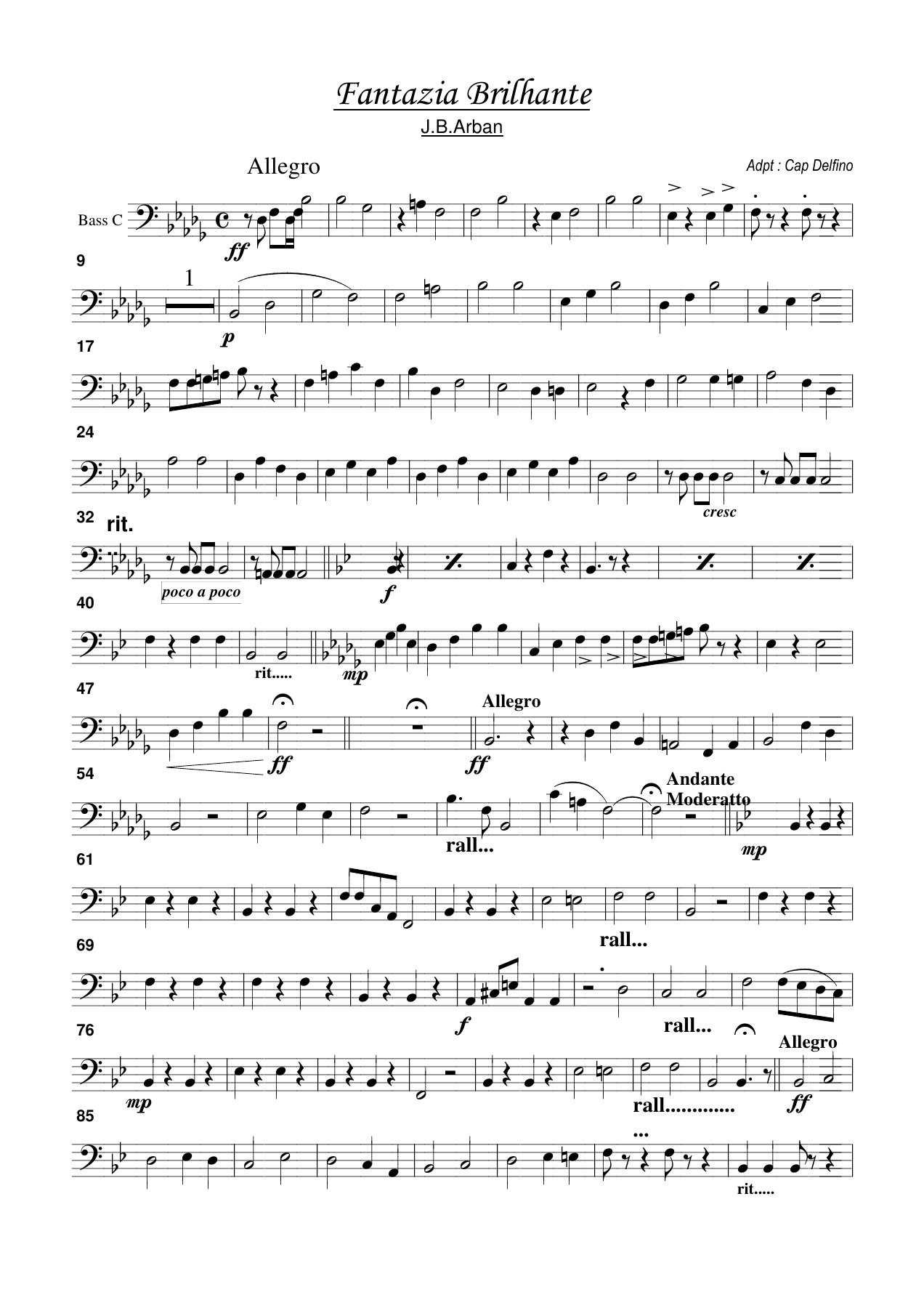
bass C (C.Delfino) sheet music preview

bass C (C.Delfino)

Composed by Jean-Baptiste Arban

Arranged by Cap Delfino

  • Ensemble: Concert Band
  • Style: Jazz Standard
  • Pages: 16
  • Instruments (14): 1st Alto Saxophone, 2nd Tenor Saxophone, 3rd Alto Saxophone, 4th Tenor Saxophone, 5th Eb Baritone Saxophone, 1st Trumpet, 2nd Trumpet, 3rd Trumpet, 1st Trombone, 2nd Trombone, 3rd Trombone, Piano, Bass, Drums
  • Difficulty: easy
  • Content: Individual Parts
  • Format: PDF Download (Instant)
  • Price: $10.99

Jean-Baptiste Arban's "Carnival of Venice" variations, a cornerstone of brass pedagogy since the mid-19th century, finds a vibrant, unexpected new life in Cap Delfino's masterful jazz concert band arrangement, "bass C (C.Delfino)." While Arban's original was a virtuosic showpiece for cornet, Delfino reimagines its iconic theme through the lens of a medium-tempo jazz standard, transforming its classical precision into a swinging, sophisticated ensemble experience. The original "Carnival" theme, a folk melody of Italian origin, has been adopted by countless instrumentalists across genres, but its transformation into a jazz standard, particularly for a large ensemble, offers a fresh perspective on its enduring melodic appeal. Delfino's arrangement pays homage to the theme's historical significance while firmly planting it in the modern jazz lexicon, making it a compelling addition to any concert band's repertoire. Delfino’s "bass C" breathes with a relaxed, medium swing feel, typically around 120-130 BPM, establishing a groove that is both comfortable and infectious. The arrangement is primarily set in C Major, offering a bright, accessible harmonic landscape, yet Delfino skillfully introduces subtle chromaticism and extended harmonies characteristic of post-bop jazz. The mood is generally upbeat and playful, reflecting the carnival spirit of the original, but infused with the cool sophistication of a classic jazz ensemble. The energy builds organically, transitioning from a laid-back opening statement to more dynamic, full-band sections. Delfino's distinctive arranging style is immediately apparent: he favors rich, dense voicings that give the concert band a truly authentic big band sound, utilizing the full spectrum of brass and woodwind colors. Expect intricate counterlines and thoughtful harmonic reharmonizations that elevate the familiar melody. A hallmark of Delfino's approach is his clever use of soli sections and a powerful shout chorus that drives the arrangement to its climax. The melody is initially presented by the trombones and low brass, giving the piece its "bass C" moniker and a wonderfully warm, grounded texture. This low brass feature provides a unique twist, contrasting with the high-register brilliance of Arban's original. Subsequent melodic statements are passed through various sections, including a captivating woodwind soli that showcases Delfino's command of orchestral jazz writing. While there isn't a dedicated open solo section, Delfino integrates brief, improvised-sounding fills and obbligatos within the ensemble, allowing individual players to contribute their jazz sensibilities. The technical challenges are moderate, focusing on rhythmic precision, blend, and articulation within the swing idiom, making it highly rewarding for a college or advanced high school concert band. Professional community bands will also find this piece engaging, offering a fresh, challenging take on a familiar tune. The arrangement culminates in a powerful, full-ensemble shout chorus that is both exhilarating to perform and thrilling for the audience. "bass C (C.Delfino)" requires a precise yet relaxed medium swing feel, ideally around 120-130 BPM, emphasizing a strong rhythmic foundation from the bass and drums. Conductors should encourage a loose, flowing eighth-note interpretation rather than a rigid, straight feel. Key technical challenges include maintaining rhythmic accuracy in the intricate soli passages and achieving a balanced, blended sound in the rich, extended voicings. Pay close attention to dynamics, particularly the subtle swells and decays that give the arrangement its jazz character. Articulation should be light and precise for swing figures, with clear separation between notes. There are no specific mute requirements beyond standard brass mutes for dynamic contrast. Rehearsal time should be dedicated to establishing the core swing groove, ensuring clean transitions between sections, and balancing the low brass melody against the accompanying figures. Focus on the interplay between sections, particularly during the woodwind and brass soli, to achieve a cohesive, professional sound. Q: What instruments/parts are included in the "bass C (C.Delfino)" arrangement? A: This arrangement is scored for a standard concert band, typically including flutes, oboe, clarinets, bassoons, alto saxophones, tenor saxophone, baritone saxophone, trumpets, horns, trombones, euphonium, tuba, string bass, and a full drum set part. Q: What is the difficulty level of this arrangement? A: "bass C (C.Delfino)" is rated as a Grade 4-5 arrangement, making it suitable for advanced high school, college, or professional community concert bands. It requires solid instrumental technique and a good understanding of jazz rhythmic and harmonic concepts. Q: What is the musical style and historical context of this piece? A: This arrangement transforms Jean-Baptiste Arban's classical "Carnival of Venice" theme into a sophisticated, medium-swing jazz standard for concert band, blending 19th-century melodic charm with 20th-century jazz harmonies and rhythms. Q: What makes Cap Delfino's arrangement of "bass C" unique? A: Delfino's arrangement is distinctive for its rich, dense voicings, the initial presentation of the melody by the low brass, and its clever integration of soli sections and a powerful shout chorus, effectively reimagining a classical theme in a genuine jazz concert band idiom. Q: What is the typical performance duration and tempo for "bass C (C.Delfino)"? A: The typical performance duration for this arrangement is approximately 3.5 to 4.5 minutes. It is designed to be performed at a medium swing tempo, generally around 120-130 beats per minute.

Questions and answers

What is included in the bass C (C.Delfino) PDF?
The verified current file contains individual parts across 16 pages.
How many instruments or parts are listed for bass C (C.Delfino)?
The verified instrumentation list contains 14 entries for this Concert Band arrangement.
Who is credited for bass C (C.Delfino)?
Composer: Jean-Baptiste Arban. Arranger: Cap Delfino.
What difficulty is listed for bass C (C.Delfino)?
The verified difficulty level is easy.
What style is listed for bass C (C.Delfino)?
The catalog lists the style as Jazz Standard.
Can I preview bass C (C.Delfino) before buying?
Yes. The product page provides a preview generated from the current PDF file.
How is bass C (C.Delfino) delivered?
After successful payment, the digital PDF is made available for download. The displayed price is $10.99.

Musicians Also Search For

bass C Cap Delfino PDFbass C Cap Delfino sheet musicbass C arranged by Cap DelfinoCap Delfino concert band chartsCap Delfino jazz arrangements PDFbass C Jean-Baptiste Arban sheet musicbass C Jean-Baptiste Arban concert band arrangementsJean-Baptiste Arban concert band chartsbass C concert band arrangementsbass C concert band PDF downloadbass C jazz sheet musicconcert band sheet music downloadbass C individual parts downloadbass C sheet music PDFbass C Jazz Standard chartsJazz Standard concert band arrangementsbuy bass C sheet musicdownload bass C PDFbass C jazz chartsbest Cap Delfino concert band arrangementsJean-Baptiste Arban arranged by Cap Delfinobass C printable sheet musicconcert band repertoire PDF

All arrangements by Cap Delfino All Jean-Baptiste Arban sheet music