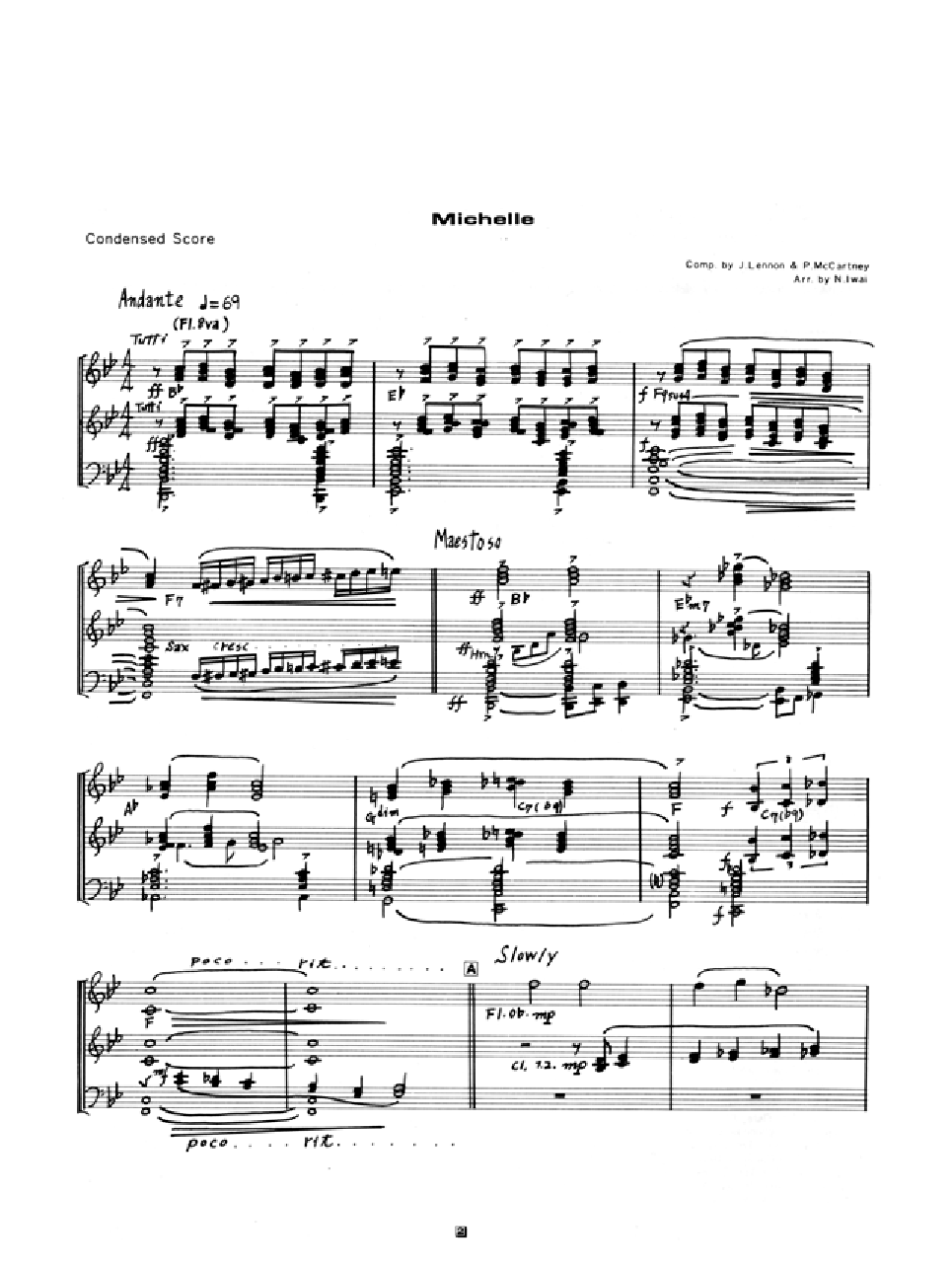
Michelle (N.Iwai)
Composed by Lennon-McCartney
Arranged by N.Iwai
- Ensemble: Concert Band
- Style: Pop
- Pages: 36
- Instruments (30): 1st Flute & Piccolo, 2nd Flute, Oboe, Bassoon, Clarinet in Eb, 1st Clarinet in Bb, 2nd Clarinet in Bb, 3rd Clarinet in Bb, Bass Clarinet in Bb, 1st Alto Saxophone in Eb, 2nd Alto Saxophone in Eb, 1st Tenor Saxophone in Bb, 2nd Tenor Saxophone in Bb, Baritone Saxophone in Eb, 1st Trumpet in Bb, 2nd Trumpet in Bb, 3rd Trumpet in Bb, 4th Trumpet in Bb, 1st & 2nd Horns in F, 3rd & 4th Horns in F, 1st Trombone, 2nd Trombone, 3rd Trombone, Euphonium, Bass in C, Electric Bass Guitar, Drums, Timpani, Glockenspiel, Xylophone, Vibraphone & Tambourine
- Difficulty: medium
- Content: Individual Parts
- Format: PDF Download (Instant)
- Price: $22.99
Originally penned by the iconic songwriting duo Lennon-McCartney and released on The Beatles' groundbreaking 1965 album *Rubber Soul*, "Michelle" quickly transcended its pop origins to become a beloved standard, cherished for its elegant melody and sophisticated harmonic movement. This particular arrangement, crafted by N.Iwai, re-envisions the classic tune for concert band, offering a fresh perspective on its enduring charm. The original piece is a quintessential example of mid-1960s pop innovation, blending folk influences with classical elements, particularly in its distinctive bass line and French lyrical interludes. Its enduring popularity stems from its melodic beauty and the subtle complexity that belies its seemingly simple structure, making it a compelling candidate for diverse interpretations. N.Iwai's treatment of "Michelle" maintains the original's gentle, reflective mood, presenting it as a medium-slow ballad with a flowing, lyrical feel, perfectly suited for a concert band setting. While the original is firmly rooted in pop, Iwai's arrangement leans into its inherent melodicism and harmonic richness, allowing the concert band instrumentation to highlight its expressive qualities. The primary key is thoughtfully chosen to optimize the blend and resonance of the wind instruments, creating a warm, enveloping soundscape. The arrangement emphasizes lush voicings and sustained lines, evoking a sense of calm sophistication. Unlike a typical jazz big band arrangement, there are no improvisational solos; instead, the focus is on the ensemble's ability to shape phrases and achieve a cohesive, expressive sound. The melody of "Michelle" is primarily carried by the upper woodwinds, often in unison or octaves, providing clarity and warmth. Brass sections contribute with rich harmonic pads and counter-melodic figures, supporting the main theme without overpowering it. A distinctive aspect of N.Iwai's arranging style, evident here, is the careful distribution of melodic and harmonic material across the full spectrum of the concert band, ensuring that each section has engaging and musically significant passages. The arrangement features several moments where the instrumentation shifts, offering varied timbral colors, from delicate woodwind passages to full, resonant brass swells. The technical demands are moderate, focusing more on breath control, intonation, and expressive phrasing rather than rapid technical passages, making it highly rewarding for bands capable of achieving a unified, lyrical sound. This arrangement is ideally suited for high school, community, and college concert bands seeking a well-crafted, melodically rich piece that showcases their ensemble's expressive capabilities. It provides an excellent opportunity to work on blend, balance, and sustained lyrical playing within a familiar and much-loved musical context. The absence of complex rhythmic figures or extreme ranges makes it accessible, yet the depth of Iwai's scoring offers ample room for musical interpretation and refinement, allowing bands to achieve a truly polished and moving performance. Conductors should emphasize a consistent, medium-slow tempo that allows for the full breadth of the melodic lines to unfold without rushing. The overall feel should be lyrical and expressive, focusing on sustained phrases and smooth transitions between sections. Pay close attention to dynamics, as much of the piece's emotional impact comes from subtle shifts in volume and articulation. Intonation will be paramount, particularly in the sustained chordal passages where brass and woodwinds blend. Encourage musicians to listen across sections to achieve a unified sonority. The primary technical challenge lies in maintaining breath support for long phrases and achieving a seamless legato. Rehearsal time should be dedicated to shaping the melody, ensuring the main theme is always prominent but beautifully supported by the accompanying voices. Focus on the ensemble's ability to play *together* expressively, rather than on individual virtuosity. Q: What instruments and parts are included in this arrangement? A: This arrangement for concert band typically includes a full complement of woodwinds (flute, oboe, clarinet, bass clarinet, saxophone), brass (trumpet, horn, trombone, euphonium, tuba), and percussion parts, consistent with standard concert band instrumentation. Q: What is the difficulty level of this arrangement? A: N.Iwai's "Michelle" for concert band is generally considered to be of a medium difficulty, suitable for high school, community, and college ensembles. It emphasizes musicality, blend, and phrasing over extreme technical demands. Q: What musical style and historical context does this arrangement represent? A: This arrangement is based on The Beatles' iconic 1965 pop song "Michelle." While the original is pop, N.Iwai's arrangement adapts it for concert band, highlighting its lyrical and harmonic qualities in a medium-slow ballad style. Q: What makes N.Iwai's arrangement of "Michelle" unique? A: N.Iwai's distinctive approach lies in transforming the pop classic into a lush, expressive concert band piece, focusing on rich voicings, careful melodic distribution, and sustained lyrical lines, rather than improvisational elements or complex rhythmic figures. Q: What is the typical performance duration or tempo for this piece? A: "Michelle" is arranged as a medium-slow ballad. A typical performance duration would be approximately 3-4 minutes, allowing for the unhurried and expressive delivery of its beautiful melody and harmonies.
Questions and answers
- What is included in the Michelle (N.Iwai) PDF?
- The verified current file contains a conductor score and individual parts across 36 pages.
- How many instruments or parts are listed for Michelle (N.Iwai)?
- The verified instrumentation list contains 30 entries for this Concert Band arrangement.
- Who is credited for Michelle (N.Iwai)?
- Composer: Lennon-McCartney. Arranger: N.Iwai.
- What difficulty is listed for Michelle (N.Iwai)?
- The verified difficulty level is medium.
- What style is listed for Michelle (N.Iwai)?
- The catalog lists the style as Pop.
- Can I preview Michelle (N.Iwai) before buying?
- Yes. The product page provides a preview generated from the current PDF file.
- How is Michelle (N.Iwai) delivered?
- After successful payment, the digital PDF is made available for download. The displayed price is $22.99.
Musicians Also Search For
Michelle N.Iwai PDF • Michelle N.Iwai sheet music • Michelle arranged by N.Iwai • N.Iwai concert band charts • N.Iwai jazz arrangements PDF • Michelle Lennon-McCartney sheet music • Michelle Lennon-McCartney concert band arrangements • Lennon-McCartney concert band charts • Michelle concert band arrangements • Michelle concert band PDF download • Michelle jazz sheet music • concert band sheet music download • Michelle conductor score PDF • Michelle individual parts download • Michelle sheet music PDF • Michelle Pop charts • Pop concert band arrangements • buy Michelle sheet music • download Michelle PDF • Michelle jazz charts • best N.Iwai concert band arrangements • Lennon-McCartney arranged by N.Iwai • Michelle printable sheet music • concert band repertoire PDF