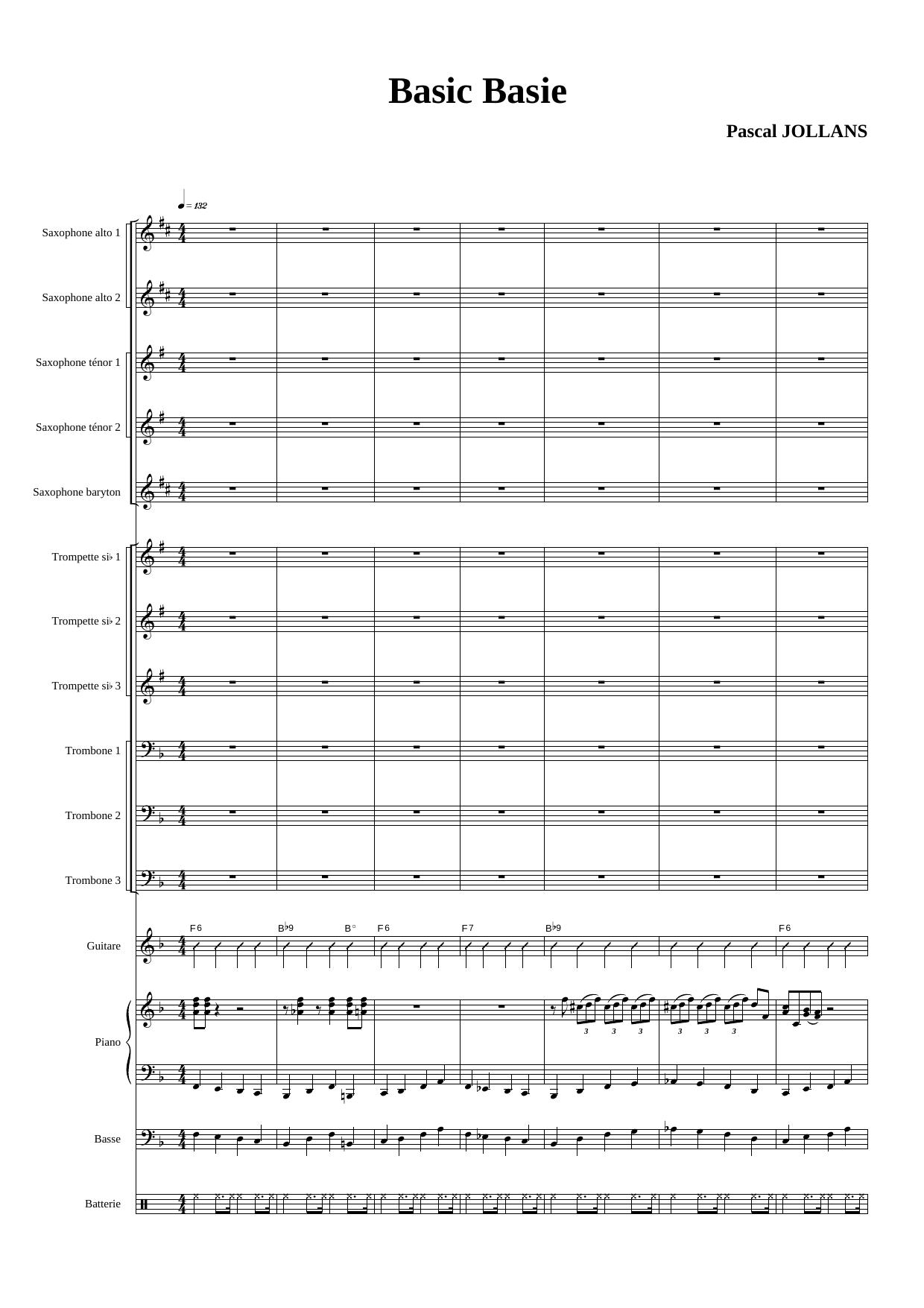
Basic Basie (P.Jollans)
Composed by P. Jollans
Arranged by P.Jollans
- Ensemble: Big Band
- Style: Jazz Standard
- Pages: 32
- Instruments (16): Saxophone Alto 1, Saxophone Alto 2, Saxophone Tenor 1, Saxophone Tenor 2, Saxophone Baryton, Trompette Sib 1, Trompette Sib 2, Trompette Sib 3, Trombone 1, Trombone 2, Trombone 3, Trombone 4 Bb, Guitare, Piano, Basse, Batterie
- Difficulty: easy
- Content: Individual Parts
- Format: PDF Download (Instant)
- Price: $24.99
Channeling the irresistible drive and effortless elegance of the legendary Count Basie Orchestra, "Basic Basie," arranged by P. Jollans, is a masterclass in Kansas City swing style. Rooted in the golden era of big band jazz where the primary emphasis rested heavily on a relentless four-beat rhythm section, blues-inflected horn shout choruses, and call-and-response phrasing, this composition captures the quintessential aesthetic of the 1930s and 40s swing movement. While modern big band charts often overcomplicate textures with dense, contemporary harmonic extensions, this chart honors the tradition of economy of space, proving that swing is less about how many notes are played and more about the precision of the notes that are omitted. Musically, the chart settles into a buoyant, driving medium-swing tempo in 4/4 time that encourages both the band and the audience to tap their feet immediately. The harmonic landscape remains firmly grounded in traditional blues and standard jazz forms, utilizing bright major-key tonalities, crisp minor-seventh substitutions, and signature dominant-seventh voicings that evoke a smoky, high-energy jazz club atmosphere. The mood swings dynamically from sophisticated, laid-back cool during the muted brass statements to an unbridled, explosive energy during the climactic ensemble passages. The energy level is sustained entirely by the momentum of the underlying swing groove, demanding absolute rhythmic synchronization across the entire ensemble. P. Jollans approaches the arrangement with a keen ear for authentic section writing, balancing rich, harmonized sax solis with punchy, staccato brass counterlines that define the Basie tradition. The arrangement strategically deploys classic big band devices, including dropdown dynamic shifts, subtle plunger-style accents, and a textbook shout chorus that builds tension through rhythmic displacement before opening up into a full-ensemble release. The melody is initially introduced cleanly by the saxophones before being handed off to the brass, ensuring every section gets a share of the spotlight. Featured solo sections provide ample space for a featured improviser to stretch out over standard blues or rhythm changes form, backed by punchy background figures from the brass. Advanced high school, collegiate, and community jazz ensembles will find this chart exceptionally rewarding to rehearse and perform. The technical demands are moderate in terms of extreme ranges, but the chart places a premium on stylistic maturity, articulation discipline, and internal timekeeping. Horn players must master short, articulated swing eighth notes, while the rhythm section—particularly the pianist and drummer—must understand the minimalist, comping-heavy approach pioneered by Count Basie and Freddie Green. Delivering an authentic, swinging performance of this arrangement will push a band to listen closely across sections, making it a standout highlight for any spring concert, festival adjudication, or club performance. Success with "Basic Basie" hinges on stylistic uniformity, particularly regarding the execution of swing eighth notes. The conductor should enforce a strict "da-dit" articulation style, ensuring that off-beats are played with crisp authority rather than lazy dragging. The tempo should remain rock-steady; avoid the temptation to rush the shout chorus, as the inherent excitement must come from dynamic contrast and rhythmic precision rather than an acceleration of speed. Rhythm section players must study historical Basie recordings: the pianist should utilize sparse, upper-register comping stabs rather than thick, block-chord voicings, while the guitar player should employ unamplified, four-to-the-bar acoustic rhythm chopping. Horn players should make liberal use of natural drops and doits on accented notes to add authentic vocal inflection, while keeping vibrato tasteful and controlled. Rehearsal time is best spent isolating the rhythm section to lock in the groove before layering in the sax and brass solis piece by piece. Q: What instrumentation and parts are included in this publication? A: The 32-page publication includes a comprehensive conductor score alongside standard big band instrumentation: 5 saxophones (alto 1-2, tenor 1-2, baritone), 4 trumpets, 4 trombones, and a full rhythm section comprising piano, guitar, bass, and drums. Q: What is the difficulty level of this arrangement? A: This arrangement is graded at a medium difficulty level, making it well-suited for proficient high school, collegiate, and community big bands that have a solid grasp of basic swing articulation. Q: What style and historical era does this piece represent? A: The piece represents the classic Kansas City swing style of the 1930s and 1940s, directly emulating the swinging, blues-drenched aesthetic made famous by the Count Basie Orchestra. Q: What makes this specific arrangement by P. Jollans unique? A: It uniquely balances authentic historical big band voicings with accessible contemporary scoring, offering tight shout choruses and well-crafted solis that capture the legendary Basie "less-is-more" philosophy without requiring virtuosic extremes. Q: What is the recommended performance duration and tempo feel? A: The chart is designed for a medium-swing feel with a performance duration of approximately 3 to 4 minutes, depending on the length of the open improvised solo sections.
Questions and answers
- What is included in the Basic Basie (P.Jollans) PDF?
- The verified current file contains a conductor score and individual parts across 32 pages.
- How many instruments or parts are listed for Basic Basie (P.Jollans)?
- The verified instrumentation list contains 16 entries for this Big Band arrangement.
- Who is credited for Basic Basie (P.Jollans)?
- Composer: P. Jollans. Arranger: P.Jollans.
- What difficulty is listed for Basic Basie (P.Jollans)?
- The verified difficulty level is easy.
- What style is listed for Basic Basie (P.Jollans)?
- The catalog lists the style as Jazz Standard.
- Can I preview Basic Basie (P.Jollans) before buying?
- Yes. The product page provides a preview generated from the current PDF file.
- How is Basic Basie (P.Jollans) delivered?
- After successful payment, the digital PDF is made available for download. The displayed price is $24.99.
Musicians Also Search For
Basic Basie P.Jollans PDF • Basic Basie P.Jollans sheet music • Basic Basie arranged by P.Jollans • P.Jollans big band charts • P.Jollans jazz arrangements PDF • Basic Basie P. Jollans sheet music • Basic Basie P. Jollans big band arrangements • P. Jollans big band charts • Basic Basie big band arrangements • Basic Basie big band PDF download • Basic Basie jazz sheet music • big band sheet music download • Basic Basie conductor score PDF • Basic Basie individual parts download • Basic Basie sheet music PDF • Basic Basie Jazz Standard charts • Jazz Standard big band arrangements • buy Basic Basie sheet music • download Basic Basie PDF • Basic Basie jazz charts • best P.Jollans big band arrangements • P. Jollans arranged by P.Jollans • Basic Basie printable sheet music • big band repertoire PDF