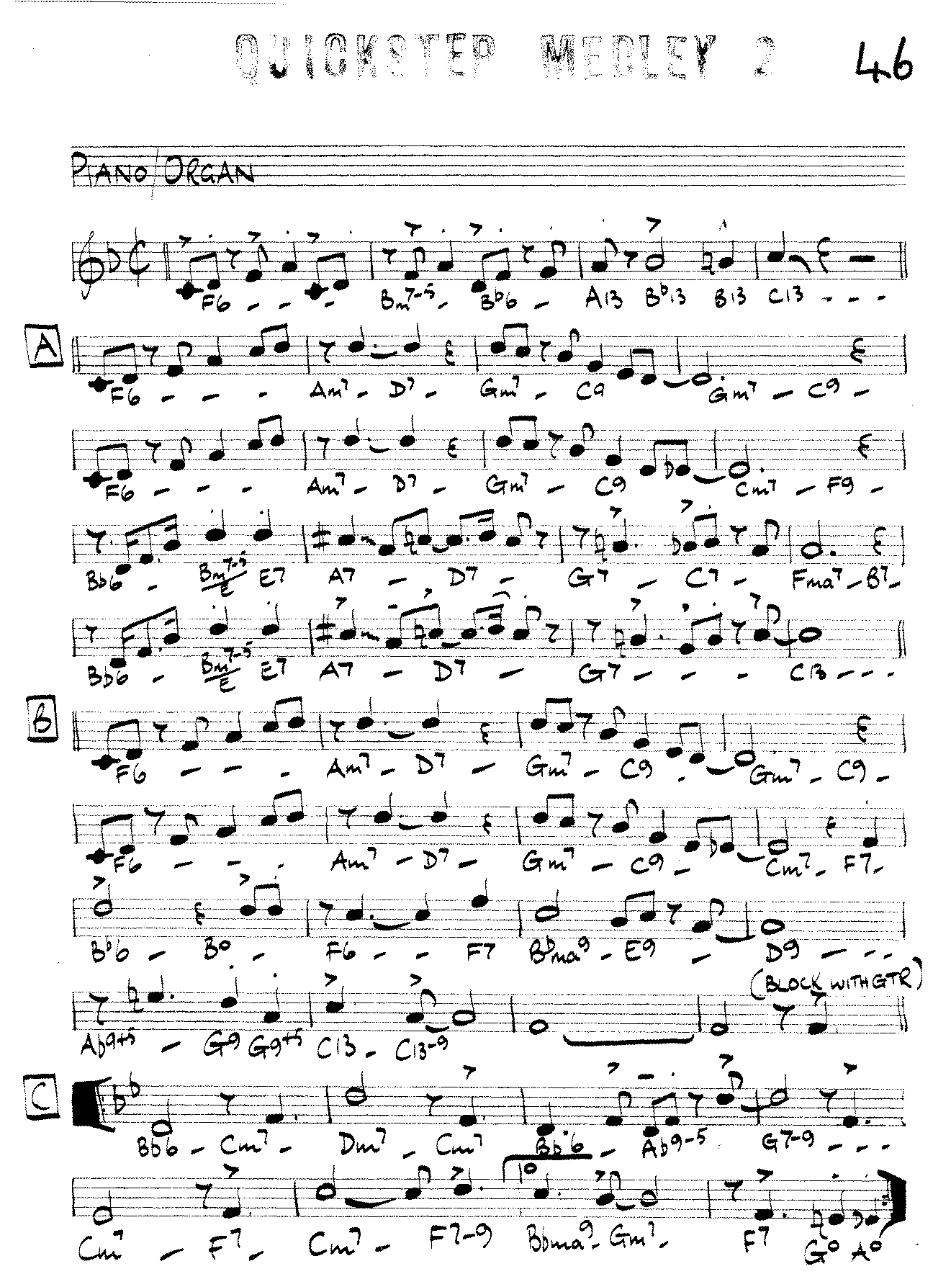
Quickstep Medley 2
Composed by Various
Arranged by Unknown Arranger
- Ensemble: Big Band
- Style: Quickstep
- Pages: 28
- Instruments (14): Piano / Organ, Guitar, Bass, Drums, Alto Saxophone, Tenor Saxophone 1, Tenor Saxophone 2, Trombone 1, Trombone 2, Trombone 3, Trombone 4, Trumpet 1, Trumpet 2, Trumpet 3
- Difficulty: easy
- Content: Individual Parts
- Format: PDF Download (Instant)
- Price: $24.99
The Quickstep, a vibrant and energetic dance form, emerged from the Foxtrot in the 1920s, solidifying its place as a cornerstone of ballroom and social dancing throughout the 20th century. Characterized by its brisk tempo and light, often syncopated rhythms, it quickly became a staple in the repertoire of big bands and dance orchestras. This "Quickstep Medley 2" arrangement, while featuring an unknown arranger, draws upon this rich tradition, likely weaving together several popular tunes from the era that lent themselves perfectly to the quickstep's effervescent charm. These were the melodies that filled dance halls, providing the soundtrack to an era of burgeoning social freedoms and musical innovation, a period when jazz was still evolving from its ragtime and Dixieland roots into the sophisticated big band sound. The original composers, though various, would have contributed to a canon of catchy, memorable tunes designed for movement and celebratory expression. This particular arrangement captures the quintessential quickstep feel with an infectious, driving energy. Expect a bright, up-tempo 4/4 meter, typically around 200-220 beats per minute, demanding precision and buoyancy from the ensemble. The musical character is undeniably cheerful and exhilarating, designed to evoke a sense of joyous movement and lightheartedness. While the specific key is not provided, quickstep arrangements often favor brighter keys like F, Bb, or Eb major to enhance their sparkling quality. The mood is consistently optimistic and lively, making it an excellent choice for setting an upbeat atmosphere. The arrangement likely features a succession of distinct melodic sections, transitioning smoothly between different tunes or thematic ideas, all unified by the quickstep's characteristic rhythmic pulse. The arranger's approach to "Quickstep Medley 2," despite the anonymity, is clearly focused on delivering a robust and authentic big band quickstep experience. Given the ensemble type, one can anticipate classic big band voicings, likely featuring tight, harmonized brass sections that drive the rhythmic and melodic content. The arrangement details specify three trombones, suggesting a prominent role for this section, perhaps with intricate soli passages or powerful block chords that punctuate the ensemble sound. While specific techniques like shout choruses or modulations are not explicitly stated, they are common in quickstep arrangements to build excitement and provide dynamic contrast. The emphasis will be on clean articulation, rhythmic precision, and a unified ensemble sound to maintain the quickstep's characteristic forward momentum. Performance of "Quickstep Medley 2" will be rewarding for bands seeking to master the intricacies of a classic dance style. The melodies are likely distributed across various sections, with the brass, particularly the trombones, carrying significant melodic and harmonic weight. While the arrangement details do not specify solo sections, the nature of quickstep often allows for brief, bright improvised breaks or written-out solos that maintain the danceable tempo. Technical challenges will include maintaining consistent, brisk tempo without rushing, precise articulation in fast passages, and achieving a unified, balanced sound across the full big band. The reward lies in performing a piece that is both historically significant and inherently fun, bringing a vibrant, dance-oriented energy to any performance. This arrangement is ideally suited for college and community big bands looking to expand their repertoire with an authentic quickstep, as well as professional ensembles seeking a spirited and engaging dance number. Conductors should prioritize establishing a consistent, brisk 4/4 quickstep tempo, ideally between 200-220 bpm, from the outset. Emphasize a light, buoyant articulation throughout, avoiding any heaviness that might drag the feel. Key technical challenges include maintaining rhythmic precision in fast passages, particularly in the brass sections, and ensuring clean, unified attacks and releases. Rehearsal should focus on sectionals to perfect intricate brass voicings and ensure balance, especially within the three-trombone section. Pay close attention to dynamic contrasts to prevent the piece from becoming monotonous, building excitement towards climactic moments. While specific techniques like plunger mutes or falls are not explicitly noted, their tasteful inclusion, if appropriate for the melodic lines, can add authentic period flavor. Encourage musicians to feel the dance rhythm, fostering a sense of collective energy and joy in the performance. Q: What instruments and parts are included in the "Quickstep Medley 2" arrangement? A: This arrangement is for a full big band, specifically detailing parts for Trombone 1, Trombone 2, and Trombone 3, totaling 28 pages of music. Q: What is the difficulty level of "Quickstep Medley 2"? A: "Quickstep Medley 2" is suitable for college and community big bands, as well as professional ensembles, requiring proficiency in brisk tempos, precise articulation, and unified ensemble playing. Q: What is the musical style and historical context of this arrangement? A: This arrangement is in the Quickstep style, a lively 4/4 dance form that emerged from the Foxtrot in the 1920s, representing the energetic big band era of social dancing. Q: What makes this arrangement unique, given the "Unknown Arranger"? A: Despite the unknown arranger, this arrangement is notable for its authentic capture of the quickstep's driving energy and likely features classic big band voicings with a prominent role for the three-trombone section, characteristic of the era. Q: What is the typical performance duration or tempo for this quickstep medley? A: Quickstep medleys are typically performed at a brisk tempo, usually around 200-220 beats per minute in 4/4 time, making for an energetic and lively performance.
Questions and answers
- What is included in the Quickstep Medley 2 PDF?
- The verified current file contains individual parts across 28 pages.
- How many instruments or parts are listed for Quickstep Medley 2?
- The verified instrumentation list contains 14 entries for this Big Band arrangement.
- Who is credited for Quickstep Medley 2?
- Composer: Various. Arranger: Unknown Arranger.
- What difficulty is listed for Quickstep Medley 2?
- The verified difficulty level is easy.
- What style is listed for Quickstep Medley 2?
- The catalog lists the style as Quickstep.
- Can I preview Quickstep Medley 2 before buying?
- Yes. The product page provides a preview generated from the current PDF file.
- How is Quickstep Medley 2 delivered?
- After successful payment, the digital PDF is made available for download. The displayed price is $24.99.
Musicians Also Search For
Quickstep Medley 2 Unknown Arranger PDF • Quickstep Medley 2 Unknown Arranger sheet music • Quickstep Medley 2 arranged by Unknown Arranger • Unknown Arranger big band charts • Unknown Arranger jazz arrangements PDF • Quickstep Medley 2 Various sheet music • Quickstep Medley 2 Various big band arrangements • Various big band charts • Quickstep Medley 2 big band arrangements • Quickstep Medley 2 big band PDF download • Quickstep Medley 2 jazz sheet music • big band sheet music download • Quickstep Medley 2 individual parts download • Quickstep Medley 2 sheet music PDF • Quickstep Medley 2 Quickstep charts • Quickstep big band arrangements • buy Quickstep Medley 2 sheet music • download Quickstep Medley 2 PDF • Quickstep Medley 2 jazz charts • best Unknown Arranger big band arrangements • Various arranged by Unknown Arranger • Quickstep Medley 2 printable sheet music • big band repertoire PDF