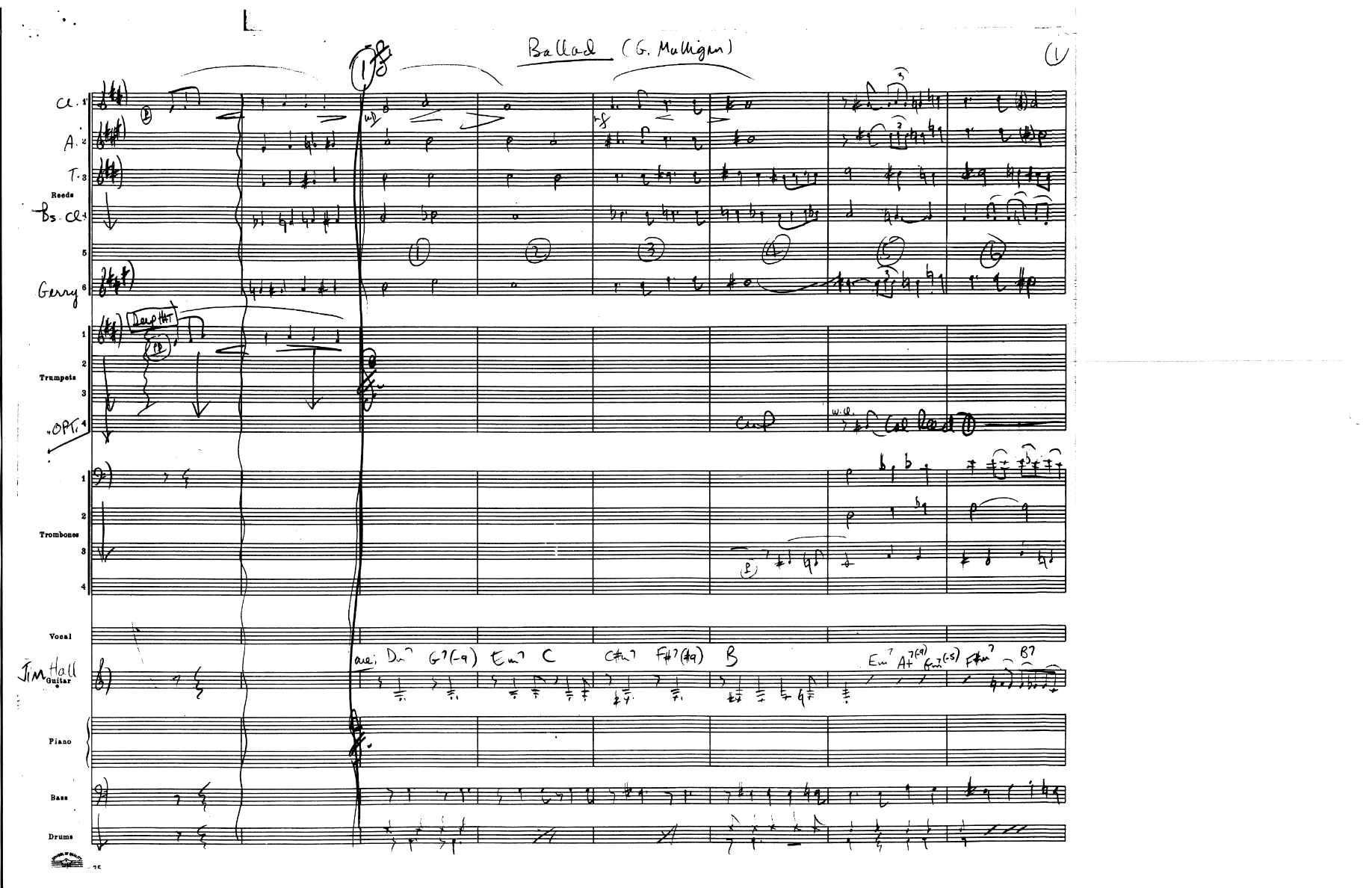
Ballad (G.Mullingan) sheet music preview

Ballad (G.Mullingan)

Composed by Gerry Mulligan

Arranged by Gerry Mulligan

  • Ensemble: Big Band
  • Pages: 36
  • Instruments (15): Reed I (Clarinet), Reed II (Alto Saxophone), Reed III (Tenor Saxophone), Reed IV (Bass Clarinet), Reed V (Baritone Saxophone), Trumpet I, Trumpet II, Trumpet III, Trumpet IV, Trombone I, Trombone II, Trombone III, Guitar, Bass, Drums
  • Difficulty: medium
  • Content: Individual Parts
  • Format: PDF Download (Instant)
  • Price: $24.99

Gerry Mulligan’s distinctive compositional voice occupies a legendary space in modern jazz, defined by his pioneering work with the pianoless quartet and his lush, inventive writing for larger ensembles. Written during the height of the West Coast jazz movement, "Ballad" captures the sophisticated, introspective atmosphere that characterized Mulligan's mid-century output. While Mulligan is most universally celebrated for his iconic baritone saxophone styling, his writing for ensemble formats reveals a masterclass in counterpoint and harmonic economy. This composition bridges the gap between cool jazz understatement and rich, overarching big band lyricism, serving as a masterclass in linear development and subtle dynamic shading. Slow, deeply reflective, and unhurried in its pacing, the work unfolds in a relaxed 4/4 meter that demands absolute control over tone and intonation. The harmonic landscape is sophisticated yet transparent, avoiding thick, block-chord congestion in favor of transparent, linear voice-leading that lets individual countermelodies breathe. The mood shifts fluidly from melancholic introspection to moments of warm, expansive optimism. Rather than relying on heavy, brass-heavy climaxes, the emotional weight is carried by velvety woodwind textures and melancholy harmonic suspensions that evoke the cool, foggy nights of 1950s coastal California. As both composer and arranger, Mulligan brings his signature compositional thumbprint to this chart: the clever utilization of a lightweight horn deployment that maximizes tonal color without excessive volume. The arrangement relies heavily on tight, harmonized sax solids and unique cross-section pairings—frequently wedding the baritone saxophone with the trombone or trumpet to create a dark, resonant composite timbre. Instead of a traditional, bombastic shout chorus, Mulligan constructs a linear, developmental climax that builds organically through rising counterpoint and thickening orchestration, maintaining the delicate ballad aesthetic from the first measure to the final unresolved cadence. The frontline melody is primarily anchored by the saxophone section, with the baritone sax often taking a commanding, lyrical lead that subverts its usual role as a mere rhythm-section anchor. Featured solo space allows a sensitive horn player to stretch out over lush, modal-leaning chord changes that invite expressive rubato phrasing. Technically, the challenges lie not in breakneck velocity, but in endurance, breath control, maintaining a consistent, warm vibrato, and executing precise intonation across wide intervals. Advanced high school, collegiate, and professional jazz ensembles will find immense artistic rewards here, as it forces the ensemble to listen across sections and prioritize blend, balance, and sophisticated phrasing over sheer decibel output. Mastering this chart requires a refined approach to ballad playing where silence and space are just as important as executed notes. The tempo should remain steady yet flexible, resisting any urge to rush through the rubato transitions. Conductors must emphasize horizontal linear momentum over vertical chord-stabbing; every line must sing with vocal quality. The primary technical hurdle is intonation within the saxophone and brass sections during exposed, harmonized passages. Players should spend dedicated rehearsal time balancing the inner voices of the chord clusters. Mutes are generally not required, keeping the acoustic profile pure and organic. Encourage the rhythm section—particularly the pianist and bassist—to practice extreme economy, utilizing sparse, tasteful voicings that leave plenty of room for the horns to breathe. Pay close attention to dynamic markings; the emotional peak of the arrangement relies on a gradual, controlled crescendo rather than sudden, dramatic volume spikes. Q: What instruments and parts are included in this 36-page arrangement? A: Scored specifically for an 8-instrument ensemble, the instrumentation features Alto Saxophone, Tenor Saxophone, Baritone Saxophone, Trumpet, Trombone, and a standard rhythm section framework across the comprehensive 36-page manuscript. Q: What is the difficulty level of this Gerry Mulligan arrangement? A: This piece is best suited for advanced high school, collegiate, and professional jazz ensembles due to its demanding requirements for intonation, breath control, and mature lyrical phrasing. Q: What is the stylistic and historical context of the music? A: Rooted in the 1950s West Coast cool jazz movement, the arrangement reflects Gerry Mulligan's signature transparent counterpoint and sophisticated harmonic style popularized during his legendary small-group and big-band eras. Q: What makes this specific arrangement unique compared to standard big band charts? A: It bypasses traditional, bombastic shout choruses in favor of linear development, inventive cross-section voice pairings, and a prominent, melodic role for the baritone saxophone. Q: What is the recommended tempo and performance duration for this ballad? A: Performed at a slow, unhurried ballad tempo with a relaxed 4/4 feel, the piece typically runs for approximately 4 to 5 minutes depending on the length of the improvised solo sections.

Questions and answers

What is included in the Ballad (G.Mullingan) PDF?
The verified current file contains a conductor score and individual parts across 36 pages.
How many instruments or parts are listed for Ballad (G.Mullingan)?
The verified instrumentation list contains 15 entries for this Big Band arrangement.
Who is credited for Ballad (G.Mullingan)?
Composer: Gerry Mulligan. Arranger: Gerry Mulligan.
What difficulty is listed for Ballad (G.Mullingan)?
The verified difficulty level is medium.
Can I preview Ballad (G.Mullingan) before buying?
Yes. The product page provides a preview generated from the current PDF file.
How is Ballad (G.Mullingan) delivered?
After successful payment, the digital PDF is made available for download. The displayed price is $24.99.

Musicians Also Search For

Ballad Gerry Mulligan PDFBallad Gerry Mulligan sheet musicBallad arranged by Gerry MulliganGerry Mulligan big band chartsGerry Mulligan jazz arrangements PDFBallad Gerry Mulligan big band arrangementsBallad big band arrangementsBallad big band PDF downloadBallad jazz sheet musicbig band sheet music downloadBallad conductor score PDFBallad individual parts downloadBallad sheet music PDFbuy Ballad sheet musicdownload Ballad PDFBallad jazz chartsbest Gerry Mulligan big band arrangementsBallad printable sheet musicbig band repertoire PDF

All arrangements by Gerry Mulligan All Gerry Mulligan sheet music