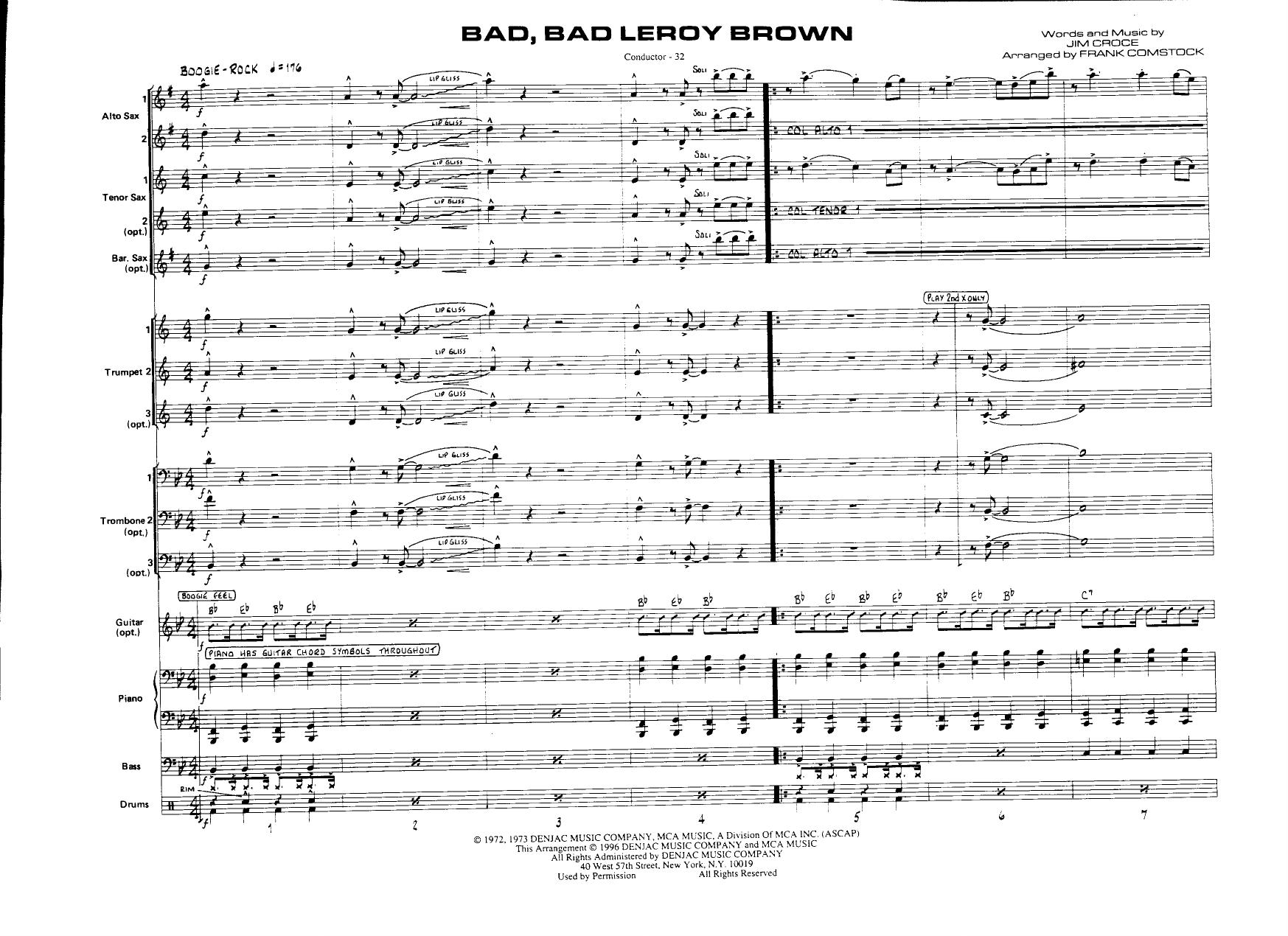
Bad, Bad Leroy Brown (F.Comstock) sheet music preview

Bad, Bad Leroy Brown (F.Comstock)

Composed by Jim Croce

Arranged by Frank Comstock

  • Ensemble: Big Band
  • Pages: 22
  • Instruments (15): 1st Eb Alto Saxophone, 2nd Eb Alto Saxophone, 1st Bb Tenor Saxophone, 2nd Bb Tenor Saxophone, Eb Baritone Saxophone, 1st Bb Trumpet, 2nd Bb Trumpet, 3rd Bb Trumpet, 1st Trombone, 2nd Trombone, 3rd Trombone, Piano, Guitar, Bass, Drums
  • Difficulty: medium
  • Content: Individual Parts
  • Format: PDF Download (Instant)
  • Price: $24.99

Jim Croce’s iconic 1973 storytelling narrative "Bad, Bad Leroy Brown" crossed over from pop-folk chart dominance into the jazz and easy-listening consciousness almost immediately upon release, capturing the gritty, swaggering bravado of a South Side Chicago character. Written during the peak of Croce's singer-songwriter era, the tune’s infectious, blues-infused strut lent itself naturally to big band adaptation. Arranger Frank Comstock seized upon this rhythmic vitality, translating Croce’s acoustic guitar-driven groove into a powerhouse orchestral chart that bridges 1970s pop-culture history with traditional mid-century big band scoring techniques. Driving with a confident, hard-swinging medium-tempo groove in 4/4 time, this arrangement radiates an unyielding, high-energy attitude. The harmonic language blends blues-rooted pentatonic shifts with crisp, punchy extended dominant chords typical of television and studio scoring. Comstock infuses the arrangement with a playful yet driving momentum, characterized by syncopated brass stabs, walking basslines, and a sassy, swaggering saxophone demeanor. The mood is cheeky, bold, and fiercely theatrical, evoking the smoky atmosphere of a classic 1970s TV variety show stage mixed with a traditional basement jazz club. Frank Comstock’s signature scoring style shines through meticulous counterpoint and brilliant section writing, utilizing tight, interlocking voicings across the reeds and brass to mimic the narrative pacing of Croce's lyrics. The arrangement opens with a recognizable, hook-driven vamp before trading melodic duties dynamically between the brass and the saxophone sections. A standout soli section allows the saxophones to purr with rich, sub-tone warmth before building into a roaring, high-octane shout chorus that forces the entire ensemble to dig deep into their articulation. Strategic dynamic contrasts and accented drop-offs keep the texture transparent, ensuring that the driving rhythm section remains the engine room of the performance. Advanced high school, collegiate, and professional community jazz orchestras will find this chart to be an absolute crowd-pleaser that demands both precision and personality. While the individual technical demands are manageable—avoiding excessive ultra-high altissimo or breakneck tempos—the true challenge lies in stylistic execution: locking in the aggressive swing articulation, maintaining a steady, driving groove, and balancing the tongue-in-cheek dramatic flair. Featuring ample room for rhythm section interplay and powerful ensemble hits, it serves as an ideal mid-concert anchor or high-impact closer that guaranteed to connect instantly with any audience. Success with Frank Comstock’s chart hinges on maintaining a relentless, driving medium-swing feel without rushing the tempo. The rhythm section must lock in tightly, keeping the quarter-note pulse steady while the horns handle syncopated punch figures with crisp, military-style tongue articulation. Pay close attention to the dynamic markings; the arrangement relies heavily on sudden sub-ito drops followed by aggressive crescendos to create its signature cinematic tension. Trumpets and trombones should utilize clean, controlled falls and precise doits where indicated, avoiding over-blowing during the ensemble shout chorus to maintain a warm, blended roar rather than a shrill blast. Rehearsals should initially isolate the rhythm section to establish the foundational groove before layering in the sax soli, ensuring that the articulation matches the drummer's hi-hat crispness on beats two and four. Q: What instruments and parts are included in this big band arrangement? A: The instrumentation comprises a standard 15-instrument big band lineup featuring Alto Saxophone 1, Alto Saxophone 2, Tenor Saxophone 1, Tenor Saxophone 2, Baritone Saxophone, plus full brass and rhythm sections, accompanied by a comprehensive conductor score across 22 total pages. Q: What is the difficulty level of this Frank Comstock arrangement? A: This chart is graded at an intermediate to advanced level (typically suitable for upper-level high school, collegiate, and professional community big bands), requiring strong section blend and stylistic versatility rather than extreme technical acrobatics. Q: What is the musical style and historical background of the piece? A: Originally a 1973 Billboard #1 pop hit by singer-songwriter Jim Croce, this arrangement transforms the narrative folk-rock tune into a swaggering, blues-inflected jazz big band chart with a driving medium-swing feel. Q: What makes this specific arrangement unique? A: Frank Comstock brings his legendary studio-arranging genius to the table, combining clever, television-style dynamic contrasts, sassy saxophone soli sections, and a roaring shout chorus that captures the cinematic bravado of the original storytelling lyrics. Q: What is the approximate performance duration and tempo of the chart? A: While performance time varies slightly based on the chosen groove and optional repeats, the chart moves at a confident, driving medium-swing tempo that typically clocks in around 3 to 4 minutes.

Questions and answers

What is included in the Bad, Bad Leroy Brown (F.Comstock) PDF?
The verified current file contains a conductor score and individual parts across 22 pages.
How many instruments or parts are listed for Bad, Bad Leroy Brown (F.Comstock)?
The verified instrumentation list contains 15 entries for this Big Band arrangement.
Who is credited for Bad, Bad Leroy Brown (F.Comstock)?
Composer: Jim Croce. Arranger: Frank Comstock.
What difficulty is listed for Bad, Bad Leroy Brown (F.Comstock)?
The verified difficulty level is medium.
Can I preview Bad, Bad Leroy Brown (F.Comstock) before buying?
Yes. The product page provides a preview generated from the current PDF file.
How is Bad, Bad Leroy Brown (F.Comstock) delivered?
After successful payment, the digital PDF is made available for download. The displayed price is $24.99.

Musicians Also Search For

Bad, Bad Leroy Brown Frank Comstock PDFBad, Bad Leroy Brown Frank Comstock sheet musicBad, Bad Leroy Brown arranged by Frank ComstockFrank Comstock big band chartsFrank Comstock jazz arrangements PDFBad, Bad Leroy Brown Jim Croce sheet musicBad, Bad Leroy Brown Jim Croce big band arrangementsJim Croce big band chartsBad, Bad Leroy Brown big band arrangementsBad, Bad Leroy Brown big band PDF downloadBad, Bad Leroy Brown jazz sheet musicbig band sheet music downloadBad, Bad Leroy Brown conductor score PDFBad, Bad Leroy Brown individual parts downloadBad, Bad Leroy Brown sheet music PDFbuy Bad, Bad Leroy Brown sheet musicdownload Bad, Bad Leroy Brown PDFBad, Bad Leroy Brown jazz chartsbest Frank Comstock big band arrangementsJim Croce arranged by Frank ComstockBad, Bad Leroy Brown printable sheet musicbig band repertoire PDF

All arrangements by Frank Comstock All Jim Croce sheet music