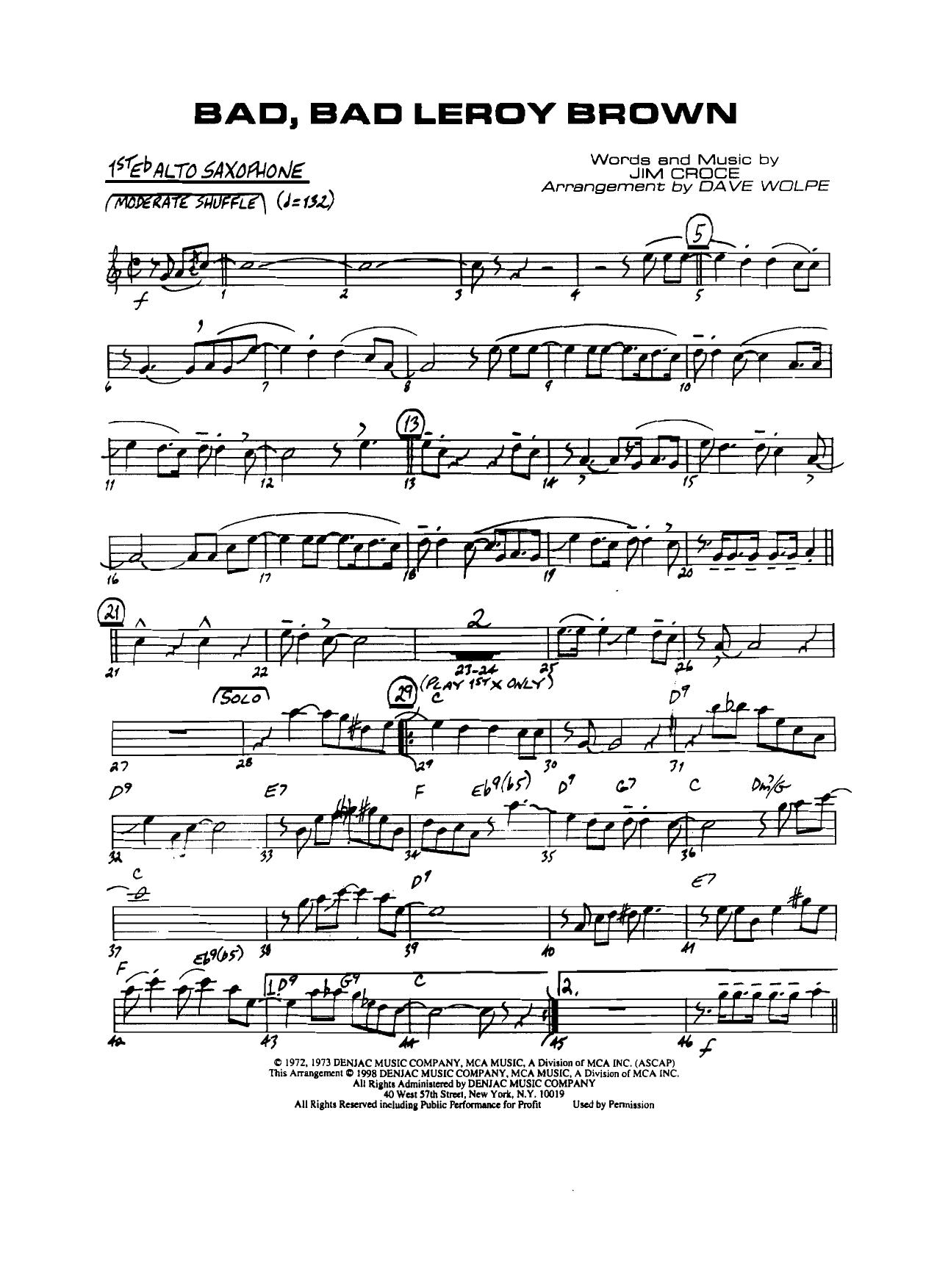
Bad, Bad Leroy Brown (D.Wolpe)
Composed by Jim Croce
Arranged by Dave Wolpe
- Ensemble: Big Band
- Pages: 36
- Instruments (17): 1st Alto Saxophone, 2nd Alto Saxophone, 1st Tenor Saxophone, 2nd Tenor Saxophone, Eb Baritone Saxophone, 1st Bb Trumpet, 2nd Bb Trumpet, 3rd Bb Trumpet, 4th Bb Trumpet, 1st Trombone, 2nd Trombone, 3rd Trombone, 4th Trombone (Bass), Piano, Guitar, Bass, Drums
- Difficulty: medium
- Content: Individual Parts
- Format: PDF Download (Instant)
- Price: $24.99
Originally penned and recorded by singer-songwriter Jim Croce in 1973, "Bad, Bad Leroy Brown" captured the quintessential American storytelling spirit of the 1970s pop-rock landscape, quickly ascending to the number-one spot on the Billboard Hot 100. Croce’s original narrative-driven hit possessed an inherent swagger and infectious blues-infused bounce that begged for a dynamic big band translation. Transcending its folk-rock origins, the tune has long been embraced by the jazz and commercial horn band communities as a high-energy crowd-pleaser, thanks to its irresistible rhythmic drive and memorable, swaggering melody line. Dave Wolpe’s masterful big band treatment injects heavy doses of classic swing and contemporary stage-band vitality into Croce’s outlaw classic. Set in an energetic, driving medium-swing groove (approximately quarter note = 152), the arrangement opens with a playful, teasing ostinato before leaping into full-ensemble power. Wolpe trades the acoustic folk strumming of the original for sharp, punchy brass stabs and driving saxophone soli sections that emphasize the comedic yet tough-guy persona of the lyric. The emotional atmosphere is buoyant, cheeky, and relentlessly swinging, driven by a thick harmonic vocabulary that utilizes extended chord extensions, playful chromatic glisses, and classic big band dynamic contrasts. Throughout the chart, the melodic weight shifts masterfully between sections. The saxophones handle crisp, angular interpretations of the verse before opening up into a lush, roaring ensemble shout chorus that showcases Wolpe’s trademark knack for building vertical tension and releasing it into soaring brass lines. Featured solo space allows a featured soloist—ideally on tenor saxophone or trumpet—to stretch out over traditional blues-inflected changes. Technical challenges center primarily around maintaining a tight, articulate swing eighth-note feel at a brisk tempo, requiring clean section phrasing, precise tongue-and-slur patterns in the saxophone section, and controlled high-register accents from the lead trumpet. Advanced high school ensembles, collegiate jazz orchestras, and professional community big bands will find this chart to be an exceptionally rewarding addition to a concert or festival program. Because it bridges the gap between classic jazz articulation and a universally recognized pop-culture melody, it serves as an ideal choice for setting a high-energy tone in the first or second half of a performance. The 36-page set provides ample depth for meticulous sectional work, ensuring that bands who invest time into the articulations will reap massive rewards from audiences. Unlocking the full potential of Dave Wolpe’s chart requires a disciplined approach to the medium-swing feel. The tempo should remain locked at a confident, driving medium-up swing; avoid rushing, as the groove relies on a relaxed yet intensely focused backbeat from the rhythm section. Pay close attention to the articulation markings: short notes must be clipped and punchy, while longer lines require a smooth, vocal legato. Brass players should make liberal use of stylistic devices like falls, doits, and engineered plunger effects where indicated to maximize the humorous, theatrical attitude of the tune. In rehearsal, conductors should isolate the rhythm section first to ensure the foundational walking bassline and hi-hat on beats two and four lock in tightly before layering in the horn sections. Work on section blend during the soli passages, ensuring the baritone saxophone and bass trombone anchor the low end without muddying the bright, snappy voicings of the upper reeds and trumpets. Finally, balance the dynamics carefully during the shout chorus so that the ensemble can crescendo naturally into the final climax without forcing their tone quality. Q: What instruments and parts are included in this 36-page arrangement? A: This chart is scored for a standard 17-instrument big band instrumentation, featuring 5 saxophones (Alto 1, Alto 2, Tenor 1, Tenor 2, Baritone), 4 trumpets, 4 trombones, and a standard 4-piece rhythm section (piano, guitar, bass, drums), plus full conductor score. Q: What is the difficulty level of Dave Wolpe’s "Bad, Bad Leroy Brown"? A: This arrangement is graded as medium-advanced (approximate Grade 4), making it ideal for advanced high school, collegiate, and professional community big bands with strong section players and a capable featured soloist. Q: How does this arrangement adapt Jim Croce’s original 1970s pop hit into a jazz context? A: Arranger Dave Wolpe transforms the folk-rock storytelling tune into a hard-driving, blues-infused swing chart complete with punchy brass stabs, intricate sax solis, and a roaring shout chorus that honors the original melody while utilizing classic big band harmonic language. Q: What makes this specific arrangement unique compared to other vocal or instrumental charts of the song? A: Unlike vocal-centric versions, this instrumental arrangement focuses heavily on dynamic ensemble interplay, clever thematic development across all four horn sections, and ample room for an improvised instrumental solo over classic blues changes. Q: What is the recommended performance tempo and duration for this chart? A: The arrangement is designed to be played at a driving medium-swing tempo of approximately quarter note = 152, resulting in a performance duration of roughly 3 to 4 minutes depending on the length of the open solo section.
Questions and answers
- What is included in the Bad, Bad Leroy Brown (D.Wolpe) PDF?
- The verified current file contains individual parts across 36 pages.
- How many instruments or parts are listed for Bad, Bad Leroy Brown (D.Wolpe)?
- The verified instrumentation list contains 17 entries for this Big Band arrangement.
- Who is credited for Bad, Bad Leroy Brown (D.Wolpe)?
- Composer: Jim Croce. Arranger: Dave Wolpe.
- What difficulty is listed for Bad, Bad Leroy Brown (D.Wolpe)?
- The verified difficulty level is medium.
- Can I preview Bad, Bad Leroy Brown (D.Wolpe) before buying?
- Yes. The product page provides a preview generated from the current PDF file.
- How is Bad, Bad Leroy Brown (D.Wolpe) delivered?
- After successful payment, the digital PDF is made available for download. The displayed price is $24.99.
Musicians Also Search For
Bad, Bad Leroy Brown Dave Wolpe PDF • Bad, Bad Leroy Brown Dave Wolpe sheet music • Bad, Bad Leroy Brown arranged by Dave Wolpe • Dave Wolpe big band charts • Dave Wolpe jazz arrangements PDF • Bad, Bad Leroy Brown Jim Croce sheet music • Bad, Bad Leroy Brown Jim Croce big band arrangements • Jim Croce big band charts • Bad, Bad Leroy Brown big band arrangements • Bad, Bad Leroy Brown big band PDF download • Bad, Bad Leroy Brown jazz sheet music • big band sheet music download • Bad, Bad Leroy Brown individual parts download • Bad, Bad Leroy Brown sheet music PDF • buy Bad, Bad Leroy Brown sheet music • download Bad, Bad Leroy Brown PDF • Bad, Bad Leroy Brown jazz charts • best Dave Wolpe big band arrangements • Jim Croce arranged by Dave Wolpe • Bad, Bad Leroy Brown printable sheet music • big band repertoire PDF