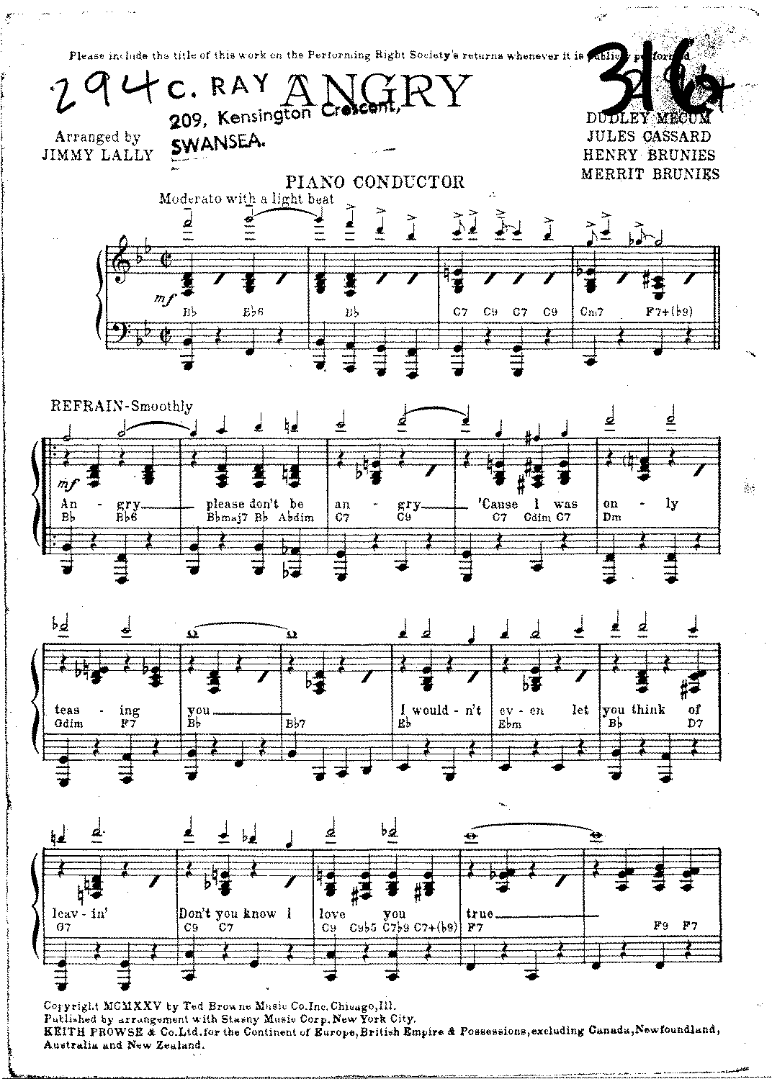
Angry (J.Lally)
Composed by Dudley Mecum
Arranged by J. Lally
- Ensemble: Big Band Dance
- Style: Foxtrot
- Pages: 31
- Instruments (15): Piano, Alto Saxophone 1, Alto Saxophone 2, Tenor Saxophone 1, Tenor Saxophone 2, Baritone Saxophone, Trumpet 1, Trumpet 2, Trumpet 3, Trombone 1, Trombone 2, Guitar, Bass, Drum Set, Violin
- Difficulty: medium
- Content: Individual Parts
- Format: PDF Download (Instant)
- Price: $24.99
Dudley Mecum's "Angry" emerged from the vibrant dance band era of the 1920s, a period characterized by the burgeoning popularity of jazz and its integration into mainstream American entertainment. While not as universally recognized as some Tin Pan Alley standards, "Angry" captured the energetic, often whimsical spirit of the Foxtrot, a dance rhythm that dominated ballrooms and speakeasies. Its original recordings, often by popular dance orchestras of the time, showcased the era's distinctive instrumentation and arranging styles, blending catchy melodic lines with syncopated rhythms designed for dancing. The piece embodies the infectious optimism and playful sophistication that defined much of the early jazz and dance music landscape, making it a delightful, if lesser-known, gem from the Roaring Twenties. J. Lally's arrangement of "Angry" for big band dance ensemble masterfully reinterprets this classic Foxtrot for a modern, yet historically informed, performance. The arrangement maintains a bright, medium-up tempo feel, firmly rooted in 4/4 time, evoking the original danceability while injecting contemporary big band power. Lally's signature approach is evident in the sophisticated voicings, particularly in the saxophone soli sections, which feature tight, harmonically rich clusters that pay homage to the era's sound while adding a touch of modern sheen. The brass writing is punchy and articulate, driving the rhythmic momentum without overpowering the melodic clarity. The overall mood is one of spirited exuberance, a playful defiance that perfectly captures the essence of its title in a musical, rather than aggressive, sense. The melody of "Angry" is primarily carried by the saxophone section, often in unison or harmonized lines, providing a strong, cohesive sound. Lally introduces a compelling call-and-response dynamic between the saxophones and brass, building excitement through contrasting textures. While specific improvised solos are not explicitly notated, the arrangement provides ample space for a tenor saxophone or trumpet soloist to interpret the changes during an open solo section, allowing for creative expression within the established Foxtrot framework. A standout feature is the powerful shout chorus, where the full ensemble unleashes a dynamic, harmonically dense statement, culminating in a thrilling climax. The technical challenges lie in maintaining a consistent, driving swing feel, executing precise articulations, and navigating the intricate ensemble passages with tight synchronization. The rewarding aspect is the sheer joy of performing a piece that is both historically rich and musically engaging, guaranteed to bring a smile to both performers and audience. This arrangement is ideally suited for college-level jazz ensembles, advanced high school bands, or community big bands with strong lead players and a solid rhythm section. Its blend of historical authenticity and contemporary arranging techniques offers an excellent educational opportunity to explore the Foxtrot style within a big band context. The demands on articulation, balance, and ensemble precision make it a valuable piece for developing musicality and tight ensemble playing, while its infectious energy ensures it will be a crowd-pleaser in any performance setting. "Angry" demands a bright, medium-up tempo Foxtrot feel, around quarter note = 180-190 bpm, with a strong emphasis on a light, driving swing eighth-note interpretation. The rhythm section should maintain a consistent, buoyant groove, with the bass providing a clear walking line and the drums utilizing a crisp ride cymbal pattern. Articulation is paramount; brass should play with a sharp, precise attack, while saxophones should aim for a smooth, connected, yet rhythmic delivery, particularly in the soli passages. Pay close attention to dynamics, building tension through crescendos into the shout chorus and contrasting with softer, more lyrical sections. Ensure the lead trumpet and lead alto saxophone establish clear melodic lines and accurate intonation, as they often guide the ensemble. Rehearsal time should focus on rhythmic precision in the ensemble hits and balancing the dense voicings in the saxophone soli. No special techniques like plunger mutes or doits are explicitly required, but tasteful falls and scoops can be added by brass players to enhance the period feel. Q: What instruments are included in this arrangement of "Angry"? A: This arrangement is scored for a standard 17-piece big band dance ensemble, including Alto Saxophone 1, Alto Saxophone 2, Tenor Saxophone 1, Tenor Saxophone 2, Baritone Saxophone, Trumpet 1, Trumpet 2, Trumpet 3, Trumpet 4, Trombone 1, Trombone 2, Trombone 3, Trombone 4, Piano, Bass, Drums, and Guitar. Q: What is the difficulty level of J. Lally's "Angry" arrangement? A: This arrangement is rated as medium-advanced. It requires strong section playing, precise articulation, and a solid understanding of swing rhythm, making it suitable for college-level ensembles, advanced high school bands, or experienced community big bands. Q: What musical style and historical context does this arrangement represent? A: This arrangement is a contemporary big band interpretation of Dudley Mecum's "Angry," originally a Foxtrot from the 1920s dance band era. It captures the energetic and playful spirit of early jazz and dance music. Q: What makes J. Lally's arrangement of "Angry" unique? A: J. Lally's arrangement stands out for its sophisticated voicings, particularly in the saxophone soli, and its powerful shout chorus, which reinterprets the original Foxtrot with modern big band dynamics while maintaining historical integrity. Q: What is the typical performance duration and tempo for this piece? A: The typical performance duration for this arrangement is approximately 3:00-3:30 minutes. It is designed to be played at a bright, medium-up Foxtrot tempo, around quarter note = 180-190 bpm.
Musicians Also Search For
Angry J. Lally PDF • Angry J. Lally sheet music • Angry arranged by J. Lally • J. Lally big band dance charts • J. Lally jazz arrangements PDF • Angry Dudley Mecum sheet music • Angry Dudley Mecum big band dance arrangement • Dudley Mecum big band dance charts • Angry big band dance arrangement • Angry big band dance PDF download • Angry jazz ensemble sheet music • big band dance sheet music instant download • Angry conductor score PDF • Angry individual parts download • Angry sheet music with parts • Angry Foxtrot chart • Foxtrot big band dance arrangements • buy Angry sheet music online • download Angry PDF • Angry jazz chart • best J. Lally big band dance arrangements • Dudley Mecum songs arranged by J. Lally • Angry printable sheet music • big band dance repertoire PDF