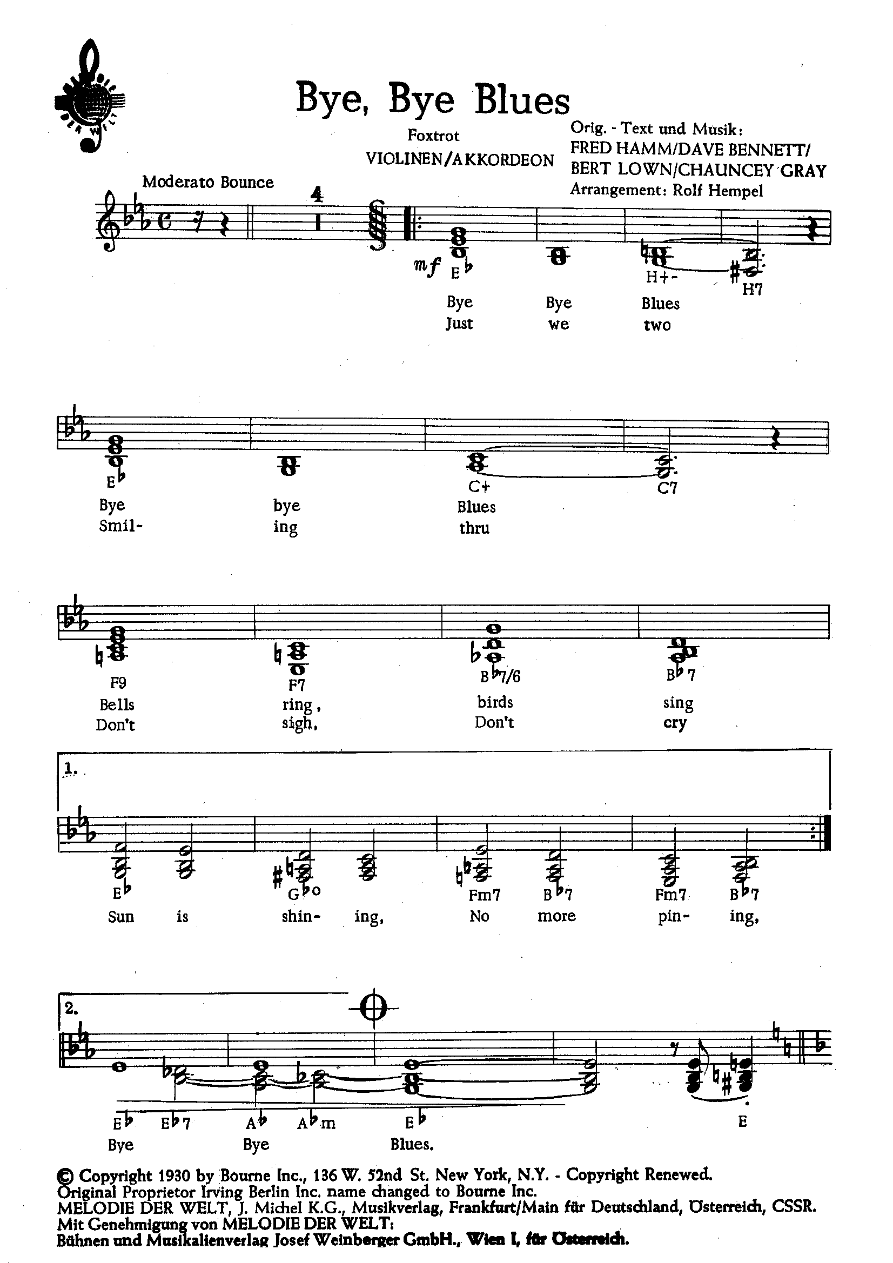
Bye Bye Blues (R.Hempel) sheet music preview

Bye Bye Blues (R.Hempel)

Composed by Fred Hamm, Dave Bennett, Bert Lown, Chauncey Zez Confrey

Arranged by R. Hempel

  • Ensemble: Big Band Dance
  • Style: Foxtrot
  • Pages: 18
  • Instruments (17): Alto Saxophone 1, Alto Saxophone 2, Tenor Saxophone 1, Tenor Saxophone 2, Baritone Saxophone, Trumpet 1, Trumpet 2, Trumpet 3, Trumpet 4, Trombone 1, Trombone 2, Trombone 3, Bass Trombone, Piano, Bass, Drums, Guitar
  • Difficulty: easy
  • Content: Individual Parts
  • Format: PDF Download (Instant)
  • Price: $18.99

## SECTION 1: Description "Bye Bye Blues," a cornerstone of the American songbook, emerged in 1925, a product of the collaborative genius of Fred Hamm, Dave Bennett, Bert Lown, and Chauncey Zez Confrey. This enduring Foxtrot became an instant hit, encapsulating the buoyant optimism and sophisticated charm of the Roaring Twenties. Its simple, memorable melody and accessible chord changes quickly cemented its status as a jazz standard, performed and recorded by countless artists across decades, from the early dance bands to crooners and swing orchestras. The tune's inherent cheerfulness and straightforward harmonic progression make it an ideal vehicle for both intricate improvisation and elegant ensemble work, representing a timeless slice of early 20th-century popular music that continues to resonate with audiences today. R. Hempel's arrangement of "Bye Bye Blues" for big band dance ensemble masterfully reinterprets this classic, infusing it with a vibrant, medium-swing feel while preserving its original Foxtrot essence. Hempel's signature approach often involves a meticulous balance between respecting the source material and injecting fresh, contemporary big band voicings. In this chart, listeners will immediately recognize the iconic melody, initially presented by the saxophone section in a smooth, harmonized soli, setting a bright and engaging mood. The arrangement then progresses through carefully crafted ensemble passages, featuring crisp brass punctuations and dynamic contrasts that build excitement. Hempel's harmonic palette, while rooted in the traditional, occasionally incorporates subtle extended harmonies that add a sophisticated shimmer without departing from the tune's accessible character. The performance journey of this arrangement is both rewarding and educational. The melody is shared effectively, with the saxophones carrying the primary statement, followed by a robust brass soli that provides a contrasting texture and power. There are ample opportunities for featured solos, typically allocated to tenor saxophone and trumpet, allowing for individual expression within the established swing framework. Technical challenges include precise articulation in the brass sections, maintaining a consistent medium-swing groove across the rhythm section, and achieving balanced voicings in the saxophone soli passages. The arrangement culminates in a classic big band shout chorus, where the full ensemble delivers a powerful, harmonically rich statement, bringing the piece to an exhilarating close. This particular arrangement is ideally suited for college-level jazz ensembles, advanced community bands, and professional dance orchestras looking for a well-crafted, historically informed, yet dynamically engaging chart that will delight both performers and audiences. Its blend of historical authenticity and contemporary big band arranging techniques makes it a standout choice for any concert or dance program. ## SECTION 2: Performance Notes This arrangement of "Bye Bye Blues" thrives on a consistent, relaxed medium-swing feel at approximately 120-130 BPM. The primary technical challenge lies in achieving unified articulation, particularly in the brass section's syncopated figures and the saxophone soli passages. Encourage a light, buoyant approach to the eighth notes, avoiding a heavy or stiff feel. The rhythm section should lay down a solid, swinging foundation, with the bass providing a walking line and the drums maintaining a crisp ride cymbal pattern. Special attention should be paid to dynamic contrasts, especially between the piano/guitar comping and the full ensemble sections. Rehearsal should focus on balancing the intricate voicings in the saxophones and ensuring precise cut-offs and releases throughout the chart to maintain its polished, professional sound. ## SECTION 3: FAQ Q: What instruments and parts are included in this arrangement? A: This arrangement is scored for a standard 17-piece big band dance ensemble, including Alto Saxophone 1 & 2, Tenor Saxophone 1 & 2, Baritone Saxophone, Trumpet 1-4, Trombone 1-4, Piano, Bass, Guitar, and Drums. The full set comprises 18 pages of music. Q: What is the difficulty level of R. Hempel's "Bye Bye Blues" arrangement? A: This arrangement is considered advanced intermediate to advanced, suitable for college-level jazz ensembles, skilled community big bands, and professional dance orchestras. It requires proficient sight-reading, strong ensemble blend, and solid improvisational skills from soloists. Q: What musical style and historical context does this arrangement represent? A: This is a Foxtrot, originally composed in 1925, arranged here with a medium-swing feel for big band. It embodies the cheerful, sophisticated dance music popular during the Roaring Twenties and early swing era, making it a timeless jazz standard. Q: What makes R. Hempel's arrangement of "Bye Bye Blues" unique? A: Hempel's arrangement distinguishes itself by preserving the original tune's charming Foxtrot character while infusing it with modern big band voicings, dynamic contrasts, and a vibrant medium-swing groove. It features well-crafted soli sections, opportunities for improvisation, and a powerful shout chorus. Q: What is the recommended tempo and approximate performance duration for this piece? A: The recommended tempo is a medium swing, approximately 120-130 beats per minute. The typical performance duration, depending on the length of improvised solos, is around 3 to 4 minutes.

All arrangements by R. Hempel All Fred Hamm, Dave Bennett, Bert Lown, Chauncey Zez Confrey sheet music