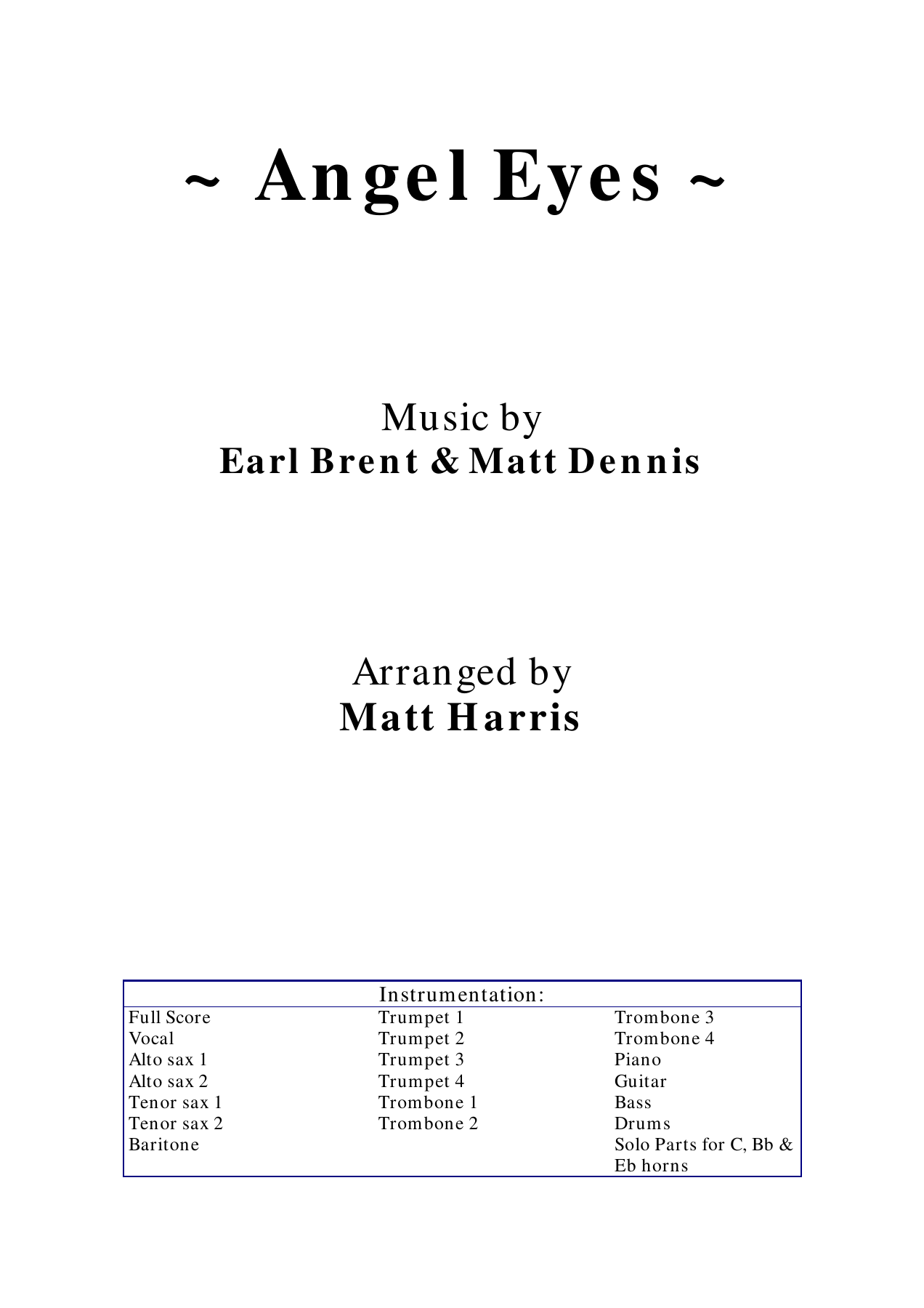
Angel Eyes (M.Harris) vocal
Composed by Matt Dennis
Arranged by M.Harris
- Ensemble: Big Band Vocal
- Style: Jazz Vocal
- Pages: 37
- Instruments (21): Solo Vocal, 1st Eb Alto Sax, 2nd Eb Alto Sax, 1st Bb Tenor Sax, 2nd Bb Tenor Sax, Eb Baritone Sax, Solo Bb Tenor Sax (Substitute for Solo Vocal), 1st Bb Trumpet, 2nd Bb Trumpet, 3rd Bb Trumpet, 4th Bb Trumpet, 1st Trombone, 2nd Trombone, 3rd Trombone, 4th Trombone, Solo Trombone, Piano, Guitar, Bass, Drums, Eb Instr.
- Difficulty: medium
- Content: Individual Parts
- Format: PDF Download (Instant)
- Price: $24.99
Composed by Matt Dennis in 1946, "Angel Eyes" quickly ascended to become a quintessential jazz ballad standard, renowned for its poignant melody and evocative lyrics. Originally featured in the film *Jennifer*, the song gained widespread acclaim through iconic interpretations by vocalists such as Frank Sinatra, who recorded it multiple times, cementing its place in the Great American Songbook. Its enduring appeal lies in its sophisticated harmonic progression, often characterized by minor keys and descending chromatic lines, which perfectly convey a sense of melancholic longing and lost love. The piece embodies the emotional depth and harmonic richness characteristic of post-war jazz ballads, offering both vocalists and instrumentalists ample room for expressive interpretation. M.Harris's vocal arrangement of "Angel Eyes" masterfully captures the song's inherent drama and intimacy, presenting it as a medium-slow swing ballad in the key of C minor. The arrangement opens with a lush, harmonically rich introduction, immediately setting a contemplative and slightly somber mood. Harris is known for his sophisticated voicings and this chart is no exception, utilizing dense, yet transparent, brass and saxophone pads that support the vocalist without overpowering them. The arrangement features a delicate interplay between sections, with subtle counter-melodies and sustained chords creating a rich textural tapestry. The overall mood is reflective and tender, building to moments of understated passion before returning to its introspective core. The vocal melody is carried primarily by the soloist, with the big band providing a sensitive and dynamic accompaniment. Harris employs a "less is more" approach in the initial choruses, allowing the vocalist's interpretation to shine through. As the arrangement progresses, the ensemble gradually builds in intensity, incorporating tasteful soli sections for the saxophones and brass that echo thematic material, adding depth and harmonic interest. There is a beautifully crafted instrumental interlude that provides a moment for the band to truly express the song's emotional arc, showcasing Harris's signature ability to weave intricate lines within a cohesive big band sound. While there isn't an extended instrumental solo section in the traditional sense, the ensemble's contributions are soloistic in their melodic and harmonic sophistication. The chart culminates in a powerful, yet controlled, final chorus, bringing the emotional journey to a satisfying and memorable close. This arrangement is ideally suited for college, community, and professional big bands seeking a sophisticated and emotionally resonant vocal feature. Its challenges lie not in technical acrobatics, but in achieving a unified, expressive ensemble sound, precise dynamics, and a deep understanding of the ballad style. The rewarding experience comes from performing a timeless classic with an arrangement that respects its legacy while offering fresh, compelling musicality. This arrangement of "Angel Eyes" thrives on a medium-slow swing feel, approximately quarter note = 80-88 BPM. The primary technical challenge lies in maintaining a consistent, relaxed swing pulse at this slower tempo, ensuring the rhythmic subdivisions are precise without feeling rushed or dragging. Conductors should emphasize blend and balance, particularly in the delicate brass and saxophone pads that support the vocalist; avoid overblowing. Dynamic control is paramount, with careful attention to crescendos and decrescendos that build and release tension. Encourage wind players to focus on warm, sustained tones and precise intonation, especially in the denser harmonic passages. Drummers should lay down a subtle, flowing swing pattern, utilizing brushes or light stick work to enhance the ballad feel, saving heavier cymbal work for moments of increased intensity. Rehearse the vocal entrances and cutoffs meticulously with the band to ensure seamless transitions and a cohesive performance. Q: What instruments and parts are included in this arrangement? A: This arrangement includes parts for a standard big band: 5 saxophones (AATTB), 4 trombones, 4 trumpets, piano, bass, drums, guitar, and a dedicated vocal lead sheet. Q: What is the difficulty level of this arrangement? A: This arrangement is rated as medium-advanced. While not technically demanding in terms of speed, it requires strong ensemble blend, precise intonation, nuanced dynamic control, and a mature understanding of ballad interpretation. Q: What musical style and historical context does "Angel Eyes" represent in this arrangement? A: This arrangement is a classic jazz vocal ballad, embodying the sophisticated harmonic and melodic characteristics of mid-20th century jazz standards, particularly those popularized by vocalists like Frank Sinatra. Q: What makes M.Harris's arrangement of "Angel Eyes" unique? A: M.Harris's arrangement is distinguished by its lush, sophisticated voicings, sensitive ensemble support for the vocalist, and a gradual, emotionally compelling build-up that showcases the band's expressive capabilities without overshadowing the lead. Q: What is the typical performance duration and tempo for this piece? A: The typical performance duration for this arrangement is approximately 4-5 minutes, performed at a medium-slow swing tempo, generally around quarter note = 80-88 BPM.
Questions and answers
- What is included in the Angel Eyes (M.Harris) vocal PDF?
- The verified current file contains a conductor score and individual parts across 37 pages.
- How many instruments or parts are listed for Angel Eyes (M.Harris) vocal?
- The verified instrumentation list contains 21 entries for this Big Band Vocal arrangement.
- Who is credited for Angel Eyes (M.Harris) vocal?
- Composer: Matt Dennis. Arranger: M.Harris.
- What difficulty is listed for Angel Eyes (M.Harris) vocal?
- The verified difficulty level is medium.
- What style is listed for Angel Eyes (M.Harris) vocal?
- The catalog lists the style as Jazz Vocal.
- Can I preview Angel Eyes (M.Harris) vocal before buying?
- Yes. The product page provides a preview generated from the current PDF file.
- How is Angel Eyes (M.Harris) vocal delivered?
- After successful payment, the digital PDF is made available for download. The displayed price is $24.99.
Musicians Also Search For
Angel Eyes M.Harris PDF • Angel Eyes M.Harris sheet music • Angel Eyes arranged by M.Harris • M.Harris big band vocal charts • M.Harris jazz arrangements PDF • Angel Eyes Matt Dennis sheet music • Angel Eyes Matt Dennis big band vocal arrangements • Matt Dennis big band vocal charts • Angel Eyes big band vocal arrangements • Angel Eyes big band vocal PDF download • Angel Eyes jazz sheet music • big band vocal sheet music download • Angel Eyes conductor score PDF • Angel Eyes individual parts download • Angel Eyes sheet music PDF • Angel Eyes Jazz Vocal charts • Jazz Vocal big band vocal arrangements • buy Angel Eyes sheet music • download Angel Eyes PDF • Angel Eyes jazz charts • best M.Harris big band vocal arrangements • Matt Dennis arranged by M.Harris • Angel Eyes printable sheet music • big band vocal repertoire PDF