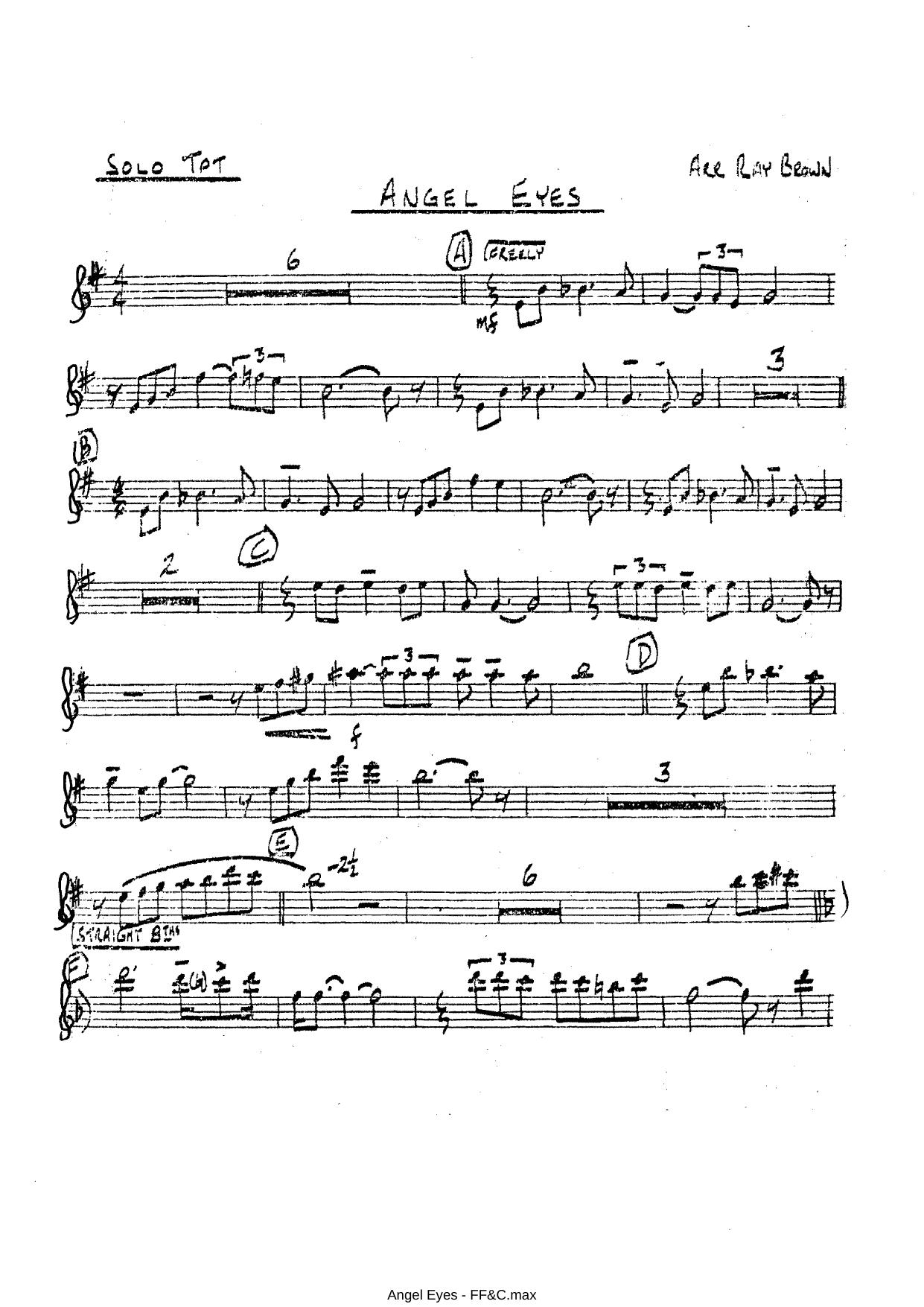
Angel Eyes TRP.Solo (R.Brown)
Composed by Matt Dennis
Arranged by Ray Brown
- Ensemble: Big Band
- Pages: 34
- Instruments (17): Solo Trumpet, Alto Saxophone I, Alto Saxophone II, Tenor Saxophone I, Tenor Saxophone II, Baritone Saxophone, Trumpet I, Trumpet II, Trumpet III, Trumpet IV, Trombone I, Trombone II, Trombone III, Trombone IV, Piano, Bass, Drums
- Difficulty: medium
- Content: individual parts only
- Format: PDF Download (Instant)
- Price: $24.99
Composed in 1946 by Matt Dennis with lyrics by Earl Brent, "Angel Eyes" stands as one of the most hauntingly sophisticated torch ballads in the Great American Songbook. It achieved legendary status through definitive interpretations by vocal icons like Frank Sinatra and instrumental masters such as Earl Bostic and Chet Baker. Rooted in the post-war cool jazz and classic saloon-song tradition, the composition is celebrated for its melancholic chromaticism, striking harmonic shifts, and an atmosphere of late-night introspection. It remains a litmus test for jazz musicians seeking to convey deep emotional resonance within a standard 32-bar AABA framework. Ray Brown’s masterful big band adaptation reimagines this classic vehicle as a lush, deeply expressive ballad centered around a prominent trumpet feature. The arrangement unfolds at a slow, deliberate tempo (approx. 66–72 BPM), maintaining a relaxed yet intense 12/8 or slow 4/4 swing feel that allows the harmonic textures to breathe. The mood is moody, smoky, and reflective, evoking the quintessential atmosphere of a dim-lit jazz club at closing time. Rich, extended chord voicings in the brass and subtle woodwind doubling create a velvety harmonic cushion that supports the soloist while adding modern, sophisticated colorations reminiscent of West Coast arranging styles. The arrangement showcases the trumpet soloist throughout the form, demanding a mature player with impeccable control over intonation, dynamic nuance, and lyrical phrasing in the upper-middle register. While the brass section provides warm, swelling background pads and tightly voiced harmonic commentary, the saxophones (comprising alto, tenor, and baritone) deliver lush, cascading soli passages that bridge the thematic statements. A standout moment occurs in the bridge of the final chorus, where the ensemble swells dynamically before dropping to a whisper, setting up a poignant, cadenza-like resolution for the featured trumpet. The writing avoids excessive technical fireworks in favor of deep musicality, ensemble blend, and expressive timing. Advanced high school ensembles, collegiate jazz orchestras, and professional big bands will find this chart an exceptional vehicle for developing ballad-playing maturity and sectional balance. Because the primary challenge lies not in fast fingerwork, but in sustaining intensity, maintaining pitch center at ultra-slow tempos, and balancing dense chord structures, it serves as a rigorous masterclass in stylistic execution. Directors looking to feature a standout trumpet soloist while simultaneously refining their ensemble's dynamic control and emotional delivery will discover that this 34-page score is an invaluable, rewarding addition to their repertoire. Sustaining a slow ballad requires immense physical control and mental focus from both the ensemble and the featured trumpet soloist. The conductor must establish a subdivision in the mind before the downbeat to prevent the tempo from dragging or rushing during rubato-adjacent phrases. The primary technical challenge lies in intonation across the saxophone section's close voicings and the muted brass pads. Players must lock their pitch centers immediately, utilizing a warm, centered tone without excessive vibrato. Balance is critical: the rhythm section—especially the piano and guitar—should lay down sparse, transparent chord voicings that leave ample space for the horn textures. The trumpet soloist should approach the melody with vocal-like inflection, treating the lyrics (even though instrumental) as a guide for phrasing and emotional arc. Ensure that background figures from the trombones and saxophones remain strictly subservient to the soloist’s dynamic ceiling. Rehearsals should focus heavily on sectional blend, unified breath attacks, and smooth dynamic crescendos and decrescendos on sustained chords. Q: What instruments and parts are included in this arrangement? A: This 34-page arrangement is scored for a standard modern big band instrumentation featuring 8 core instrumental parts: Alto Saxophone, Tenor Saxophone, Baritone Saxophone, Trumpet, Trombone, and rhythm section support. Q: What is the difficulty level of this chart? A: This arrangement is graded as advanced, best suited for collegiate, advanced high school, and professional jazz ensembles due to its demands on slow-tempo intonation, balance, and expressive control. Q: What is the style and historical context of "Angel Eyes"? A: It is a classic jazz ballad in a slow swing feel, originating from the 1946 composition by Matt Dennis that became a cornerstone of the cool jazz and vocal standard repertoire. Q: What makes Ray Brown's arrangement unique? A: It features a prominent trumpet solo integrated seamlessly with lush, modern chord voicings and delicate saxophone soli sections that elevate a standard vocal ballad into a sophisticated instrumental showcase. Q: What is the performance duration and suggested tempo? A: The arrangement plays out over approximately 4 to 5 minutes at a slow, expressive tempo of around 66 to 72 beats per minute.
Questions and answers
- What is included in the Angel Eyes TRP.Solo (R.Brown) PDF?
- The verified current file contains individual parts across 34 pages.
- How many instruments or parts are listed for Angel Eyes TRP.Solo (R.Brown)?
- The verified instrumentation list contains 17 entries for this Big Band arrangement.
- Who is credited for Angel Eyes TRP.Solo (R.Brown)?
- Composer: Matt Dennis. Arranger: Ray Brown.
- What difficulty is listed for Angel Eyes TRP.Solo (R.Brown)?
- The verified difficulty level is medium.
- Can I preview Angel Eyes TRP.Solo (R.Brown) before buying?
- Yes. The product page provides a preview generated from the current PDF file.
- How is Angel Eyes TRP.Solo (R.Brown) delivered?
- After successful payment, the digital PDF is made available for download. The displayed price is $24.99.
Musicians Also Search For
Angel Eyes TRP.Solo Ray Brown PDF • Angel Eyes TRP.Solo Ray Brown sheet music • Angel Eyes TRP.Solo arranged by Ray Brown • Ray Brown big band charts • Ray Brown jazz arrangements PDF • Angel Eyes TRP.Solo Matt Dennis sheet music • Angel Eyes TRP.Solo Matt Dennis big band arrangements • Matt Dennis big band charts • Angel Eyes TRP.Solo big band arrangements • Angel Eyes TRP.Solo big band PDF download • Angel Eyes TRP.Solo jazz sheet music • big band sheet music download • Angel Eyes TRP.Solo individual parts download • Angel Eyes TRP.Solo sheet music PDF • buy Angel Eyes TRP.Solo sheet music • download Angel Eyes TRP.Solo PDF • Angel Eyes TRP.Solo jazz charts • best Ray Brown big band arrangements • Matt Dennis arranged by Ray Brown • Angel Eyes TRP.Solo printable sheet music • big band repertoire PDF