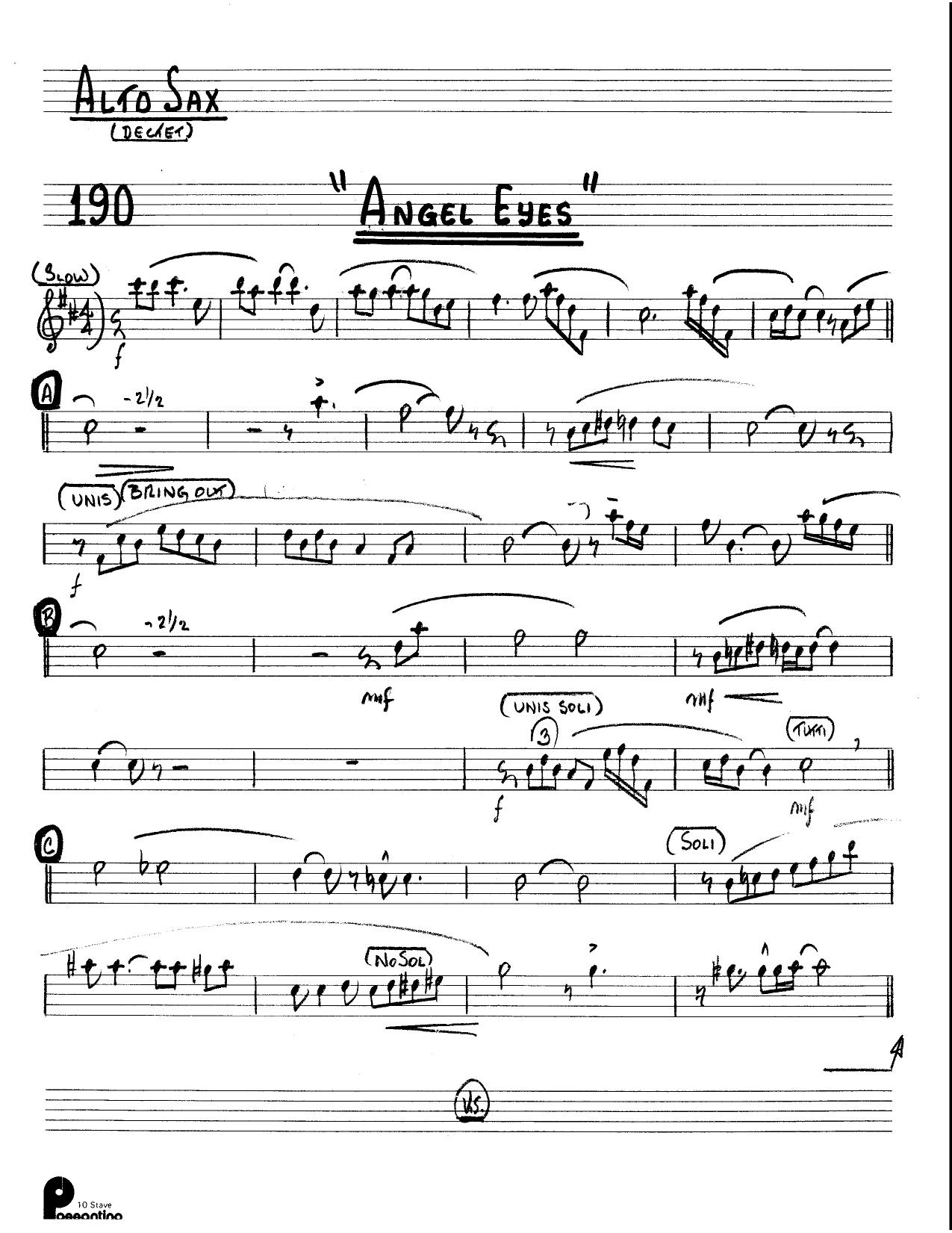
Angel Eyes (Kenton Dectet #190) sheet music preview

Angel Eyes (Kenton Dectet #190)

Composed by Matt Dennis

Arranged by Kenton Dectet #190

  • Ensemble: Small Ensemble
  • Style: Jazz Standard
  • Pages: 18
  • Instruments (9): Alto Sax, Tenor Sax, Baritone Sax, Trumpet 1, Trumpet 2, Trombone, Piano, Bass, Drums
  • Difficulty: easy
  • Content: Individual Parts
  • Format: PDF Download (Instant)
  • Price: $12.99

"Angel Eyes," composed by Matt Dennis with lyrics by Earl K. Brent in 1946, stands as a quintessential jazz standard and a poignant torch song of the mid-20th century. Its enduring appeal lies in its evocative melody and harmonic richness, which convey themes of longing and heartbreak. The piece gained wider recognition after its feature in the 1953 film "Jennifer," where Dennis himself performed it. While Herb Jeffries made the first recording in 1947, its widespread popularity truly blossomed through iconic interpretations by vocalists such as Ella Fitzgerald—who reportedly considered it her favorite song and recorded it multiple times—and Frank Sinatra, whose melancholic rendition on his 1958 album "Frank Sinatra Sings for Only the Lonely" cemented its place in the Great American Songbook. The song's harmonic progression, particularly its use of minor ii-V-i cells and bridge modulations, offers a sophisticated framework that has inspired countless instrumental and vocal interpretations across various jazz styles. This Kenton Dectet #190 arrangement reimagines the classic "Angel Eyes" with a distinct small ensemble approach, characteristic of the "combo ork" style prevalent in the 1950s. While the original often evokes a slow ballad or medium tempo feel, this arrangement likely infuses the piece with the sophisticated harmonic language and precise ensemble work associated with the Kenton sound, even in a reduced instrumentation. Expect a nuanced exploration of the tune's inherent melancholy, possibly in the common key of C minor, allowing for rich, extended harmonies and intricate voicings that highlight the unique timbres of a small jazz ensemble. The arranger's touch will likely emphasize clarity and precision, with a focus on blending and balance within the smaller group, rather than the sheer power of a full big band. The arrangement features the melody primarily carried by a lead instrument, with other voices providing counterpoint and harmonic support through carefully constructed soli sections. Solos are a central component, offering opportunities for improvisation over the tune's compelling chord changes, which are known for their chromatic substitutions and minor-key functional shifts. Technical challenges will include maintaining a cohesive sound within the small ensemble, executing precise articulations, and navigating the sophisticated harmonic landscape during both written passages and improvised solos. The reward lies in performing a deeply expressive and harmonically rich piece that allows each musician to contribute significantly to the overall texture, fostering a strong sense of musical interaction and collective artistry. This arrangement is ideally suited for college-level jazz combos, advanced community jazz ensembles, or professional small groups seeking a challenging yet deeply rewarding interpretation of a beloved standard. Its intricate details and demand for musical maturity make it an excellent vehicle for developing advanced ensemble skills and harmonic understanding. This arrangement of "Angel Eyes" thrives on a medium-slow swing feel, emphasizing a relaxed yet precise rhythmic pulse. Conductors should encourage musicians to internalize the underlying eighth-note subdivision, avoiding any tendency to rush or drag, particularly during the rubato sections that may introduce the melody. Key technical challenges include precise intonation within the close voicings, especially in the horn lines, and maintaining a consistent dynamic balance across the small ensemble. Rehearsal should focus on the interplay between the melodic lead and the supporting voices, ensuring that counter-melodies and harmonic fills are both present and supportive without overpowering the main theme. Soloists should be encouraged to explore the rich harmonic extensions and altered dominant tensions inherent in the chord changes, particularly the minor ii-V-i progressions. Articulation should be smooth and legato for the ballad sections, with crisp, unified attacks for any accented figures. Q: What instruments/parts are included in this arrangement? A: This Kenton Dectet #190 arrangement includes parts for a small jazz ensemble, typically consisting of a lead instrument (e.g., trumpet or alto saxophone), other horn voices (e.g., trombone, tenor saxophone, baritone saxophone), piano, bass, and drums. The exact instrumentation is optimized for a dectet (10-piece) configuration. Q: What is the difficulty level of this arrangement? A: This arrangement is considered advanced, suitable for college-level jazz combos, advanced community ensembles, or professional small groups. It requires strong technical proficiency, advanced harmonic understanding, and a high degree of ensemble precision. Q: What is the musical style and historical context of "Angel Eyes"? A: "Angel Eyes" is a classic jazz standard and torch song, originally composed by Matt Dennis in 1946. It embodies the melancholic and sophisticated ballad style of the mid-20th century, often associated with film noir aesthetics and popularized by vocalists like Ella Fitzgerald and Frank Sinatra. Q: What makes this Kenton Dectet #190 arrangement unique? A: This arrangement is unique due to its adaptation for a small ensemble (dectet) in the distinctive Kenton style. It features sophisticated voicings, intricate harmonic extensions, and a focus on precise ensemble interplay, offering a nuanced and challenging interpretation of the standard. Q: What is the typical performance duration or tempo for this piece? A: "Angel Eyes" is generally performed as a medium-slow swing ballad. The exact duration will vary based on the number of solo choruses, but typically ranges from 4 to 6 minutes, allowing ample space for expressive interpretation and improvisation.

Questions and answers

What is included in the Angel Eyes (Kenton Dectet #190) PDF?
The verified current file contains individual parts across 18 pages.
How many instruments or parts are listed for Angel Eyes (Kenton Dectet #190)?
The verified instrumentation list contains 9 entries for this Small Ensemble arrangement.
Who is credited for Angel Eyes (Kenton Dectet #190)?
Composer: Matt Dennis. Arranger: Kenton Dectet #190.
What difficulty is listed for Angel Eyes (Kenton Dectet #190)?
The verified difficulty level is easy.
What style is listed for Angel Eyes (Kenton Dectet #190)?
The catalog lists the style as Jazz Standard.
Can I preview Angel Eyes (Kenton Dectet #190) before buying?
Yes. The product page provides a preview generated from the current PDF file.
How is Angel Eyes (Kenton Dectet #190) delivered?
After successful payment, the digital PDF is made available for download. The displayed price is $12.99.

Musicians Also Search For

Angel Eyes Kenton Dectet #190 PDFAngel Eyes Kenton Dectet #190 sheet musicAngel Eyes arranged by Kenton Dectet #190Kenton Dectet #190 small ensemble chartsKenton Dectet #190 jazz arrangements PDFAngel Eyes Matt Dennis sheet musicAngel Eyes Matt Dennis small ensemble arrangementsMatt Dennis small ensemble chartsAngel Eyes small ensemble arrangementsAngel Eyes small ensemble PDF downloadAngel Eyes jazz sheet musicsmall ensemble sheet music downloadAngel Eyes individual parts downloadAngel Eyes sheet music PDFAngel Eyes Jazz Standard chartsJazz Standard small ensemble arrangementsbuy Angel Eyes sheet musicdownload Angel Eyes PDFAngel Eyes jazz chartsbest Kenton Dectet #190 small ensemble arrangementsMatt Dennis arranged by Kenton Dectet #190Angel Eyes printable sheet musicsmall ensemble repertoire PDF

All arrangements by Kenton Dectet #190 All Matt Dennis sheet music