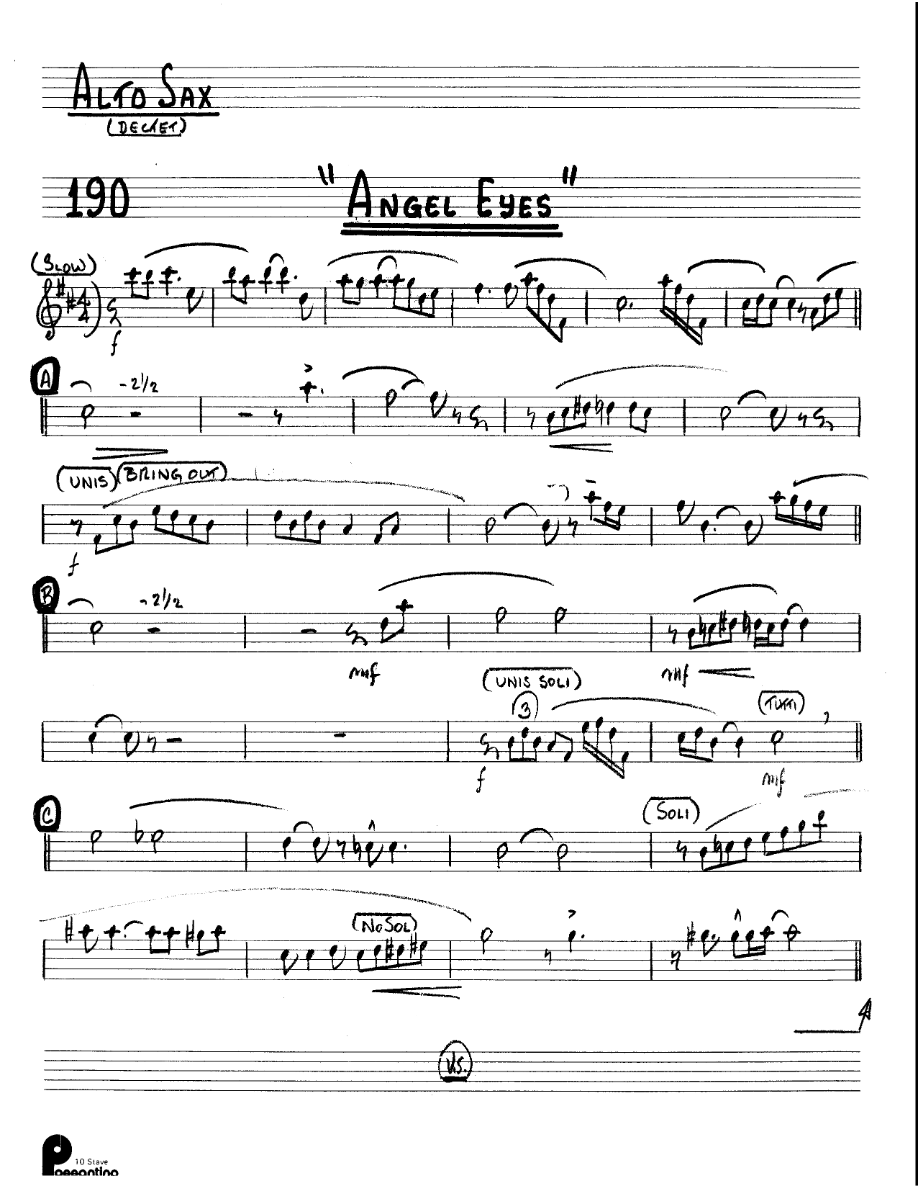
Angel Eyes (M.Paich)
Composed by Matt Dennis
Arranged by M.Paich
- Ensemble: Small Ensemble
- Style: Jazz Standard
- Pages: 18
- Instruments (9): Alto Sax, Tenor Sax, Baritone Sax, Trumpet 1, Trumpet 2, Trombone, Piano, Bass, Drums
- Difficulty: easy
- Content: Individual Parts
- Format: PDF Download (Instant)
- Price: $12.99
"Angel Eyes," a poignant jazz standard penned by Matt Dennis in 1946 with lyrics by Earl Brent, emerged from the post-World War II era, a period ripe with sophisticated ballads and torch songs. Its melancholic yet alluring melody quickly captivated audiences, solidifying its place in the Great American Songbook. The song gained immense popularity through iconic interpretations by vocalists such as Frank Sinatra, whose 1958 Capitol recording with Nelson Riddle's arrangement is often cited as definitive, and later by artists like Ella Fitzgerald and Chet Baker. Its enduring appeal lies in its evocative harmonies and narrative depth, painting a picture of lost love and longing, making it a cornerstone of the jazz ballad repertoire. The piece's inherent flexibility allows for diverse interpretations, from intimate vocal features to powerful instrumental showcases, ensuring its continued relevance in jazz performance. M. Paich's arrangement of "Angel Eyes" for small ensemble masterfully reinterprets this classic, infusing it with his signature West Coast cool jazz aesthetic. Known for his sophisticated harmonic palette and meticulous voicings, Paich transforms the original into a nuanced instrumental journey. This particular rendition maintains the song's inherent melancholic mood, presenting it as a medium-slow swing ballad in a thoughtful 4/4 time signature. Paich's approach is characterized by rich, close-knit harmonies, often employing extended chords (9ths, 11ths, 13ths) and subtle inner-voice movement that create a shimmering, almost ethereal soundscape. The arrangement navigates through carefully constructed soli sections and interwoven counter-melodies, showcasing the ensemble's collective artistry rather than relying on bombastic shout choruses. The arrangement opens with a delicate, often rubato, introduction, setting a reflective tone before settling into a gentle swing feel. The melody is typically carried by a lead horn, often doubled or harmonized with another, allowing for expressive phrasing. Paich's genius shines in his ability to create dense textures with a small group, utilizing intricate voicings that give the impression of a larger ensemble. Solos are strategically placed, offering opportunities for individual expression over Paich's reharmonized chord changes, which are both challenging and inspiring. The technical demands lie in achieving a seamless blend, executing precise articulations, and navigating the harmonic complexities with sensitivity. Performing this arrangement is deeply rewarding, as it encourages musicians to delve into the emotional core of the piece, fostering a collective, empathetic musical conversation. This arrangement is ideally suited for college-level jazz ensembles, advanced community bands, or professional small groups seeking a sophisticated and emotionally resonant chart. The harmonic language and intricate voicings require musicians with a strong grasp of jazz theory and excellent intonation. While not overtly technically demanding in terms of speed, the precision required for ensemble blend, dynamic control, and harmonic accuracy presents a significant challenge. It serves as an excellent vehicle for developing lyrical improvisation and honing ensemble sensitivity, making it a valuable addition to any serious jazz repertoire. Conductors should emphasize a medium-slow swing feel, focusing on a relaxed, unhurried pulse rather than a strict metronomic tempo. The primary technical challenge lies in achieving precise intonation and blend within Paich's dense, often close-voiced harmonies; encourage musicians to listen across the ensemble, particularly in the soli passages. Articulation should be light and legato, supporting the ballad's lyrical character. Pay close attention to dynamic contrasts, using subtle swells and decays to enhance the emotional arc. Rehearsal should prioritize slow, deliberate readings of harmonic sections to ensure all voices are balanced and understood, followed by attention to expressive phrasing in the melody and solo sections. Encourage soloists to embrace the melancholic mood and utilize the rich harmonic backdrop for melodic exploration. Q: What instruments/parts are included in this arrangement? A: This small ensemble arrangement typically includes parts for a lead trumpet, alto saxophone, tenor saxophone, trombone, piano, bass, and drums, though specific instrumentation may vary slightly depending on the exact publication. Q: What is the difficulty level of this arrangement? A: This arrangement is considered advanced intermediate to advanced, suitable for college-level or professional musicians due to its sophisticated harmonic language, intricate voicings, and demands for precise ensemble blend and intonation. Q: What is the musical style and historical context of "Angel Eyes (M.Paich)"? A: This is a small ensemble jazz standard arrangement in a medium-slow swing ballad style, reflecting the West Coast cool jazz aesthetic of M. Paich, based on the classic 1946 tune by Matt Dennis. Q: What makes M. Paich's arrangement of "Angel Eyes" unique? A: M. Paich's signature approach involves rich, extended harmonies, intricate voicings, and a focus on ensemble texture and lyrical expression, transforming the standard into a sophisticated instrumental showcase rather than a typical shout-chorus arrangement. Q: What is the typical performance duration or tempo for this piece? A: Given its medium-slow swing ballad feel, a typical performance duration for this arrangement is approximately 4-6 minutes, depending on the number and length of improvised solos.
Questions and answers
- What is included in the Angel Eyes (M.Paich) PDF?
- The verified current file contains individual parts across 18 pages.
- How many instruments or parts are listed for Angel Eyes (M.Paich)?
- The verified instrumentation list contains 9 entries for this Small Ensemble arrangement.
- Who is credited for Angel Eyes (M.Paich)?
- Composer: Matt Dennis. Arranger: M.Paich.
- What difficulty is listed for Angel Eyes (M.Paich)?
- The verified difficulty level is easy.
- What style is listed for Angel Eyes (M.Paich)?
- The catalog lists the style as Jazz Standard.
- Can I preview Angel Eyes (M.Paich) before buying?
- Yes. The product page provides a preview generated from the current PDF file.
- How is Angel Eyes (M.Paich) delivered?
- After successful payment, the digital PDF is made available for download. The displayed price is $12.99.
Musicians Also Search For
Angel Eyes M.Paich PDF • Angel Eyes M.Paich sheet music • Angel Eyes arranged by M.Paich • M.Paich small ensemble charts • M.Paich jazz arrangements PDF • Angel Eyes Matt Dennis sheet music • Angel Eyes Matt Dennis small ensemble arrangements • Matt Dennis small ensemble charts • Angel Eyes small ensemble arrangements • Angel Eyes small ensemble PDF download • Angel Eyes jazz sheet music • small ensemble sheet music download • Angel Eyes individual parts download • Angel Eyes sheet music PDF • Angel Eyes Jazz Standard charts • Jazz Standard small ensemble arrangements • buy Angel Eyes sheet music • download Angel Eyes PDF • Angel Eyes jazz charts • best M.Paich small ensemble arrangements • Matt Dennis arranged by M.Paich • Angel Eyes printable sheet music • small ensemble repertoire PDF