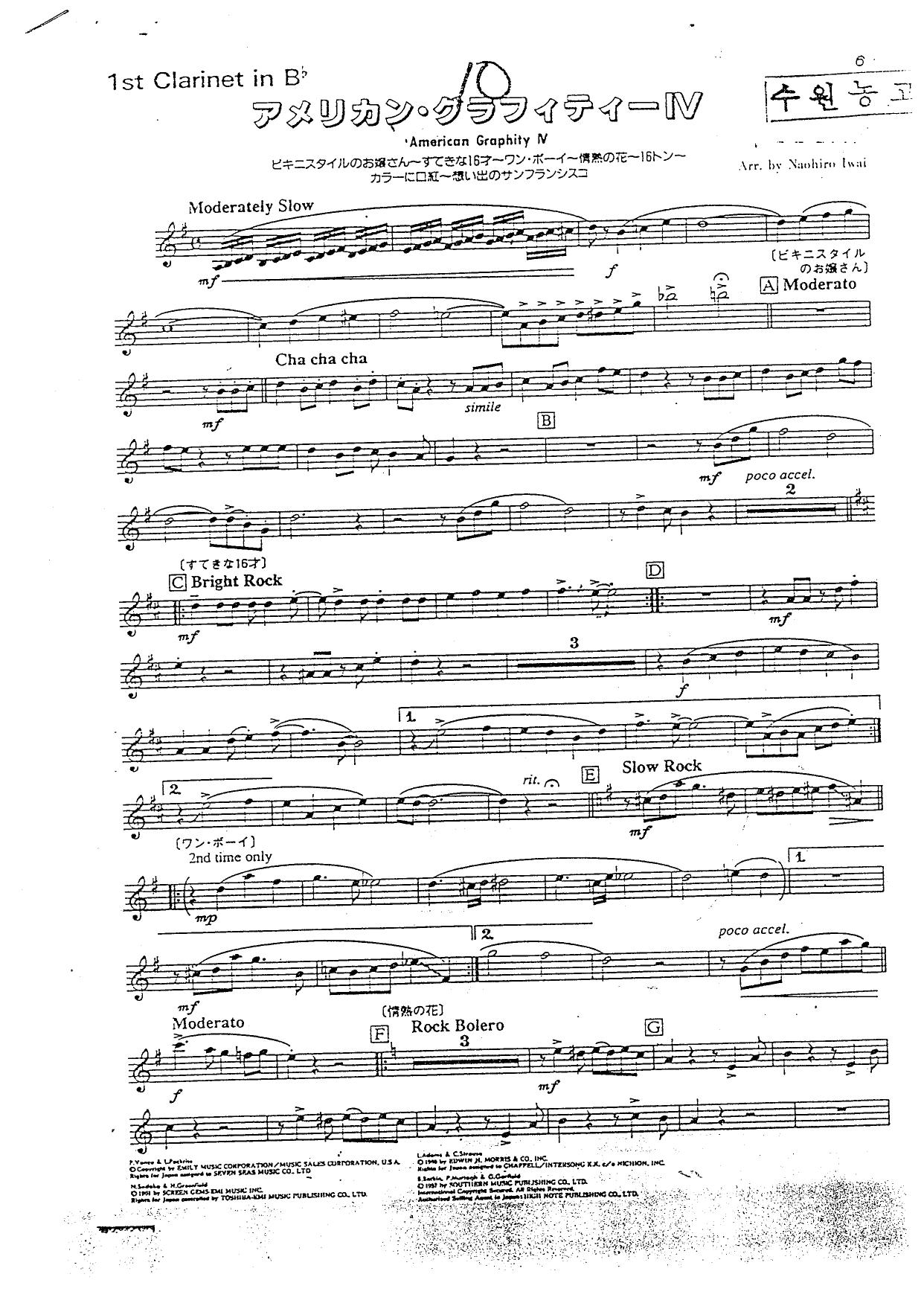
American Grapithy-4 (N.Iwai)
Composed by Naohiro Iwai
Arranged by N.Iwai
- Ensemble: Concert Band
- Style: Jazz Standard
- Pages: 120
- Instruments (32): 1st Clarinet in Bb, Piccolo, 1st & 2nd Flutes, 2nd Clarinet in Bb, 3rd Clarinet in Bb, Bassoon, 1st & 2nd Alto Saxophones in Eb, 1st & 2nd Tenor Saxophones in Bb, Baritone Saxophone in Eb, 1st & 2nd Trumpets in Bb, 3rd & 4th Trumpets in Bb, 1st & 2nd Horns in F, 3rd & 4th Horns in F, 1st Trombone, 2nd & 3rd Trombones, Bass Trombone, Euphonium, Bass in C, Timpani, Shaker (or Maracas), Triangle, Drums, Suspended Cymbal, Conga, Glockenspiel, Xylophone, Guiro, Tambourine, Wind Chime, Wood Block, Vibraphone, Marimba
- Difficulty: advanced
- Content: Individual Parts
- Format: PDF Download (Instant)
- Price: $22.99
Naohiro Iwai’s "American Grapithy-4" stands as a masterclass in cross-cultural jazz orchestration, capturing the vibrant essence of mid-century American popular and jazz idioms through the lens of one of Japan’s most prolific wind band arrangers. Building upon Iwai's celebrated fascination with Americana, this suite-like movement draws inspiration from the golden age of American musical entertainment, synthesizing elements of traditional jazz, theater music, and swing-era dance band traditions. Iwai, renowned for bridging the gap between authentic jazz styling and the concert band medium, infuses the work with a sophisticated harmonic palette that honors the lineage of classic big band arrangers like Sammy Nestico and Billy May, while maintaining the textural clarity required for a full wind orchestra. Driven by an infectious, buoyant swing feel in $4/4$ time, the musical character oscillates between high-octane brass declarations and lush, cinematic woodwind interludes. The opening establishes a bright, propulsive groove anchored by crisp syncopation and driving percussion, quickly giving way to intricate conversational counterpoint among the instrumental choirs. Iwai employs sparkling modal shifts and extended chord extensions—major sevenths, ninths, and altered dominants—that elevate the score far beyond a standard medley, evoking the neon-lit dynamism of Broadway and the smoky ambiance of classic jazz clubs. The emotional arc transitions seamlessly from effervescent joy to sophisticated melancholy, demanding precise dynamic control and stylistic versatility from every section in the ensemble. In this specific treatment, Iwai showcases his signature orchestration technique: transparent scoring that allows inner voices to weave through the texture without sacrificing the weight of the full ensemble shout choruses. The melody is intelligently distributed, passing fluidly from sultry muted trumpets and warm alto saxophones to full-ensemble tutti blocks that demand immaculate articulation. Rhythmic precision is paramount, particularly in executing the dotted-eighth-and-sixteenth swing subdivisions and sharp off-beat accents. While the 120-page conductor score and comprehensive parts layout provide a massive canvas, Iwai ensures that individual sections remain distinct, featuring clever secondary countermelodies in the low brass and clarinets that keep the arrangement engaging from downbeat to final chord. Advanced high school, collegiate, and community concert bands will find this 120-page publication an exceptionally rewarding addition to their repertoire. It serves as an ideal vehicle for teaching stylistic articulation, jazz phrasing, and ensemble listening skills to classical players who may be less familiar with swing idioms. Standout moments include a cascading transitional bridge that highlights upper woodwind agility and a climactic final chorus where soaring high brass lines ride atop a relentless, swinging rhythm section foundation, guaranteeing an unforgettable experience for both performers and audiences alike. Achieving an authentic performance of "American Grapithy-4" requires a deep commitment to stylistic articulation rather than strict adherence to literal page reading. The tempo must remain steady and danceable, resisting the urge to drag during dense ensemble passages or rush during syncopated figures. Conductors should emphasize the natural backbeat, ensuring that eighth notes are swung appropriately with a triplet feel in moderate tempos and even eighths where specified. Technical challenges center on unison fast-tempo runs in the woodwinds and clean, punchy brass staccatos. Players must utilize varied articulations—incorporating tongue-controlled accents, subtle falls, and precise cut-offs—to mimic the vernacular of a professional big band. Rehearsal should begin with sectional work focusing on balance within the chord voicings; ensure that the lead voices project clearly over the harmonic pad of the middle horns. Pay close attention to dynamic markings, particularly during the transition from sparse, rhythmic textures to full-ensemble tutti declarations, to maintain a transparent, swinging groove throughout. Q: What instruments and parts are included in this publication? A: This comprehensive 120-page publication includes a full conductor score along with a complete set of wind, brass, and percussion parts tailored specifically for a full concert band instrumentation. Q: What is the difficulty level of this arrangement? A: This piece is best suited for advanced high school, collegiate, and community concert bands capable of navigating complex syncopation, extended harmonies, and swing-style articulation. Q: What is the musical style and historical context of the piece? A: Arranged by Naohiro Iwai, this work belongs to the jazz standard and Americana-inspired symphonic jazz tradition, reflecting the vibrant energy of mid-century American popular music and swing orchestration. Q: What makes this particular arrangement by N.Iwai unique? A: Iwai uniquely bridges the gap between traditional jazz big band idioms and the concert band medium, utilizing transparent orchestration, sophisticated chord extensions, and clever counterpoint that keeps every section actively engaged. Q: What is the expected performance duration and tempo framework? A: The piece is written in a lively, propulsive $4/4$ time signature with a driving medium-to-up swing feel, resulting in a substantial performance duration typical of a major concert band feature work.
Questions and answers
- What is included in the American Grapithy-4 (N.Iwai) PDF?
- The verified current file contains individual parts across 120 pages.
- How many instruments or parts are listed for American Grapithy-4 (N.Iwai)?
- The verified instrumentation list contains 32 entries for this Concert Band arrangement.
- Who is credited for American Grapithy-4 (N.Iwai)?
- Composer: Naohiro Iwai. Arranger: N.Iwai.
- What difficulty is listed for American Grapithy-4 (N.Iwai)?
- The verified difficulty level is advanced.
- What style is listed for American Grapithy-4 (N.Iwai)?
- The catalog lists the style as Jazz Standard.
- Can I preview American Grapithy-4 (N.Iwai) before buying?
- Yes. The product page provides a preview generated from the current PDF file.
- How is American Grapithy-4 (N.Iwai) delivered?
- After successful payment, the digital PDF is made available for download. The displayed price is $22.99.
Musicians Also Search For
American Grapithy-4 N.Iwai PDF • American Grapithy-4 N.Iwai sheet music • American Grapithy-4 arranged by N.Iwai • N.Iwai concert band charts • N.Iwai jazz arrangements PDF • American Grapithy-4 Naohiro Iwai sheet music • American Grapithy-4 Naohiro Iwai concert band arrangements • Naohiro Iwai concert band charts • American Grapithy-4 concert band arrangements • American Grapithy-4 concert band PDF download • American Grapithy-4 jazz sheet music • concert band sheet music download • American Grapithy-4 individual parts download • American Grapithy-4 sheet music PDF • American Grapithy-4 Jazz Standard charts • Jazz Standard concert band arrangements • buy American Grapithy-4 sheet music • download American Grapithy-4 PDF • American Grapithy-4 jazz charts • best N.Iwai concert band arrangements • Naohiro Iwai arranged by N.Iwai • American Grapithy-4 printable sheet music • concert band repertoire PDF