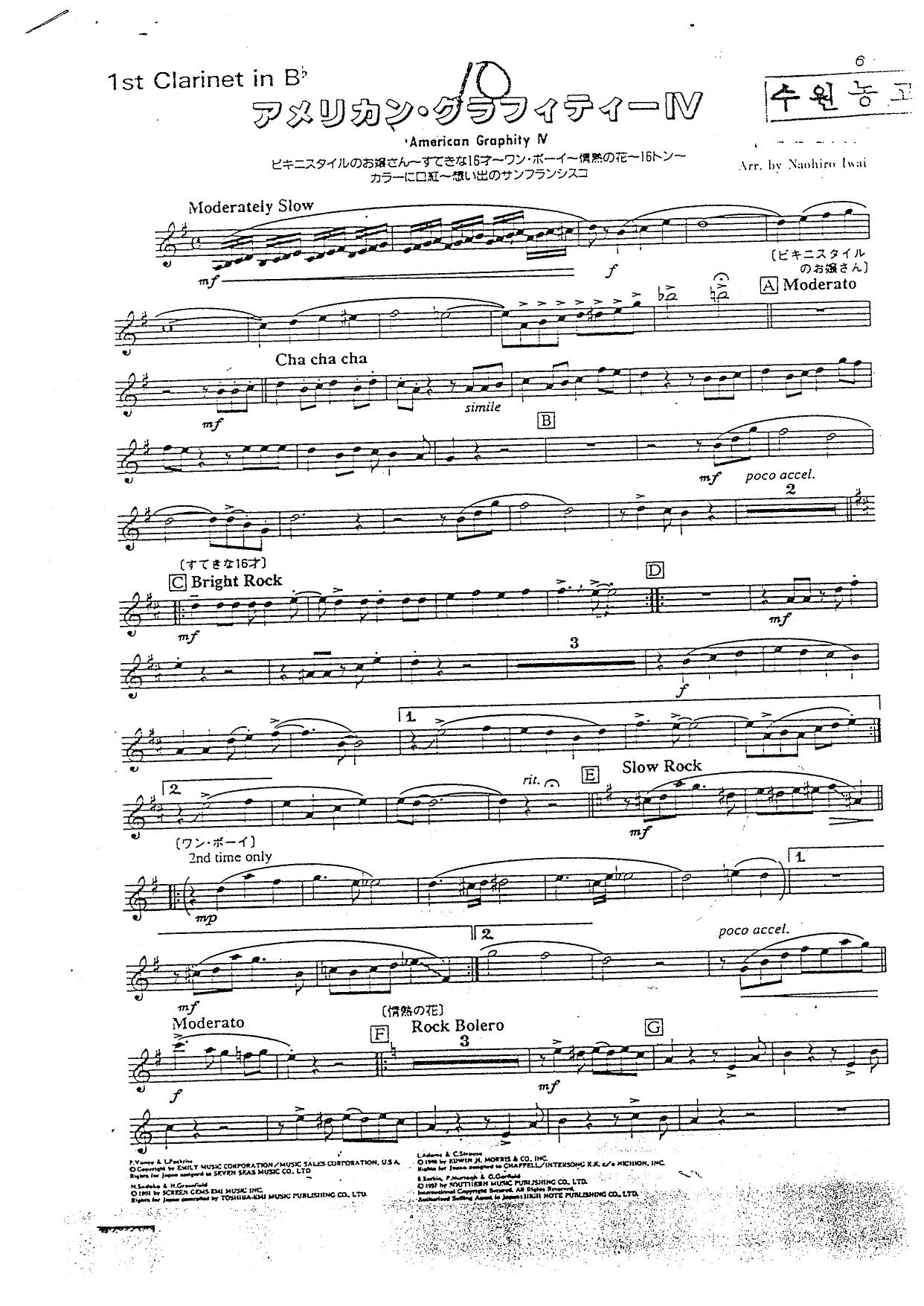
American Grapithy 1V (N.Iwai)
Composed by Naohiro Iwai
Arranged by N.Iwai
- Ensemble: Concert Band
- Style: Jazz Standard
- Pages: 120
- Instruments (32): 1st Clarinet in Bb, Piccolo, 1st & 2nd Flutes, 2nd Clarinet in Bb, 3rd Clarinet in Bb, Bassoon, 1st & 2nd Alto Saxophones in Eb, 1st & 2nd Tenor Saxophones in Bb, Baritone Saxophone in Eb, 1st & 2nd Trumpets in Bb, 3rd & 4th Trumpets in Bb, 1st & 2nd Horns in F, 3rd & 4th Horns in F, 1st Trombone, 2nd & 3rd Trombones, Bass Trombone, Euphonium, Bass in C, Timpani, Shaker (or Maracas), Triangle, Drums, Suspended Cymbal, Conga, Glockenspiel, Xylophone, Guiro, Tambourine, Wind Chime, Wood Block, Vibraphone, Marimba
- Difficulty: advanced
- Content: Individual Parts
- Format: PDF Download (Instant)
- Price: $22.99
Naohiro Iwai’s "American Grapithy IV" stands as a brilliant tribute to the golden age of American popular music and early jazz, channeling the infectious energy of ragtime, early Dixieland, and swing-era dance halls. Originally conceived by the master Japanese wind band arranger as part of his celebrated "American Grapithy" suite series, this movement captures the nostalgic, buoyant spirit of the roaring twenties and thirties. Iwai, renowned for his virtuosic ability to bridge traditional concert band instrumentation with authentic jazz idioms, crafts a multi-themed medley that functions as a historical sonic snapshot. The composition celebrates the intersection of vernacular American genres—blending syncopated ragtime rhythms, jaunty stride piano styles translated for winds, and driving swing beats that recall the legendary big bands of Goodman and Miller. Driving forward with a bright, jubilant medium-up tempo, the work opens with crisp, rhythmic precision in the woodwinds before unfolding into rich, harmonically expansive brass chorales. The mood shifts fluidly between cheeky, playful syncopation and soaring, wide-voiced melodic declarations that evoke packed dance floors and urban nightlife. Iwai’s signature arranging style is immediately recognizable in the clever counterpoint, sparkling woodwind flourishes, and structurally brilliant transitions between contrasting thematic blocks. Rather than serving as a mere medley, the arrangement functions as a cohesive symphonic jazz journey, utilizing dynamic shading, plunger-effect suggestions in the brass, and shifting textural densities to maintain high theatrical momentum from the first downbeat to the final punchy chord. Throughout the 120-page conductor score and comprehensive parts, melodic responsibility is distributed democratically across the ensemble, ensuring that every section—from the upper woodwinds handling cascading runs to the low brass anchoring the syncopated basslines—shares in the spotlight. Technical demands center on clean articulation, agile fingerwork in fast-moving scalar passages, and a strict, unyielding sense of internal rhythmic groove, particularly when navigating the dotted-eighth-and-sixteenth swing figures. Performers will find immense satisfaction in the intricate interplay between sections, where dry, staccato articulations contrast sharply against lush, open-voiced harmonies reminiscent of classic American scoring. Advanced high school, collegiate, and premier community concert bands will find this arrangement an ideal vehicle for developing stylistic versatility outside the standard wind-ensemble repertoire. It serves as an exceptional showcase piece for programs looking to inject high-energy stylistic diversity into a concert program, offering audiences a brilliantly orchestrated, nostalgia-drenched celebration of early American jazz history. Achieving an authentic performance of "American Grapithy IV" requires strict attention to stylistic articulation and rhythmic precision. The primary technical challenge lies in maintaining a buoyant, light-footed swing feel without rushing the tempo, particularly during transitions between the brisk ragtime sections and the smoother swing themes. Conductors should insist on crisp, energetic staccatos in the brass and woodwinds, avoiding heavy, over-articulated downbeats that can bog down the ragtime groove. Balance is critical: ensure that inner-voice countermelodies—often tucked into the alto saxophones and horns—cut through the texture without masking the primary lead in the trumpets or clarinets. Encourage percussionists to keep the ride cymbal and snare work bright and driving, emulating a traditional jazz rhythm section rather than a heavy symphonic march. Subtle use of jazz phrasing, including controlled falls and accented off-beats, will enhance the authentic vernacular flavor of the performance. Q: What instrumentation and parts are included in this publication? A: This comprehensive 120-page publication includes a full conductor score alongside standard concert band instrument parts, optimized for a fully populated wind band or large concert ensemble. Q: What is the difficulty level of this arrangement? A: This arrangement is graded as moderately advanced (Grade 4), making it well-suited for accomplished high school bands, collegiate ensembles, and community wind orchestras with solid technical proficiency in woodwinds and brass. Q: What musical style and historical era does this piece represent? A: The piece is a symphonic jazz tribute representing the early American jazz and swing eras, expertly blending ragtime syncopation, Dixieland energy, and 1930s big-band idioms. Q: What makes Naohiro Iwai's treatment unique compared to standard concert band arrangements? A: Iwai’s distinctive arranging style combines authentic jazz stylistic traits with symphonic wind band scoring, utilizing intricate counterpoint, clever stylistic pastiche, and transparent orchestrations that highlight individual sections. Q: What is the approximate performance duration and tempo framework? A: The arrangement features a lively, multi-templated structure anchored primarily by a bright, driving medium-up tempo, resulting in a robust performance duration ideal for a major concert program centerpiece.
Questions and answers
- What is included in the American Grapithy 1V (N.Iwai) PDF?
- The verified current file contains individual parts across 120 pages.
- How many instruments or parts are listed for American Grapithy 1V (N.Iwai)?
- The verified instrumentation list contains 32 entries for this Concert Band arrangement.
- Who is credited for American Grapithy 1V (N.Iwai)?
- Composer: Naohiro Iwai. Arranger: N.Iwai.
- What difficulty is listed for American Grapithy 1V (N.Iwai)?
- The verified difficulty level is advanced.
- What style is listed for American Grapithy 1V (N.Iwai)?
- The catalog lists the style as Jazz Standard.
- Can I preview American Grapithy 1V (N.Iwai) before buying?
- Yes. The product page provides a preview generated from the current PDF file.
- How is American Grapithy 1V (N.Iwai) delivered?
- After successful payment, the digital PDF is made available for download. The displayed price is $22.99.
Musicians Also Search For
American Grapithy 1V N.Iwai PDF • American Grapithy 1V N.Iwai sheet music • American Grapithy 1V arranged by N.Iwai • N.Iwai concert band charts • N.Iwai jazz arrangements PDF • American Grapithy 1V Naohiro Iwai sheet music • American Grapithy 1V Naohiro Iwai concert band arrangements • Naohiro Iwai concert band charts • American Grapithy 1V concert band arrangements • American Grapithy 1V concert band PDF download • American Grapithy 1V jazz sheet music • concert band sheet music download • American Grapithy 1V individual parts download • American Grapithy 1V sheet music PDF • American Grapithy 1V Jazz Standard charts • Jazz Standard concert band arrangements • buy American Grapithy 1V sheet music • download American Grapithy 1V PDF • American Grapithy 1V jazz charts • best N.Iwai concert band arrangements • Naohiro Iwai arranged by N.Iwai • American Grapithy 1V printable sheet music • concert band repertoire PDF