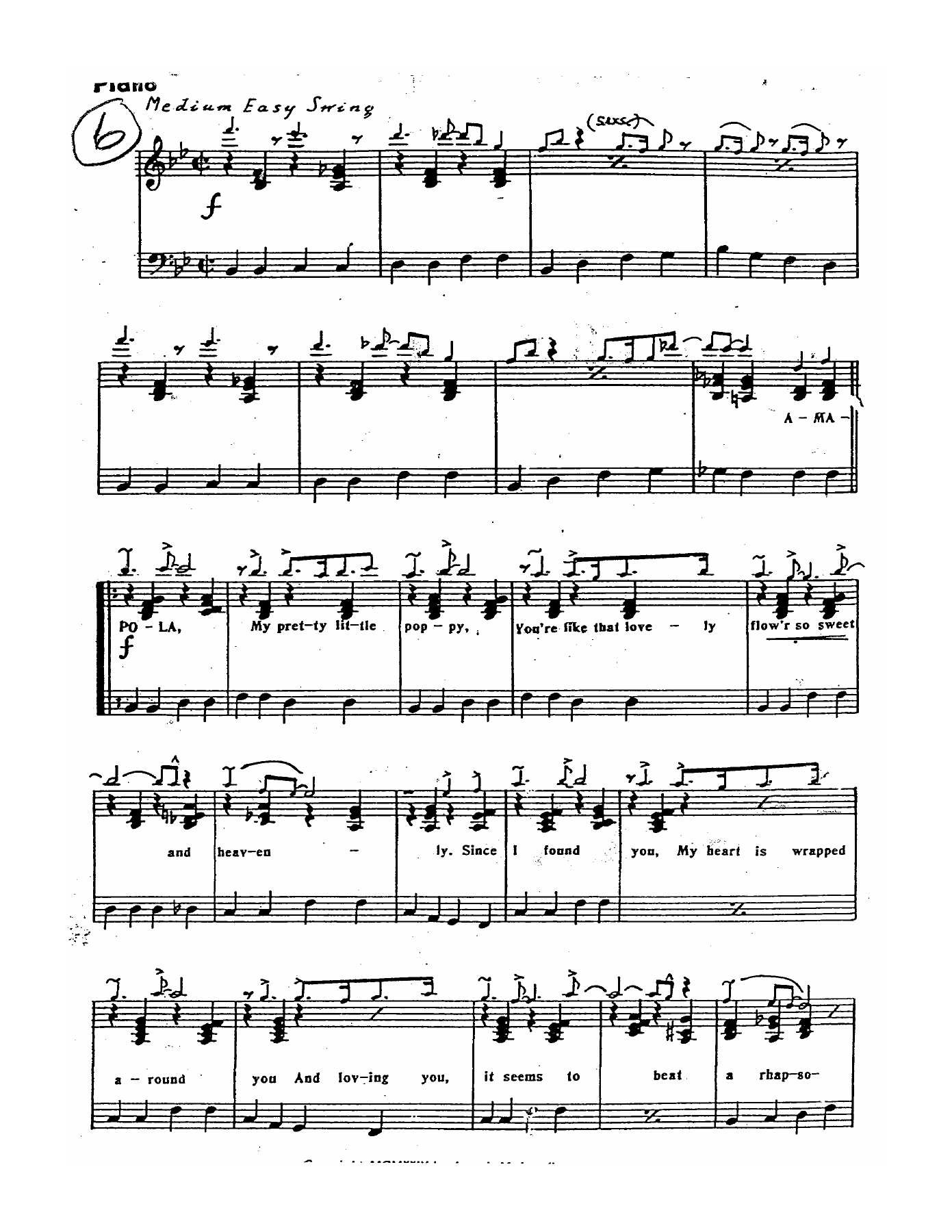
Amapola (W.Hudson)
Composed by Joseph M. Lacalle
Arranged by W. Hudson
- Ensemble: Big Band Dance
- Style: Foxtrot
- Pages: 28
- Instruments (13): Piano, 1st Trumpet in Bb, 2nd Trumpet in Bb, 3rd Trumpet in Bb, 1st Trombone, 2nd Trombone, 1st Sax. Eb Alto, 2nd Sax. Bb Tenor, 3rd Sax. Eb Alto, 4th Sax. Bb Tenor, Bass, Guitar, Drums
- Difficulty: medium
- Content: Individual Parts
- Format: PDF Download (Instant)
- Price: $24.99
Joseph Lacalle's "Amapola" emerged as a captivating Spanish-language song in 1924, gaining widespread international recognition and becoming a beloved standard across various musical genres. While originally a romantic ballad, its enduring melodic charm and harmonic simplicity made it ripe for interpretation, particularly within the burgeoning big band era. It soared to immense popularity in the early 1940s, notably through recordings by Jimmy Dorsey's Orchestra featuring vocalists Helen O'Connell and Bob Eberly, and later by the Glenn Miller Orchestra. These iconic big band renditions cemented "Amapola" as a cornerstone of the dance band repertoire, embodying the sophisticated yet accessible sound that defined the era. Its appeal lies in its memorable melody and its inherent danceability, making it a timeless piece that evokes a sense of nostalgic elegance and romanticism. W. Hudson's arrangement of "Amapola" masterfully reimagines this classic as a quintessential big band foxtrot, capturing the smooth, flowing energy characteristic of the 1940s dance halls. Set in a bright medium tempo, this arrangement maintains a consistent 4/4 meter with a gentle, understated swing feel, perfect for dancing. The key of C major provides a bright, accessible tonal center, allowing the rich voicings to shine without undue harmonic complexity. Hudson's approach emphasizes lush, full-bodied saxophone soli sections that articulate the melody with a warm, blended timbre, reminiscent of the era's signature sound. The brass sections provide crisp, harmonically supportive figures, often employing cup mutes for a classic big band texture, contributing to the overall elegant and romantic mood. A hallmark of Hudson's arranging style is his ability to blend intricate voicings with clear melodic statements. In this "Amapola" arrangement, the melody is predominantly carried by the saxophone section, often in unison or close harmony, creating a rich, cohesive sound. There are no extended improvised solos, maintaining the focus on ensemble precision and the arrangement's overall structure, which is typical of dance band charts where the ensemble is the star. However, there are brief, tasteful melodic fills and counter-melodies from the trumpet and trombone sections that add sparkle and depth. Technical challenges primarily revolve around achieving a unified ensemble sound, precise articulation in the brass, and maintaining the consistent, relaxed foxtrot groove throughout. The rewarding aspect lies in the satisfaction of delivering a polished, authentic big band sound that transports listeners back to the golden age of dance music. This arrangement is ideally suited for college, community, and advanced high school jazz ensembles seeking to explore the authentic big band dance repertoire. Its moderate technical demands, coupled with its emphasis on blend, balance, and rhythmic precision, make it an excellent teaching tool for developing a cohesive ensemble sound. While professional bands will appreciate its authentic style and charm, its structure is particularly beneficial for groups looking to hone their foundational big band skills, including section playing, dynamic control, and understanding the nuances of the foxtrot feel. The clarity of Hudson's writing ensures that bands can achieve a professional-sounding performance with dedicated rehearsal. To achieve the authentic foxtrot feel, maintain a consistent, relaxed medium tempo around quarter note = 120-128 bpm, emphasizing a smooth, connected swing eighth-note feel without being overly aggressive. Articulation is key: brass should play with crisp, controlled attacks, especially on accented figures, while saxophones should aim for a legato, blended sound in soli sections. Pay close attention to dynamics, particularly the subtle crescendos and decrescendos that shape the melodic phrases. The use of cup mutes for designated brass passages is essential for the characteristic big band texture. Rehearsal should focus on precise rhythmic alignment between sections, especially during the call-and-response figures, and ensuring the bass and drums lock into a steady, danceable groove. Emphasize blend and balance within each section, particularly the saxophone soli, to achieve a rich, unified timbre. Q: What instruments are included in this arrangement? A: This arrangement is scored for a full 17-piece big band, including Alto Saxophone 1 & 2, Tenor Saxophone 1 & 2, Baritone Saxophone, Trumpet 1-4, Trombone 1-4, Piano, Bass, Drums, and Guitar. Q: What is the difficulty level of W. Hudson's "Amapola" arrangement? A: This arrangement is rated as medium difficulty, suitable for college, community, and advanced high school jazz ensembles. It focuses on ensemble precision, blend, and rhythmic consistency rather than complex improvisation. Q: What musical style and historical context does this arrangement represent? A: This is a classic big band foxtrot arrangement, capturing the romantic and danceable sound popular in the early 1940s, famously performed by orchestras like Jimmy Dorsey's and Glenn Miller's. Q: What makes W. Hudson's arrangement of "Amapola" unique? A: Hudson's arrangement stands out for its authentic big band voicings, lush saxophone soli sections, and faithful recreation of the 1940s foxtrot style, prioritizing ensemble sound over individual improvisation. Q: What is the approximate performance duration and tempo for this piece? A: The approximate performance duration is 3-4 minutes, designed for a consistent medium foxtrot tempo around quarter note = 120-128 bpm, maintaining a smooth, understated swing feel.
Questions and answers
- What is included in the Amapola (W.Hudson) PDF?
- The verified current file contains individual parts across 28 pages.
- How many instruments or parts are listed for Amapola (W.Hudson)?
- The verified instrumentation list contains 13 entries for this Big Band Dance arrangement.
- Who is credited for Amapola (W.Hudson)?
- Composer: Joseph M. Lacalle. Arranger: W. Hudson.
- What difficulty is listed for Amapola (W.Hudson)?
- The verified difficulty level is medium.
- What style is listed for Amapola (W.Hudson)?
- The catalog lists the style as Foxtrot.
- Can I preview Amapola (W.Hudson) before buying?
- Yes. The product page provides a preview generated from the current PDF file.
- How is Amapola (W.Hudson) delivered?
- After successful payment, the digital PDF is made available for download. The displayed price is $24.99.
Musicians Also Search For
Amapola W. Hudson PDF • Amapola W. Hudson sheet music • Amapola arranged by W. Hudson • W. Hudson big band dance charts • W. Hudson jazz arrangements PDF • Amapola Joseph M. Lacalle sheet music • Amapola Joseph M. Lacalle big band dance arrangements • Joseph M. Lacalle big band dance charts • Amapola big band dance arrangements • Amapola big band dance PDF download • Amapola jazz sheet music • big band dance sheet music download • Amapola individual parts download • Amapola sheet music PDF • Amapola Foxtrot charts • Foxtrot big band dance arrangements • buy Amapola sheet music • download Amapola PDF • Amapola jazz charts • best W. Hudson big band dance arrangements • Joseph M. Lacalle arranged by W. Hudson • Amapola printable sheet music • big band dance repertoire PDF