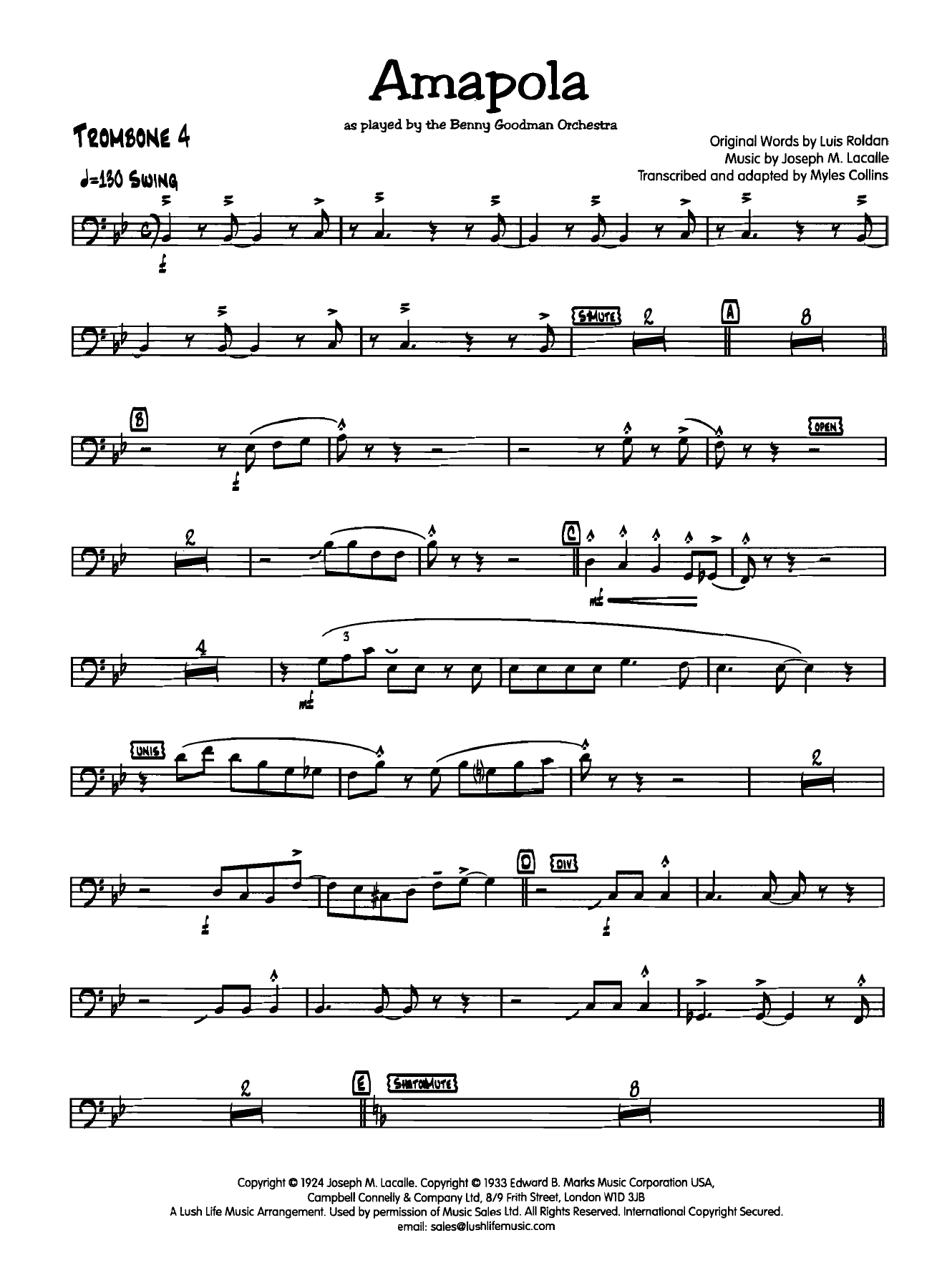
Amapola 4 Trombone (M.Collins)
Composed by Joseph M. Lacalle
Arranged by Myles Collins
- Ensemble: Big Band Vocal
- Style: Latin Jazz
- Pages: 116
- Difficulty: easy
- Content: Sheet Music
- Format: PDF Download (Instant)
- Price: $12.99
Originally penned in 1920 by Spanish composer Joseph M. Lacalle, "Amapola" (Spanish for "poppy") quickly blossomed into a global sensation, transcending its European origins to become a beloved standard across diverse musical landscapes. While initially a romantic Spanish-language song, its enduring melody and evocative harmonies made it ripe for reinterpretation. It gained significant traction in the American popular music scene in the 1940s, notably through instrumental versions by big bands like Jimmy Dorsey's Orchestra, whose 1941 recording with vocalists Helen O'Connell and Bob Eberly became a monumental hit. This widespread popularity cemented "Amapola" as a timeless classic, frequently revisited by jazz and Latin artists for its lyrical beauty and inherent rhythmic possibilities. Its transition into the jazz repertoire highlights its melodic strength and harmonic versatility, allowing for creative improvisation and stylistic adaptation. Myles Collins' arrangement of "Amapola" for big band with a vocal feature masterfully reimagines this classic as a vibrant Latin Jazz excursion. Departing from its traditional bolero or foxtrot roots, Collins infuses the piece with an infectious, medium-fast Latin groove, primarily a Mambo or Cha-Cha feel in 4/4, immediately setting a lively and sophisticated tone. The arrangement opens with a captivating rhythmic introduction, establishing the Latin pulse before the vocalist enters with the iconic melody. Collins' signature is evident in his rich, often dense voicings, particularly within the brass sections, which provide a lush harmonic backdrop without overpowering the soloist. Expect sophisticated harmonic substitutions and carefully crafted counter-melodies that weave through the arrangement, adding depth and contemporary flair while respecting the original's melodic integrity. This arrangement is a showcase for both the vocalist and the ensemble. The melody is predominantly carried by the vocalist, allowing for expressive interpretation, but Collins intersperses beautifully orchestrated soli sections for the brass and saxophones, providing dynamic contrast and demonstrating the band's collective prowess. There are dedicated solo sections, typically for tenor saxophone and trumpet, offering ample space for improvisation over the Latin changes. Technically, the piece demands precision in rhythm and articulation from all sections to maintain the authentic Latin feel. Brass players will encounter some challenging, high-register passages and intricate rhythmic figures, while the saxophone section will need to navigate tight, harmonically rich soli. The rewarding aspect lies in the collective energy generated by the Latin groove and the opportunity to perform a beloved standard in a fresh, exhilarating style. "Amapola 4 Trombone (M.Collins)" is ideally suited for advanced high school, collegiate, community, and professional jazz ensembles. Its demands in terms of rhythmic accuracy, ensemble blend, and improvisational skill make it an excellent vehicle for developing sophisticated musicality. The arrangement's length, at 116 pages, reflects its comprehensive scoring and the depth of Collins' musical vision, offering a substantial and engaging piece for both performers and audiences. It provides a fantastic opportunity to explore Latin jazz rhythms and harmonies within the familiar framework of a classic tune, making it a valuable addition to any big band's repertoire. Conductors should emphasize a consistent, driving medium-fast Latin groove throughout, primarily a Mambo or Cha-Cha feel, ensuring the rhythm section lays down a solid foundation. Articulation is paramount; brass should play with crisp, accented attacks, while saxophones need a blend of legato and staccato to articulate the intricate soli lines clearly. Pay close attention to dynamic contrasts, particularly between the vocal sections and the ensemble soli, to build excitement and maintain musical interest. The brass section will encounter some challenging high-register passages, requiring strong embouchure and breath support. Rehearsal time should be dedicated to locking in the rhythmic interplay between sections, especially in the syncopated figures, and ensuring clean releases. The featured soloists should be encouraged to embrace the Latin harmonic language, utilizing scales and arpeggios appropriate for the style. No special mutes or extended techniques are explicitly required beyond standard jazz articulation. Q: What instruments and parts are included in this "Amapola 4 Trombone (M.Collins)" arrangement? A: This big band arrangement includes parts for a full standard jazz big band instrumentation (5 saxophones, 4 trumpets, 4 trombones, guitar, piano, bass, drums) plus a dedicated vocal part. Q: What is the overall difficulty level of this arrangement? A: This arrangement is considered advanced, suitable for advanced high school, collegiate, community, and professional jazz ensembles due to its rhythmic complexity, sophisticated harmonies, and demands on individual section technique and improvisation. Q: What musical style and historical context does this arrangement represent? A: This arrangement reimagines Joseph M. Lacalle's classic "Amapola" in a vibrant Latin Jazz style, specifically a medium-fast Mambo/Cha-Cha groove, departing from its original early 20th-century romantic song form. Q: What makes Myles Collins' arrangement of "Amapola" unique compared to other versions? A: Myles Collins' treatment is distinctive for its transformation into a Latin Jazz piece, featuring rich, contemporary voicings, intricate ensemble soli, and dedicated solo sections, all while maintaining the original melody's charm within a driving, sophisticated groove. Q: What is the typical performance duration and tempo for this arrangement? A: While variable based on solos, this arrangement typically performs in the 4-6 minute range. The tempo should be a consistent medium-fast Latin groove, around 180-200 BPM, embodying a lively Mambo or Cha-Cha feel.
Musicians Also Search For
Amapola 4 Trombone Myles Collins PDF • Amapola 4 Trombone Myles Collins sheet music • Amapola 4 Trombone arranged by Myles Collins • Myles Collins big band vocal charts • Myles Collins jazz arrangements PDF • Amapola 4 Trombone Joseph M. Lacalle sheet music • Amapola 4 Trombone Joseph M. Lacalle big band vocal arrangement • Joseph M. Lacalle big band vocal charts • Amapola 4 Trombone big band vocal arrangement • Amapola 4 Trombone big band vocal PDF download • Amapola 4 Trombone jazz ensemble sheet music • big band vocal sheet music instant download • Amapola 4 Trombone sheet music with parts • Amapola 4 Trombone Latin Jazz chart • Latin Jazz big band vocal arrangements • buy Amapola 4 Trombone sheet music online • download Amapola 4 Trombone PDF • Amapola 4 Trombone jazz chart • best Myles Collins big band vocal arrangements • Joseph M. Lacalle songs arranged by Myles Collins • Amapola 4 Trombone printable sheet music • big band vocal repertoire PDF